The Gate can be visited
Town FortificationRostock
Town Fortification Rostock-Kröpeliner Gate
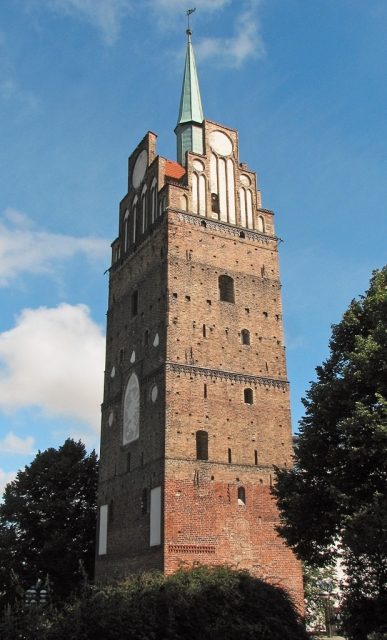
The Kröpeliner Tor, the westernmost of the four great gates of Rostock's city fortifications, was built around 1270 in the Gothic style. Even then, with its two stories, it was very large and remained one of the most imposing of the up to 22 city gates that existed at times. Whether it was named after the small town of Kröpelin, in whose direction it leads, or after a patrician family of the same name, is still debated today. It marks the western end of Kröpeliner Straße.
A wooden gate is already mentioned in 1255. The later stone gate was built at the same location as part of the construction of Rostock's fortifications with a wall, towers, and gates, after the three original city centers officially united in 1265. It was first mentioned in 1280. The original two stories are still very clearly recognizable by the different coloring of the stones.
Over time, the gate was significantly expanded. Around 1400, the city's bourgeoisie decided to add 5 stories, bringing it to its current height of 54 meters. Since it was located on the road to Lübeck and Wismar, it was intended to convey the Hanseatic grandeur and importance of the city, especially to traveling merchants.
In 1847, around the time the city began to expand beyond its original borders, a neo-Gothic annex was built. The functional gate thus became a magnificent building of the city. When a restoration took place in 1905, a griffin was also inserted into the large pointed arch blind on the field side. In contrast to the largely destroyed surroundings, the gate suffered little damage during the British bombing raids at the end of April 1942. In 1945, although undamaged, the annex was removed for aesthetic reasons. In addition, a section of the city wall, which extended north of the gate to the Fischerbastion and withstood the bombs, was demolished in favor of never-realized traffic plans. Until 1960, a tram line also ran through the gate.
The next restoration work took place from 1966-1969. Since then, it has been the seat of the Museum for City History. It was closed in 2004. Today, it is the seat of the Geschichtswerkstatt Rostock e. V. association.
General Information+
Traces in the masonry show the attachment of the city wall, as well as the fortifications of the upper wooden battlement (cf. fig.). The gate no longer has contact with the wall. Plans to close this gap were rejected by the Office for Urban Planning in April 2006; instead, in connection with the construction of the Kröpeliner-Tor-Center (KTC), a partial course of the wall – albeit without historical citations – was recreated.
Take Mobile History with you
You are reading this text for free. Premium adds what matters on the road: descriptions read aloud, sites found through your camera, whole regions taken offline.
- Every description, including the ~17,700 Premium sites
- Audio guide: have descriptions read to you on location
- AR finder: see sites through your camera, with distance and bearing
- Unlimited saved sites
14 days free, then from €2.99 a month. Cancel anytime.
Source: Wikipedia · Licence: CC BY-SA 4.0 · Image: https://commons.wikimedia.org/wiki/File:Rostock_Kr%C3%B6peliner_Tor.jpg
This description draws on the facts documented in the linked Wikipedia article; Wikipedia content is licensed under CC BY-SA 4.0. Wording and editing: Mobile History.
Location: 54.0885, 12.1291