The Castle can be visited
Museum
Restaurant
CastleRonneburg - Altwiedermus
Ronneburg Castle
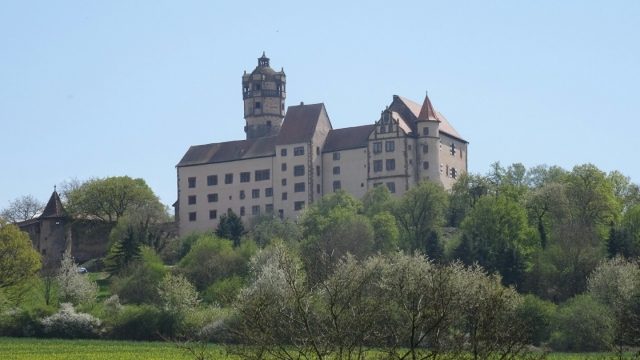
Ronneburg Castle, located in the municipality of Ronneburg-Altwiedermus in the Main-Kinzig district of Hesse, is widely visible due to its position on a steep basalt cone and gives its name to the Ronneburg Hills.
The hilltop castle is first mentioned in 1231, when an altar "in castro Roneburg" is spoken of, but the Staufer defensive structure is likely older. It may have been built by Gerlach I von Büdingen in the first quarter of the 12th century, but at the latest in the first half of the 13th century by Gerlach II von Büdingen to secure the surrounding judicial districts and the passing trade routes. The earlier name Raneberg or Roneberg probably derives from the Old High German word "Rone," which means "fallen tree" and suggests a much older palisade-fortified complex.
With Gerlach II, the Lords of Büdingen died out in the male line by 1247 at the latest, and the castle came into the possession of the Hohenlohe family before the turn of the 14th century. Gottfried III von Hohenlohe-Brauneck sold it to the Archbishopric of Mainz in 1313. The diocese pledged the castle from 1327 to the Knights of Rockenberg, who expanded the castle. From 1339 to 1356, the complex was again under the administration of the Archbishopric. During this time, further additions and alterations were made. From 1424, the castle was again pledged; this time to the Count of Hanau.
In 1476, the Archbishop of Mainz, Diether von Ysenburg, transferred the castle to his brother, Count Ludwig II von Ysenburg-Büdingen. After Ludwig's death in 1511, a war of succession between his three sons shook the Büdingen region from 1517. In 1523, the castle fell to Philipp von Ysenburg-Büdingen, who founded the Ysenburg-Büdingen-Ronneburg line, later Ysingen-Ronneburg. Under his regency, Ronneburg received its final form. After the death of Heinrich von Ysingen-Ronneburg, who outlived his father Anton by only about a year, in 1601, the line died out again. Wolfgang Ernst I von Ysenburg-Büdingen invoked his right of inheritance and took possession of the castle by force.
In 1621, large parts of the castle were destroyed in a fire. Thirteen years later, Ronneburg fell victim to looting by Croatian cavalry troops during the Thirty Years' War.
Thanks to the Calvinist Ysenburg-Büdingens, Protestant exiles were allowed to settle in the castle from 1700. For a long time, it became a refuge for the religiously persecuted and "homeless" (Jews and Roma). In 1736, Count von Zinzendorf moved in with his Moravian Brethren community and made the castle a much-visited pilgrimage site. However, just two years later, the complex was too small for the brethren; they moved to a nearby hill and founded the settlement of Herrnhaag there. From 1750, many of these settlers emigrated to America and other countries.
In June 2004, Wolfgang Ernst Prince von Ysenburg-Büdingen sold Ronneburg to Forfin GmbH (Joachim Benedikt Freiherr von Herman auf Wain, a cousin of Leonille Princess von Ysenburg-Büdingen (née Princess zu Sayn-Wittgenstein-Berleburg), is the managing director and sole shareholder of Forfin GmbH).
Complex+
Particularly noteworthy is the more than 96 m deep well of Ronneburg. Despite the height of the hill on which the castle stands, it was thus possible for the inhabitants to obtain drinking water.
Current Use+
The 30 m high keep of the castle can be climbed and offers a view of several kilometers, even as far as Frankfurt in good weather. The castle complex houses a museum and a restaurant. At Ronneburg, bow-making seminars are regularly held, where historical and prehistoric bows are recreated and basic knowledge of instinctive archery is taught.
Take Mobile History with you
You are reading this text for free. Premium adds what matters on the road: descriptions read aloud, sites found through your camera, whole regions taken offline.
- Every description, including the ~17,700 Premium sites
- Audio guide: have descriptions read to you on location
- AR finder: see sites through your camera, with distance and bearing
- Unlimited saved sites
14 days free, then from €2.99 a month. Cancel anytime.
Source: Wikipedia · Licence: CC BY-SA 4.0 · Image: Jörg Heldt
This description draws on the facts documented in the linked Wikipedia article; Wikipedia content is licensed under CC BY-SA 4.0. Wording and editing: Mobile History.
Location: 50.2382, 9.0604