The remains of the roman Castle can be visited
Ancient BuildingElztal-Neckarburken
Roman Castle (Eastkastell) Neckarburken
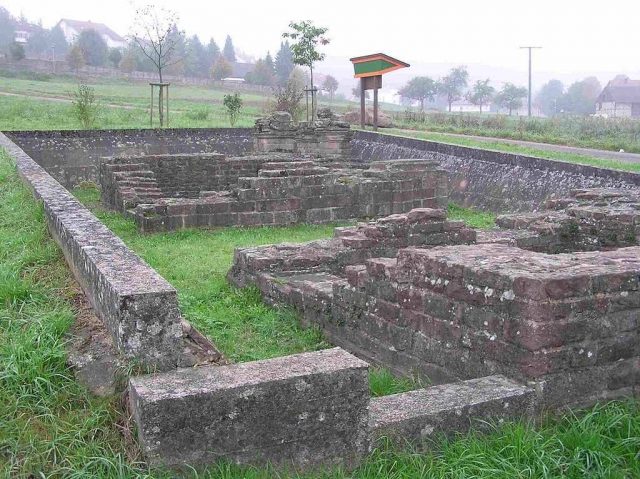
The Roman forts of Neckarburken are located in the area of the eponymous village of Neckarburken, a district of the municipality of Elztal in the Neckar-Odenwald-Kreis. Although literature and various websites often refer to "the" fort of Neckarburken, there are in fact two distinct and spatially separate forts from the same period: the West Fort and the East Fort. Both belong to the older Odenwald Line of the Neckar-Odenwald Limes and were occupied from approximately 100 AD until at least 159 AD, with the East Fort possibly remaining in use slightly longer.
A Vicus was located between the two forts, or west of the cohort fort. Nothing of it remains visible today. The burial grounds have not yet been definitively located.
Research History+
Pioneers of archaeology and antiquity research, such as Karl Wilhelmi, had early on suspected a fort in Neckarburken. Already at the beginning of the 19th century, an unusually high concentration of surface finds of Roman provenance had been noticed in the area of Neckarburken. In 1808, a dedication stone erected by the scribes of the cohort for Minerva and the Emperor, as well as silver coins, were found. In 1810, extensive Roman masonry came to light, which was smashed into pieces by the uninformed population and "disposed of" in the Elz river. In 1850, a relief depicting a winged, naked, female figure was found. The first excavations were carried out in 1881 at the East Fort by the Mannheim Antiquities Association. Systematic investigations of both forts were undertaken by the Imperial Limes Commission between 1892 and 1894. Further archaeological activities, often as emergency excavations in connection with urban or road construction measures, took place during the second half of the 20th century.
East Fort (Numerus Fort)+
Fort
The East Fort of Neckarburken is a Numerus fort of approximately 6400 m², with three gates, in the shape of an irregular quadrangle. The Porta Praetoria was oriented north towards the Elz river. The oldest findings suggest that the fort was built during the Trajanic period. It likely underwent all typical construction phases for Numerus camps of the Odenwald Limes, as also evidenced for example at the forts of Würzberg and Hesselbach. A building inscription from the Porta Principalis Sinistra (East Gate), datable to between 145 and 161, securely identifies a Numerus stationed there, the Numerus Brittonum Elantiensium (Numerus of the Elz Britons). It is possible that even after the shifting of the Limes around 159, the Numerus fort of Neckarburken remained occupied for some time, fulfilling logistical functions in the hinterland of the border. After the abandonment of the fort, a civilian building, probably a Villa Rustica, was erected within the area.
The west gate of the Neckarburken East Fort is preserved and can be visited, located directly on the B27 road.
Fort Bath
Approximately 70 m northwest of the NW corner of the Numerus fort is the associated fort bath. It was only discovered in 1982 during sewer construction work. The bath underwent a significant expansion in 158, under the supervision of the then Centurion of the Elz Britons, Veranius Saturninus, which could suggest military use of the fort beyond 159. Nothing of the bath building is visible on the ground today.
Context+
The combination of two camps, a larger one with a cohort or ala and a smaller one with a Numerus or an Exploratio, is not an isolated case on the German Limes. Similar combinations exist, for example, in Murrhardt and Osterburken. While the larger auxiliary units were also part of the Roman mobile army and thus might have been elsewhere during campaigns, the smaller Numerus units were permanently stationed on site, ensuring continuous surveillance of the Limes even in times of war.
Museum at the Odenwald Limes+
The Museum at the Odenwald Limes is housed in the former town hall of Neckarburken. In addition to information and finds on the general history of the Odenwald Limes, the Neckarburken forts are naturally also presented here. The small museum is only open between April and October, on Sunday afternoons. Visitors to the museum also have the opportunity to visit the neighboring church.
Take Mobile History with you
You are reading this text for free. Premium adds what matters on the road: descriptions read aloud, sites found through your camera, whole regions taken offline.
- Every description, including the ~17,700 Premium sites
- Audio guide: have descriptions read to you on location
- AR finder: see sites through your camera, with distance and bearing
- Unlimited saved sites
14 days free, then from €2.99 a month. Cancel anytime.
Source: Wikipedia · Licence: CC BY-SA 4.0 · Image: http://de.wikipedia.org/wiki/Datei:ORL53_Kastell_Neckarburken_6.jpg
This description draws on the facts documented in the linked Wikipedia article; Wikipedia content is licensed under CC BY-SA 4.0. Wording and editing: Mobile History.
Location: 49.3780, 9.1739