The remains of the roman Castle can be visited
Ancient BuildingRegensburg
Roman Castle Castra Regina-Porta praetoria
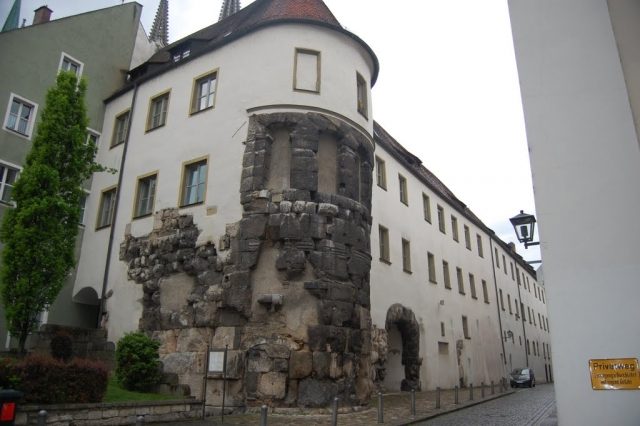
Castra Regina or Ratisbona was founded as a legionary fortress, quickly developed into an urban center on the upper Danube, and became the nucleus of the medieval city of Regensburg. It was the headquarters of the 3rd Italic Legion. Castra Regina consisted of the legionary fortress itself, the civilian town, a large cemetery, and several sanctuaries and temple complexes.
Name+
Different names for the camp have been handed down at various times. Initially, it was probably simply called legio (after a Roman milestone, cf. Leuge). In the Itinerarium Antonini (3rd century) and in the Tabula Peutingeriana (mid-4th century), it is referred to as Regino or Reginum. Castra Regina first appears around 400 in the Notitia Dignitatum. The name is derived from the river Regen, which flows into the Danube near the Roman camp. Regana is a Celtic name for water, river course. The Romans had slightly modified the Celtic name and called the river Reganum and Reganus. The name Radaspona first appears with Arbeo of Freising around 770.
Predecessors+
In the area of the later Roman civilian town, there had been a village (vicus) since the end of the 1st century AD. This seems to have been of considerable size. Several wooden buildings could also be proven. Further south, there was initially only a smaller military camp, the Kumpfmühl fort. At Regensburg-Kumpfmühl, the remains of this fort and an extensive civilian settlement were excavated. The camp dates to the first half of the 2nd century and, like the civilian settlement, was destroyed during the Marcomannic invasion around 170.
Legionary Fortress+
The legionary fortress was built in stone directly on the Danube in the late 2nd century. A building inscription indicates that it was completed in 179 AD. The camp area covered approximately 540 x 450 m, which corresponds to 360 by 300 Roman passus (double paces). The camp thus covered a total area of approximately 24.5 hectares. A pointed ditch was dug in front of the wall, which was 6–7 m wide and approximately 2.5 to 3 m deep. The camp had the usual four gates and intermediate towers erected at regular intervals on the inside of the wall. The Porta Praetoria (the north gate) is still well preserved today. Various buildings important for the infrastructure could also be proven within the camp during excavations in the urban area of modern Regensburg. The majority of the camp area was undoubtedly needed for the barracks, which offered space for 100 men each. At the head of the barracks were the centurions' quarters. In the center of the camp, the remains of various buildings important for the infrastructure were observed. There were at least two bathhouses, a praetorium, and workshops (fabrica), which in this case were also decorated with simple wall paintings.
During the archaeological investigations, several destruction horizons could be observed. The first time it was probably burned down during a Germanic invasion around 278, a second destruction horizon can be dated to approximately 288 based on coin finds. But shortly thereafter, the camp seems to have been rebuilt, with the civilian town outside the camp largely having to be abandoned and its inhabitants now housed within the camp walls.
Around 357, the camp was burned down a third time, this time by the Juthungi. This catastrophe was particularly severe. Military activities from then on concentrated almost entirely on the northeast corner of the camp. It is not known how strong the troops remaining on site were, as the legion itself was increasingly fragmented. The last regular soldiers were probably withdrawn in the fifth century.
Civilian Town+
West of the camp, a civilian settlement (canabae) quickly developed, which was roughly as large as the actual camp and therefore certainly had an urban character. Various excavations yielded residential buildings, but the general appearance of the city is unclear. A large residential quarter was excavated at today's Arnulfsplatz. Rooms with hypocausts, a garden in an inner courtyard, and a bath were found. The bricks used in the construction came from the legion stationed in Regensburg, so it was assumed that this represented the city villa of an officer. Further residential buildings were observed at today's Bismarckplatz. Remains of workshops were found, and the street there seems to have been provided with a porticus. The city flourished especially in the first half of the third century. The place seems to have suffered greatly during the Germanic invasions, but there are indications that construction continued here in the fourth century.
The former legal status of the civilian town is unknown. An aedile Aurelius Artissius is mentioned on a votive stone. An aedile is an official of a city administration. This may indicate that the place had a legal constitution. However, only a single aedile is known, so the interpretation of the inscription is uncertain.
Cemeteries+
Especially south of the civilian town, a large cemetery was uncovered. Primarily urn burials were found. In addition, inscribed sarcophagi were also found (mostly not found at their original location). Remains of relief-decorated blocks show that there were also monumental tomb complexes. Further cemeteries existed east and south of the actual legionary fortress.
Sanctuaries+
No temple has been excavated within the actual city so far. South, outside the actual city, however, stood a Mercury temple, of which even a 92 cm high statue of the god was found. Inscriptions also attest to a sanctuary of Liber Pater (Bacchus), west of the civilian settlement. Both sanctuaries stood on roads leading into the city. Other deities, mainly mentioned on votive stones, are Jupiter, Juno, Larunda, and Vulcanus.
Großprüfening+
At Großprüfening on the Danube, exactly opposite the mouth of the Naab, another smaller camp with an extensive civilian settlement existed roughly at the same time as the legionary fortress. This place was destroyed in the third century, probably during the invasion of the Alamanni. Individual coin finds attest to continued existence, but certainly on a small scale.
Christianity and Continued Existence+
There are few testimonies to Christianity in the ancient city. Nevertheless, there is a Christian tombstone dating to the 4th century.
Little is known about the history of the city in the following period. Coin finds cease, as almost everywhere in Raetia, around 408. However, this does not necessarily mean that the place was abandoned by the Romans, but only indicates that coin circulation collapsed. Excavations under the Niedermünster showed that the place was continuously settled by Germanic peoples. Raetia officially still belonged to the Roman Empire at this time. The Germanic peoples may have been mercenaries. When official control ceased is unknown, but this would have been in the 5th century. For the transition from the 5th to the 6th century, there is evidence of construction work of an unknown kind. Around 600, a wooden palisade was erected here. Around 700, the first medieval buildings can then be proven. Although the evidence is meager, Castra Regina seems to have been continuously settled.
Findings+
Terra Sigillata
In Regensburg, among other things, Terra Sigillata of a Dagodu(b)nus was found. Its production site is still unknown and could be either in Gallic Lezoux near Clermont-Ferrand or in Rheinzabern (Tabernae). Both were manufacturing centers for Sigillata production. Goods from Dagodubnus also appear in the Pfünz fort, Kösching fort, and Great Britain.
Porta praetoria
The Romans called the main gate in their military camps the Porta praetoria. It served as a sally port and was normally located on the side of the camp facing the enemy.
In Regensburg, parts of the Porta praetoria can still be visited today. Under Emperor Marcus Aurelius, the legionary fortress Castra Regina (German: camp by the river Regen) was founded at the mouth of the Regen in response to the Marcomannic Wars, and the 3rd Italic Legion was stationed here. The camp was completed in 179. Like most Roman legionary fortresses of this size, it had four gates. The main gate, the Porta praetoria, was oriented north towards the Danube.
The city of Regensburg developed from the legionary fortress. In 932, this gate was known as Porta Aquarum. When the via praetoria was built over in the High Middle Ages, the gate disappeared from consciousness. During the construction of the Bischofshof, the gate was incorporated, although parts of the gate system were also destroyed.
In 1885, the complex was discovered, and in 1887, the currently visible state was restored. The white-painted uppermost part of the corner tower visible in the picture is currently used by a hotel. Further parts of the rising masonry lie below today's street level.
Take Mobile History with you
You are reading this text for free. Premium adds what matters on the road: descriptions read aloud, sites found through your camera, whole regions taken offline.
- Every description, including the ~17,700 Premium sites
- Audio guide: have descriptions read to you on location
- AR finder: see sites through your camera, with distance and bearing
- Unlimited saved sites
14 days free, then from €2.99 a month. Cancel anytime.
Source: Wikipedia · Licence: CC BY-SA 4.0 · Image: Maciek Wegrzyn
This description draws on the facts documented in the linked Wikipedia article; Wikipedia content is licensed under CC BY-SA 4.0. Wording and editing: Mobile History.
Location: 49.0201, 12.0987