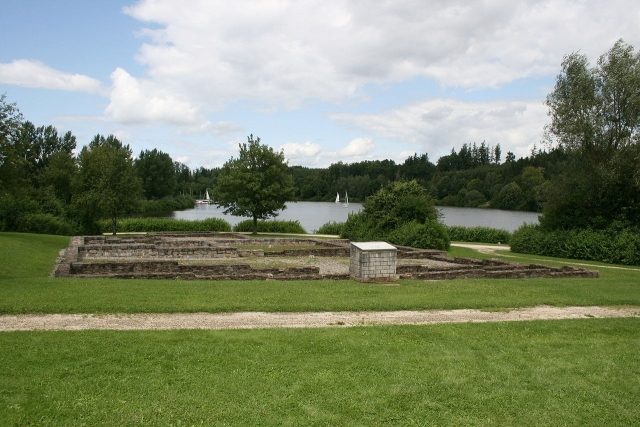
The remains of the roman Bath can be visited
Ancient BuildingBuch
Roman Castle Buch-Bath
Kastell Buch is a former Roman military camp, built near the Raetian Limes, a UNESCO World Heritage Site, for border security. Its remains are located in the district of Buch, a hamlet belonging to the municipality of Rainau in the Ostalbkreis, Baden-Württemberg. Since 1972, the fort, together with its ancient civilian settlement (Vicus), the section of the Limes running alongside it, and the Limes Gate Dalkingen, has formed the Limes-Park Rainau. Buch became known not only for the Limes Gate but also for its valuable finds.
Fort Bath+
The thermal bath belonging to the camp was located about 100 meters northeast of the northeast corner of the fort, near the confluence of the Ahlbach into the Jagst. This facility was also used by the civilian population. Researchers were able to reconstruct a complex building history with four construction phases. The bath, built almost exactly in a north-south orientation and with an approximately mirror-image room arrangement, belonged to the row type. In its spatial orientation, it did not follow the building scheme usually found on the Raetian Limes, as the entrance in Buch was in the west or south. Normally, the baths were entered from the north. The original front-side width of the central building unit, which was largely maintained over time, was about 10 meters. During the excavations, only minor remains of the actual floor could be uncovered.
Phase I
Since the fort was probably built around 130/140 AD, the construction of the thermal bath is unlikely to have occurred much later. Based on the finds, the excavator Planck could imagine its construction in the late Hadrianic period. It was probably the first structure outside the fortifications, as the Vicus only emerged in the 60s of the 2nd century, along with the construction of the wooden palisade of the Limes.
One entered the rectangular, unheated changing room (Apodyterium) of the bath from the west. Afterwards, visitors proceeded to the eastern, also rectangular, assembly hall (Basilica), the largest room of the complex, which was also unheated. In the eastern wall of the hall, to the right, was a cold bath (Frigidarium) that had approximately the same dimensions as the Apodyterium. To the north was the access to the small and larger warm bath (Tepidarium), which were in the same room alignment as the subsequent hot bath (Caldarium). From there, a small rectangular bathing pool, built against the western wall, could be entered. The thermal bath was heated from the north.
Phase II
With the establishment of the camp village, the bath was representatively expanded and enlarged in the second half of the second century. The Apodyterium, Basilica, and Frigidarium were demolished. In their place, an assembly room, about 22 meters long, resting on a stone foundation and oriented east-west, was built transversely to the actual building complex. This room was probably also used for clothes storage. As the southern end of the building, a portico extending over the entire length of the Basilica lay in front of it. From there, one entered the bath. North of the Basilica, a large Frigidarium, about ten meters wide, was built in the north-south alignment of the older, unchanged rooms. East of the cold bath, a small sweat bath (Sudatorium) was newly constructed, and to the west, an almost mirror-image Frigidarium. In Phases II and III, which are combined in some descriptions, the thermal bath reached its greatest length with an extension of about 44 meters.
Phase III
The hypocaust heating in the Sudatorium was decommissioned, and the room was used as a Frigidarium. The western wall in the existing large Frigidarium was moved to the east, thereby reducing the size of the bath. The simultaneously enlarged small Frigidarium was converted into a new Sudatorium after its hypocaust heating.
Phase IV
Since evidence for an Alamannic attack between 233 and 234 is lacking, the northern and southern parts of the balneum were probably destroyed only during the Germanic raid presumed in the early summer of 254 AD. At that time, the camp village was consumed in a fire catastrophe. Only the walls in the central area seem to have been repairable or sufficient for a perhaps decimated population for reconstruction. There were also considerations that the reduction in the size of the bath might have been necessary for economic reasons. The previous heating system, the Caldarium, and the small bathing pool no longer existed; neither did the Basilica and the Porticus. The remaining structure continued to be used as before. A wooden annex, about 10x10 meters in size, was built against the south facade as a new changing room. Finally, in this phase, the Sudatorium was also abandoned somewhat later. In its greatly reduced, provisional-looking form, the thermal bath existed at least until the end of Roman rule in 260 (Limesfall). The finds in the camp village suggest that the fort bath may even have been used until the early 4th century.
Finds
The bath yielded a variety of interesting finds: finger rings, coins, gems, hairpins, pottery shards, and glass vessels. The latter are common finds in Roman bath complexes, as perfumes and especially oils for use with a strigil were usually stored in smaller unguentaria.
Take Mobile History with you
You are reading this text for free. Premium adds what matters on the road: descriptions read aloud, sites found through your camera, whole regions taken offline.
- Every description, including the ~17,700 Premium sites
- Audio guide: have descriptions read to you on location
- AR finder: see sites through your camera, with distance and bearing
- Unlimited saved sites
14 days free, then from €2.99 a month. Cancel anytime.
Source: Wikipedia · Licence: CC BY-SA 4.0 · Image: http://de.wikipedia.org/wiki/Datei:Rainau_Buch_Badegebaeude01.jpg
This description draws on the facts documented in the linked Wikipedia article; Wikipedia content is licensed under CC BY-SA 4.0. Wording and editing: Mobile History.
Location: 48.9109, 10.1474