The remains of the roman Watchtower can be visited
Ancient BuildingMudau-Schloßau
Römischer Wachturm 10/37
The Upper Germanic-Rhaetian Limes, with a length of 550 km, from Eining near Regensburg to Rheinbrohl on the Rhine, is the largest archaeological monument in Germany and has been recognized by UNESCO as a World Heritage Site. Limes (Latin: border path/wall) refers to the border fortifications of the Roman Empire, which were erected towards the end of the 1st century AD.
This border was monitored by more than 900 towers, which were built in timber construction during the initial phase, starting around 80 AD. Stone towers followed, which were plastered from 150 AD onwards. Excavations have shown that the white plaster often had incised joints, which were painted in terracotta. This created the impression of beautiful ashlar masonry.
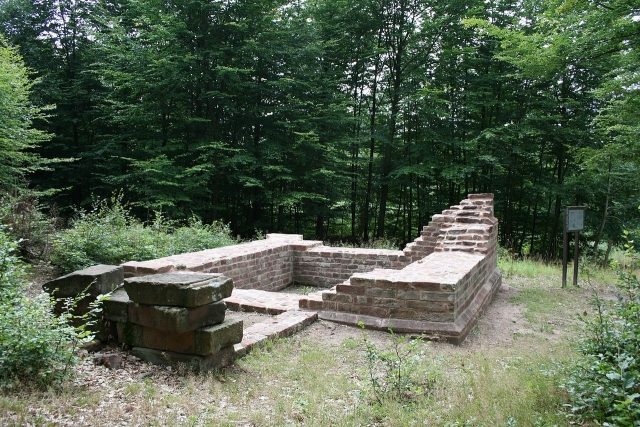
Watchtower 10/37 is one of the most unusual findings among all Limes towers and continues to puzzle scientists to this day. A timber tower site with a total diameter of 20 m was found, as well as two stone tower sites. Both stone tower foundations have been reconstructed. The western one has ordinary dimensions of 6 × 6 m. Unusual about the eastern tower, measuring 6.60 × 6.60 m, is a staircase later added to its north side. A dedicatory inscription to Jupiter was immured in the open staircase. It was placed to fulfill a vow for the completion of the burgus and probably refers to the western tower.
Latin text:
I·O·M
VEXIL
COH·I
SEQ·ET·RAVR
EQ·SVB·CVR
ANTON·NATA
LIS·LEG XXII·P
P·F·OB·BURG·EX
PLIC·V·S·L·L·M
Reading:
Iovi Optimo Maximo
vexillatio
cohortis I
Sequanorum et Rauracorum
equitatae sub cura
Antonii Nata-
lis (centurionis) legionis XXII Primigeniae
Piae Fidelis ob burgum ex-
plicitum votum solvit laetus libens merito
Translation:
To Jupiter, Best and Greatest, from the construction detachment of the mounted 1st Cohort of the Sequani and Rauraci, under the command of Antonius Natalis, centurion of the 22nd Legion Primigenia Pia Fidelis, for the completion of the burgus (tower). He has gladly, joyfully, and deservedly fulfilled his vow.
In front of the western tower, there is now a replica of the inscription. Wall plaster and paintings in red, yellow, and green were found in the rubble of the eastern tower and are likely to have come from its interior. Particularly significant, however, is the discovery of three headless statues of gods, not quite life-size (over 1 m), made of red sandstone. They are now located with the original inscription in the Roman Museum Osterburken; copies have also been placed on site since 2009. Depicted are Victoria, Mars, and Salus, in rather good quality from a local workshop. The combination of deities (goddess of victory, god of war, and goddess of health and well-being), together with the repurposing of the tower, suggests a warlike event, but the gods may also have been generally very popular among soldiers. Wedge-shaped stone finds suggest that the group of statues was placed in an arched niche. The tower also yielded the only evidence of a tile roof for a tower site on the Odenwald Limes. A fragment of Victoria's shield, found in the Oberscheidental fort, provides a clue to the dating. Together with the building inscription, this confirms a dating of the sanctuary before the withdrawal of coh. I Sequanorum et Rauracorum to Miltenberg around 159 AD.
Take Mobile History with you
You are reading this text for free. Premium adds what matters on the road: descriptions read aloud, sites found through your camera, whole regions taken offline.
- Every description, including the ~17,700 Premium sites
- Audio guide: have descriptions read to you on location
- AR finder: see sites through your camera, with distance and bearing
- Unlimited saved sites
14 days free, then from €2.99 a month. Cancel anytime.
Source: Wikipedia · Licence: CC BY-SA 4.0 · Image: http://de.wikipedia.org/wiki/Datei:Schlossau_Schneidershecke_Turm_Ost.jpg
This description draws on the facts documented in the linked Wikipedia article; Wikipedia content is licensed under CC BY-SA 4.0. Wording and editing: Mobile History.
Location: 49.5500, 9.1289