The roman Watchtower can be visited
Ancient BuildingHesselbach
Roman Watchtower 10/30 (Hesselbach)
The Upper Germanic-Rhaetian Limes, with a length of 550 km from Eining near Regensburg to Rheinbrohl on the Rhine, is the largest archaeological monument in Germany and has been recognized by UNESCO as a World Heritage Site. Limes (Latin: border path/wall) refers to the border fortifications of the Roman Empire, which were erected towards the end of the 1st century AD.
This border was monitored by more than 900 towers, which were built in timber construction during the initial phase, starting around 80 AD. Stone towers followed, which were plastered from 150 AD onwards. Excavations have shown that the white plaster often had cracked joints, which were painted in terracotta. This created the impression of beautiful ashlar masonry.
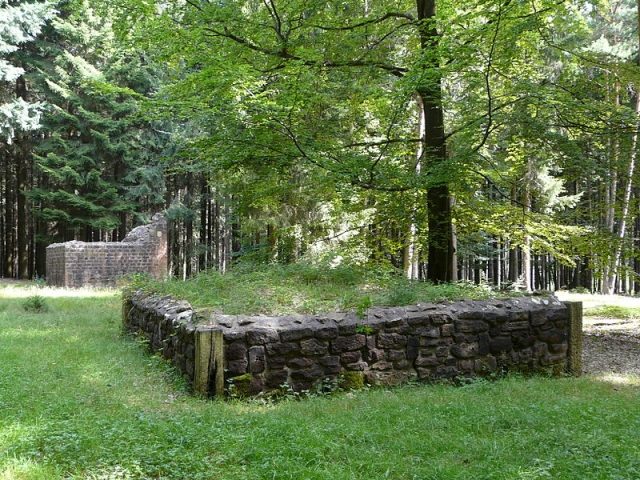
Preserved and reconstructed tower site of a stone and a wooden tower, along with a reconstructed Limes palisade. The stone tower was investigated by Friedrich Kofler during the excavations of the Hesselbach fort, and the wooden tower by Anthes in 1895.
The stone tower had a square floor plan with a side length of 4.80 m. The wooden tower mound, clearly visible in the terrain, bore a dry-stone foundation, also with a square floor plan, whose side length was 5.25 m and whose wall thickness was 65 cm. Inside, the tower foundation was divided into two unequally sized rooms by another 90 cm thick dry-stone wall. In addition, the western wall in the larger, southern room had been reinforced to a width of 1.20 m. The tower was surrounded by a circular ditch 20 m in diameter.
The Limes palisade passed the wooden tower at a distance of 30 m to the east. At a distance of 8 m to 10 m, the Limes accompanying path was located in front of it, whose width at this point was determined to be the unusual dimensions of 7.50 m and 9.00 m. The palisade itself, whose traces were observed here for the first time along the entire Odenwald Limes, was particularly carefully investigated in the area of Wp 10/30. It consisted of 25 m to 30 m thick tree trunks, which were secured in a 1.40 m deep trench using moist, compacted earth with the aid of wedge stones.
The tower site was re-excavated and cleaned in 1979 by the Rotary Club Erbach-Michelstadt. Subsequently, in consultation with the Hessian State Office for Monument Preservation, the rising masonry of the stone tower and the foundation wall of the wooden tower were preserved and partially rebuilt. Furthermore, a section of the Limes palisade was reconstructed. Due to the completeness of the ensemble thus brought to light, this complex is one of the best preserved on the Odenwald Limes.
Take Mobile History with you
You are reading this text for free. Premium adds what matters on the road: descriptions read aloud, sites found through your camera, whole regions taken offline.
- Every description, including the ~17,700 Premium sites
- Audio guide: have descriptions read to you on location
- AR finder: see sites through your camera, with distance and bearing
- Unlimited saved sites
14 days free, then from €2.99 a month. Cancel anytime.
Source: Wikipedia · Licence: CC BY-SA 4.0
This description draws on the facts documented in the linked Wikipedia article; Wikipedia content is licensed under CC BY-SA 4.0. Wording and editing: Mobile History.
Location: 49.5945, 9.0843