The roman Temple can be visited
Ancient BuildingFaimingen
Roman Apollo-Grannus-Temple Phoebiana (PANIONEI)
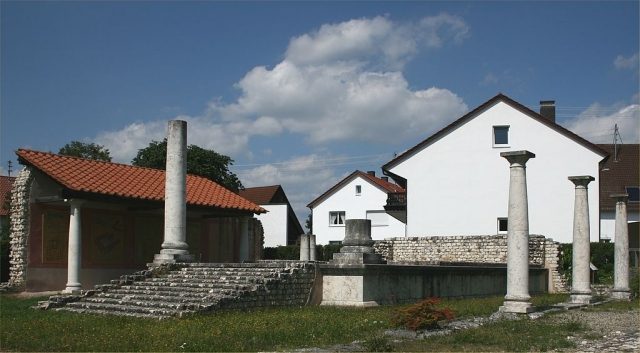
The Apollo-Grannus Temple was a Roman temple in Bavarian Faimingen near Lauingen. It belonged to the fort Phoebiana (PANIONEI) (Faimingen). Emperor Caracalla thanked the god Apollo Grannus for healing his ailments in 212. The temple's name is derived from the Roman god of healing, Apollo, and the Celtic spring and bathing god, Grannus.
The clear spring water contributed to the supra-regional importance of Phoebiana (Roman for "Faimingen") for cultic baths and drinking cures. The temple is one of the largest Roman temple buildings north of the Alps. Today, only remnants remain.
Structure+
At its peak, the size of the complex is estimated at approximately 40 ha. The temple itself is about 1000 m² large. The roads leading to Phoebiana converged on the complex's forum.
At today's entrance in the south of the complex stands a medieval well. From here, the steps of a staircase lead to the inner colonnade, porticus II. In the extension, one can see the ramp leading from the temple courtyard, temenos, to the temple antechamber, the proanos. This is followed by the main room, the cella. Eight of the originally 14 columns of the porticus enclosing the temple courtyard on three sides are preserved or reconstructed. The western columns still show part of the wall to the outer porticus I and are covered. Behind the temple is a shop, taberna. Here are the remains of another medieval well (2). Of the columns of the outer porticus, only a single one in the western part is preserved. The former course of the colonnade is painted in white on the path.
Excavation+
The first excavations began in 1888 by the Faimingen village teacher Magnus Scheller. In this and several subsequent excavations, the temple and remains of the adjacent buildings could be uncovered. The partially visible reconstruction today was made possible by the discovery of 150 hewn stones in 1972 in the Brenz river, as well as the same number of spolia from the fort wall. Ultimately, the discovery of two milestones under the parish church of the neighboring community Gundelfingen in 1981, on which the names Phoebiana and Apollo-Grannus are recorded, provided information about the name and purpose of the finds. Furthermore, they state that the Roman Emperor Caracalla donated roads and bridges here in 212/213. In 2002, another milestone with the inscription Phoebiana was found in Sontheim an der Brenz.
Open-Air Museum+
An open-air museum was established on the site of the former Apollo-Grannus Temple in 1987.
Take Mobile History with you
You are reading this text for free. Premium adds what matters on the road: descriptions read aloud, sites found through your camera, whole regions taken offline.
- Every description, including the ~17,700 Premium sites
- Audio guide: have descriptions read to you on location
- AR finder: see sites through your camera, with distance and bearing
- Unlimited saved sites
14 days free, then from €2.99 a month. Cancel anytime.
Source: Wikipedia · Licence: CC BY-SA 4.0
This description draws on the facts documented in the linked Wikipedia article; Wikipedia content is licensed under CC BY-SA 4.0. Wording and editing: Mobile History.
Location: 48.5617, 10.4091