The remains of the roman Villa can be visited
Ancient BuildingMühlacker-Enzberg
Roman Villa Enzberg
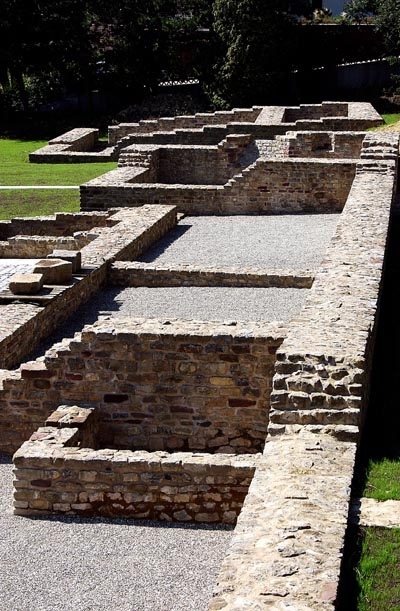
The Villa rustica Enzberg (Villa rustica Schellenäcker) is a Roman villa in Mühlacker-Enzberg. Due to its size, it is one of the most well-known villas in the Enzkreis district. It is located at the eastern exit of Enzberg (Schellenäcker field).
Origin and Structure+
The complex consists of 4 buildings, as well as a bathhouse and a stone well. It was used from about 100 AD until the fall of the Limes in 263 and is estimated to have housed 20 to 30 people. The main building was a 35 m long risalit villa. Amphora stand marks were found in the cellar, indicating the storage of imported fermenting foods such as wine. In front of the building was a 4 m deep well, which may have been used for must production, and an estimated 7 m high Jupiter column, whose base is presumed to be under the current B10 road.
Building 2, measuring 13 x 15 m, is located 10 m to the south. Due to the walls being up to 1 m thick, a multi-story structure is suspected. The main room was divided into three by timber-framed walls. The building was probably used for craft purposes.
Building 3, at 6 x 5 m, was the smallest building on the estate. Despite their thickness, the walls are poorly preserved. The function of the building is unknown.
Building 4 is located approximately 5 m west of Building 2. It was at least 15 x 10 m in size, but could not be fully excavated as the remaining part lies outside the excavation area. This is presumably a warehouse.
Excavation and Finds+
The first Roman finds were made as early as 1850. The first excavation took place in 1912 by Oskar Paret. He discovered and investigated the bathhouse, which today is largely located under the B10 road. Subsequently, the find was backfilled.
The second major excavation took place after the relocation of the B10 in 1998 under the direction of Dr. Britta Rabold. The excavation leader from the Archaeological Heritage Conservation of the State Monuments Office of Baden-Württemberg had an excavation area of 2000 m² at her disposal. Many volunteer excavation helpers were involved in its realization. In addition to tile shards and plaster remains, two approximately life-sized stone sculptures of women's heads, which belonged to the Jupiter column and are now exhibited in the Mühlacker Local History Museum, were found in the well.
Archaeological Park+
To promote the preservation and development of the Villa rustica, the Historical-Archaeological Association Mühlacker was founded in September 1999. In 2000, the plan for an open-air facility was decided, instead of backfilling the ruins as planned. On September 12, 2004, the Archaeological Park was officially inaugurated.
The Villa rustica is located directly on the B10 at the eastern exit of Enzberg, towards Mühlacker, not far from the Enz river, and is freely accessible.
Take Mobile History with you
You are reading this text for free. Premium adds what matters on the road: descriptions read aloud, sites found through your camera, whole regions taken offline.
- Every description, including the ~17,700 Premium sites
- Audio guide: have descriptions read to you on location
- AR finder: see sites through your camera, with distance and bearing
- Unlimited saved sites
14 days free, then from €2.99 a month. Cancel anytime.
Source: Wikipedia · Licence: CC BY-SA 4.0 · Image: http://www.pfenz.de/wiki/Datei:Villa_rustica_wiki.jpg
This description draws on the facts documented in the linked Wikipedia article; Wikipedia content is licensed under CC BY-SA 4.0. Wording and editing: Mobile History.
Location: 48.9422, 8.8110