The roman town can be visited
Ancient BuildingWroxeter
Roman Town Viroconium
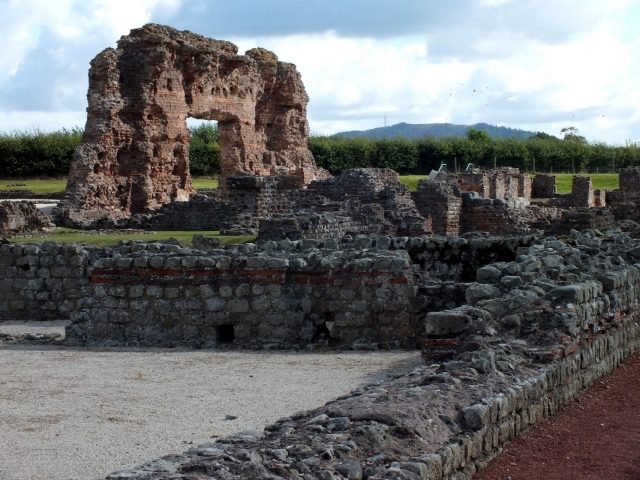
Viroconium Cornoviorum, or Viroconium or occasionally Uriconium, was a Roman town, one corner of which is now occupied by Wroxeter, a small village in Shropshire, England, about 5 miles (8.0 km) east-south-east of Shrewsbury. At its peak, Viroconium is estimated to have been the fourth largest Roman settlement in Britain, a civitas with a population of more than 15,000. The settlement probably lasted until the end of the seventh century or the beginning of the eighth. Extensive remains can still be seen.
Name+
According to Rivet and Smith, viro- may mean either "true" or "man". The -conium portion is unknown, but seems to refer to some large geographic feature such as a lake or forest. Jackson suggests that the name is a Latin form of the Brythonic Uriconon, which would have been applied to the nearby hill fort on the Wrekin. The name may be related to personal names such as Welsh Gwrgi, Breton Gurki, and Irish Ferchu, meaning "Man-hound" or "Werewolf", which in ancient Common Celtic would have had a nominative singular *Wiro-kū (oblique *Wiro-kon-); Viroconium could thus be derived from such a personal name and mean "(the place belonging to) *Wirokū". Cornoviorum means "of the Cornovii", the local tribe whose civitas it became.
Roman town+
Viroconium was established in about AD 58 as a legionary fortress for the 14th legion during their invasion of what is now Wales. They were later replaced by the 20th legion, until the fortress was abandoned by the military around AD 88 and taken over by the civilian settlement that had grown up around the fort. By AD 130 it had expanded to cover an area of more than 173 acres (70 ha). It then had many public buildings, including baths and a colonnaded forum dedicated to the Emperor Hadrian, as shown by the remains of an inscription. Simpler temples and shops have also been excavated. At its peak, Viroconium is estimated to have been the fourth largest Roman settlement in Britain, with a population of more than 15,000.
Post-Roman town+
Town life in Viroconium continued in the 5th century, but many of the buildings fell into disrepair. Between 530 and 570, when most Roman urban sites and villas in Britain were being abandoned, there was a substantial rebuilding programme. The old basilica was carefully demolished and replaced with new timber-framed buildings on rubble platforms. These probably included a very large two-storey building and a number of storage buildings and houses. In all, 33 new buildings were "carefully planned and executed" and "skillfully constructed to Roman measurements using a trained labour force". Who instigated this rebuilding programme is not known, but it may have been a bishop. Some of the buildings were renewed three times, and the community probably lasted about 75 years until, for some reason, many of the buildings were dismantled. The site was probably abandoned peacefully in the second half of the 7th century or the beginning of the 8th century.
Wroxeter Roman City+
Some remains are still standing, and further buildings have been excavated. These include "the Old Work" (an archway, part of the baths' frigidarium and the largest free-standing Roman ruin in England) and the remains of a baths complex. These are on display to the public and, along with a small museum, are looked after by English Heritage under the name "Wroxeter Roman City". Some of the more important finds are housed in Rowley's House Museum in Shrewsbury. Most of the town still remains buried, but it has largely been mapped through archaeological geophysics and aerial archaeology.
A reconstructed Roman villa was opened to the public on 19 February 2011 to give visitors an insight into Roman building techniques and how the Romans lived. A Channel 4 television series, Rome Wasn't Built in a Day, showed how it was built using authentic ancient techniques. The builders were assisted by a team of local volunteers and supervised by archaeologist Dai Morgan Evans, who designed the villa.
Take Mobile History with you
You are reading this text for free. Premium adds what matters on the road: descriptions read aloud, sites found through your camera, whole regions taken offline.
- Every description, including the ~17,700 Premium sites
- Audio guide: have descriptions read to you on location
- AR finder: see sites through your camera, with distance and bearing
- Unlimited saved sites
14 days free, then from €2.99 a month. Cancel anytime.
Source: Wikipedia · Licence: CC BY-SA 4.0 · Image: Ozymandias
This description draws on the facts documented in the linked Wikipedia article; Wikipedia content is licensed under CC BY-SA 4.0. Wording and editing: Mobile History.
Location: 52.6747, -2.6445