The remains of the roman town can be visited
Ancient BuildingNîmes
Roman City Nemausus-Castellum
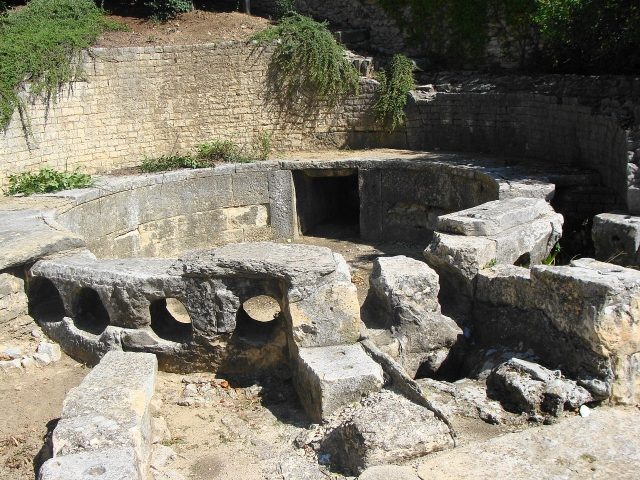
Nîmes has a rich history, dating back to the Roman Empire when the city was home to 50,000 – 60,000 people. Several famous monuments are in Nîmes, such as the Nîmes Arena and the Maison Carrée. Because of this, Nîmes is often referred to as the French Rome.
The city derives its name from that of a spring in the Roman village. The contemporary coat of arms of the city of Nîmes includes a crocodile chained to a palm tree with the inscription COLNEM, for Colonia Nemausus, meaning the "colony" or "settlement" of Nemausus, the local Celtic god of the Volcae Arecomici. Veterans of the Roman legions who had served Julius Caesar in his Nile campaigns, at the end of fifteen years of soldiering, were given plots of land to cultivate on the plain of Nîmes.
The city was located on the Via Domitia, a Roman road constructed in 118 BC which connected Italy with Spain.
Its name appears in inscriptions in Gaulish as dede matrebo Namausikabo = "he has given to the mothers of Nîmes" and "toutios Namausatis" = "citizen of Nîmes".
Roman period
Nîmes became a Roman colony sometime before 28 BC, as witnessed by the earliest coins, which bear the abbreviation NEM. COL, "Colony of Nemausus". Some years later a sanctuary and other constructions connected with the fountain were raised on the site. Nîmes was already under Roman influence, though it was Augustus who made the city the capital of Narbonne province, and gave it all its glory.
The city had an estimated population of 60,000 in the time of Augustus. Augustus gave the town a ring of ramparts six kilometres (3.7 miles) long, reinforced by fourteen towers; two gates remain today: the Porta Augusta and the Porte de France. An aqueduct was built to bring water from the hills to the north. Where this crossed the River Gard between Uzes and Remoulins, the spectacular Pont du Gard was built. This is 20 kilometres (12 miles) north east of the city. Also, the Maison Carrée is one of the best preserved temples to be found anywhere in the territory of the former Roman Empire. Nothing remains of certain monuments, the existence of which is known from inscriptions or architectural fragments found in the course of excavations. It is known that the town had a civil basilica, a curia, a gymnasium and perhaps a circus. The amphitheatre dates from the end of the 2nd century AD. The family of Roman Emperor Antoninus Pius came from Nemausus.
Emperor Constantine endowed the city with baths. It became the seat of the Diocesan Vicar, the chief administrative officer of southern Gaul.
The town was prosperous until the end of the 3rd century – during the 4th and 5th centuries, the nearby town of Arles enjoyed more prosperity. In the early 5th century the Praetorian Prefecture was moved from Trier in northeast Gaul to Arles. The city was finally captured from the Romans by the Visigoths in 473 AD.
Take Mobile History with you
You are reading this text for free. Premium adds what matters on the road: descriptions read aloud, sites found through your camera, whole regions taken offline.
- Every description, including the ~17,700 Premium sites
- Audio guide: have descriptions read to you on location
- AR finder: see sites through your camera, with distance and bearing
- Unlimited saved sites
14 days free, then from €2.99 a month. Cancel anytime.
Source: Wikipedia · Licence: CC BY-SA 4.0 · Image: http://commons.wikimedia.org/wiki/File:Castellum_PS01.JPG?uselang=de
This description draws on the facts documented in the linked Wikipedia article; Wikipedia content is licensed under CC BY-SA 4.0. Wording and editing: Mobile History.
Location: 43.8424, 4.3560