Roman Thermal Baths can be visited
Ancient BuildingTreves
Roman Thermal Baths Kaiserthermen Augusta Treverorum (Treves)
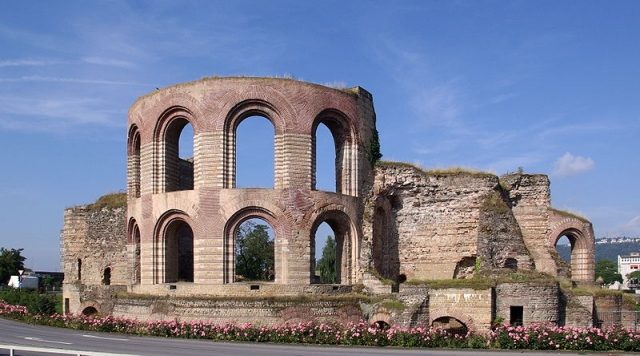
The Imperial Baths in Trier are the remains of a large Roman bath complex, which can still be visited today as an impressive ruin. The preserved apses still show the Roman construction method of layers of light stone and red bricks (so-called brick courses), which served aesthetic as well as stability goals. This style was not only used for the Imperial Baths in Trier but was also copied, among other places, in the construction of the medieval Frankenturm.
Since 1986, the Imperial Baths have been part of the UNESCO World Heritage Site "Roman Monuments, Cathedral of St. Peter and Church of Our Lady in Trier," and they are also a protected cultural property under the Hague Convention.
The complex was built around and after 300 AD as a monumental representative building for the Emperors Constantius Chlorus and his son Constantine, who had made Trier their residence. The baths rise approximately south of the center of the imperial palace district, which stretched from the area of the Cathedral (former palace) over the core building of the mighty brick structure of the Constantinian Palatine Aula to the temple district in the Altbach valley and the amphitheater (which was simultaneously integrated into the Roman city wall).
The location of this building and its predecessors was probably chosen due to its good water supply from the Altbach and Herrenbrünnchen streams, as well as from the later Ruwer water pipeline from Petrisberg via two aqueducts. This is also evidenced by numerous finds of wooden pipelines, lead pipes, drinking water channels, and wells. Three large water basins, located on the site of the later baths, also date from the 1st to 3rd centuries.
The Imperial Baths also form the eastern end of the central axis (decumanus maximus) of the Roman road system in Augusta Treverorum, starting at the Roman Bridge with the porta inclyta (today approximately in the area of Wall-/Bollwerkstraße) over the Forum with the Palace of Victorinus (today the area of the City Hall/Augustinerhof).
The bath complex consisted, among other things, of a free-standing hall similar to the Basilica of Constantine, which it hardly lagged behind in size. In accordance with Roman standards for such large buildings, a multitude of underground passages for heating and drainage were laid out beneath the complex. The diameter of the concrete dome over the Tepidarium was 16.45 m.
Based on these passages and supply infrastructure, it was determined that the interior decoration and technical equipment of the bathhouse in the baths were never fully completed, and thus bathing operations never commenced. After Constantine moved his official residence to Byzantium, the unfinished building remained unused under Constantine II and began to decay until Emperor Valentinian (364-375) had the complex converted into a barracks around 360 AD. The new barracks provided space for approximately 800 to 1,000 men of the mounted imperial bodyguard. The huge free-standing western hall was demolished, and the underground facilities in the western part of the building were filled in. What remained was the former Caldarium (warm bath), i.e., the eastern hall with its three apses and its antechamber, which, surrounded by colonnaded halls, henceforth served as a court and judicial forum.
After the end of the Roman era, the baths, like the Barbara Baths, the Porta Nigra, the Palatine Aula, and the Cathedral, were at least partially reused by the population. The Imperial Baths served as a kind of castle, under whose protection a small settlement developed in the center of the courtyard (Alt-St.-Gervasius). As the population declined to a fraction of the old imperial city in the Early Middle Ages, the urban area of approx. 285 hectares became too large for successful defense. Under Archbishop Bruno von Lauffen (1102-1124), a new city wall was built in the south from the Moselle bank to the Imperial Baths, and the southern parts of the city, including the old Roman wall belt, which ran approximately at the height of today's "Töpferstraße," were left to decay. This was followed by the construction of the eastern and northern city walls under Archbishops Albero (1131-1152) and Arnold II von Isenburg (1242-1259). Parts of this city wall are still preserved today in the area of the Süd-, Ost- and Nordallee. The east and south walls meet at the former Caldarium of the Imperial Baths, which was now incorporated as the southeastern cornerstone (gate castle) into the wall ring of the medieval city wall.
Since in the Middle Ages, buildings were often constructed on existing rubble, causing the ground level to rise by several meters (particularly evident at the Imperial Baths and the Porta Nigra), the window in the south apse could be used as a city gate ("Altport"). The much larger Roman window openings were bricked up and replaced by smaller loopholes. In the former Caldarium - now "Torburg" (gate castle) - the burgrave resided as the holder of the city's military command. The western part of the Imperial Baths with its north, west, and south wings and the gymnasium (Palaestra) served as a "quarry" for house building from the High Middle Ages onwards and were largely dismantled. Here, in addition to the already mentioned settlement around the parish church of Alt-St.-Gervasius, the St. Agnes monastery was built in the north and west wings from about 1295. A document from 1238 also mentions a Trinity Chapel, which was built in the Caldarium but fell victim to the battles between the people of Trier and the troops of Elector Jakob von Eltz in 1568, and in its place a watchtower ("Geschlechterturm") was built; around the same time, the "Torburg" was abandoned, now serving as a normal city gate. In the mid-18th century, the large apse of the Caldarium was partially destroyed and hastily repaired as a city wall (it was not rebuilt until 1984, see below).
In the vicinity of the Imperial Baths, presumably due to the water supply described above, weavers and tanners settled, which is still reflected today in the names "Weberbachstraße" and "Gerberstraße."
In the course of secularization around 1800, Alt-St.-Gervasius and St. Agnes were demolished. During the demolition of the churches, the monastery buildings, and the watchtower, the foundations of the formerly much larger bath complex were discovered. After the Caldarium was completely cleared from 1816, the "Altport" had to be closed in 1817. Extensive excavations began in the mid-19th century.
On the occasion of the 2000th anniversary of the city of Trier, the Imperial Baths were renovated before 1984. Before the work began, only the lower window arches of the apses were preserved; of the upper rows of arches, only unconnected wall remains survived. As part of the renovation work, the upper window arches were rebuilt, which was justified as a stabilization measure. Regional critics consider this measure unnecessary and object that the reconstruction served tourist purposes and that the appearance of the ruins has been permanently impaired by the newly inserted (lighter) stones and bricks and the artificially smooth finish at the upper edge of the east apse.
From 2005 to 2006, a building designed by the architectural firm of Oswald Mathias Ungers was erected over the northern part of the ruins, which is used for the admission of tourists and visitors to events taking place in the ruins (especially concerts, ancient festivals).
The large Palaestra (uncovered wrestling ground) in the western part of the Imperial Baths is today a publicly accessible lawn, still surrounded by the preserved ruins of the western bath buildings, which are up to about one meter high. The Palaestra is partly used as a circus location, for the Roman games "Brot & Spiele" (Bread & Games), or for other events, and in the remaining time, it is used by the population of Trier for play and amateur sports.
Tourism+
Today, visitors can see wall remains of the east hall and some excavated underground passages. Discounted admission is possible with the "Römerticket," a combined ticket for several Roman sites in Trier and the surrounding area.
In summer, guided tours of the Imperial Baths are offered, where a costumed actor slips into the role of the fictional tribune Mallobaudes and tells about his life in antiquity.
Take Mobile History with you
You are reading this text for free. Premium adds what matters on the road: descriptions read aloud, sites found through your camera, whole regions taken offline.
- Every description, including the ~17,700 Premium sites
- Audio guide: have descriptions read to you on location
- AR finder: see sites through your camera, with distance and bearing
- Unlimited saved sites
14 days free, then from €2.99 a month. Cancel anytime.
Source: Wikipedia · Licence: CC BY-SA 4.0
This description draws on the facts documented in the linked Wikipedia article; Wikipedia content is licensed under CC BY-SA 4.0. Wording and editing: Mobile History.
Location: 49.7497, 6.6422