The roman bath can be visited
Ancient BuildingJagsthausen
Roman Bath Jagsthausen
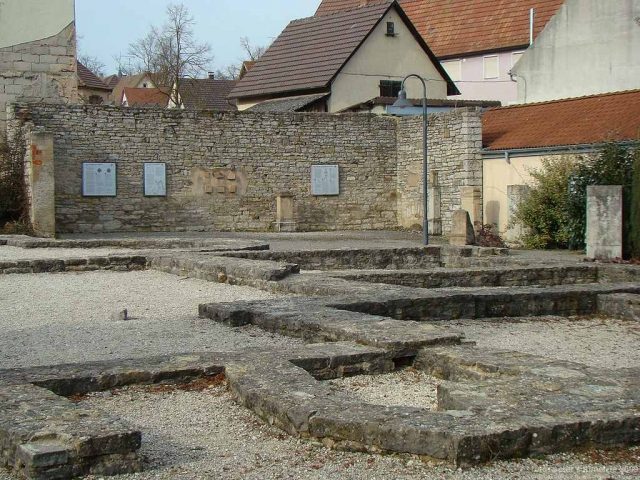
The Roman Bath Jagsthausen is a small open-air museum in Jagsthausen in the Heilbronn district of Baden-Württemberg, which displays some copies of excavation finds in the reconstructed foundation of a Roman bath.
The Cohort Fort in Jagsthausen+
Around the year 200 AD, Jagsthausen was located on the Upper Germanic-Rhaetian Limes, the northern border of the Roman Empire. Approximately 400 meters from the Limes, in the area of today's park facilities of the Weiße Schloss and Jagsthausen Castle, as well as the northern village center of Jagsthausen, lay the Roman cohort fort of Jagsthausen, with a larger civilian settlement (vicus) adjoining to the east, south, and west.
Numerous excavated Roman bricks bear the stamp of the 22nd Roman Legion Primigenia Pia Fidelis (LEG XXII P PF) and were probably fired by this legion in Nida near Frankfurt. Goods such as these bricks were presumably also transported by barges on the Neckar and Jagst rivers. The location of the Jagsthausen fort on the Hohe Straße and on the Jagst as another transport route could explain its size and importance.
The bath was presumably built together with the fort around 155 AD and extensively renovated around 200 AD under Emperor Septimius Severus, as evidenced by a renovation inscription. Although it was of considerable size, it was not a magnificent urban thermal bath, but a comparatively simple balineum. A second, smaller bath on the site was renovated again in 247/49 according to another inscription, before the Limes was abandoned about a decade later, after which the buildings fell into disrepair.
Excavations and Museum Preparation+
Excavations of the Roman foundations already took place in the 19th century, with the small bath building, 31 meters long, being discovered in 1886. North of the road to Olnhausen, a Roman-era urn field with around 200 urn graves was found between 1908 and 1913. The large Roman bath had also been known since the 19th century, but it was only systematically recorded for the first time over a length of about 40 meters by the State Office for Monument Preservation Baden-Württemberg in the run-up to planned construction work in 1992. The foundations, which are built over in their further course, probably extend to approximately the current main road, where the main entrance to the complex was probably once located.
Due to the great importance of the find, the planned construction work was abandoned. Instead, the excavations were refilled as an archaeological reserve, and an ideal reconstruction of the bath complex was erected based on the excavation results. With support from the Würth Foundation, the Kreissparkasse Heilbronn, the municipality of Jagsthausen, the Heilbronn district, the State Office for Monument Preservation Baden-Württemberg, the Monument Foundation Baden-Württemberg, as well as local associations and businesses, the complex was set up as an open-air museum, where, in addition to information boards, copies of Roman finds are displayed, including a veteran's stone, altars of beneficiarii, Jupiter altars, a week-gods stone, and more.
Take Mobile History with you
You are reading this text for free. Premium adds what matters on the road: descriptions read aloud, sites found through your camera, whole regions taken offline.
- Every description, including the ~17,700 Premium sites
- Audio guide: have descriptions read to you on location
- AR finder: see sites through your camera, with distance and bearing
- Unlimited saved sites
14 days free, then from €2.99 a month. Cancel anytime.
Source: Wikipedia · Licence: CC BY-SA 4.0 · Image: https://commons.wikimedia.org/wiki/File:Jagsthausen-roemerbad-01.jpg
This description draws on the facts documented in the linked Wikipedia article; Wikipedia content is licensed under CC BY-SA 4.0. Wording and editing: Mobile History.
Location: 49.3092, 9.4699