Residential and commercial building
ManorBensheim
Rodensteiner Hof Manor
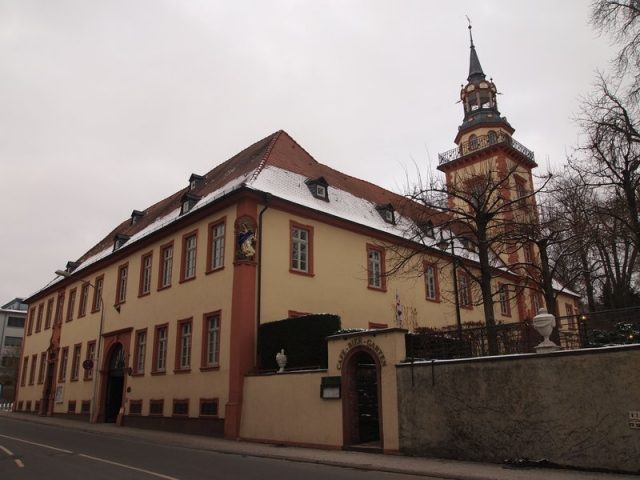
The Rodensteiner Hof is a listed cultural monument in Bensheim on the Bergstraße. It is an old noble court.
The Rodensteiner Hof is located outside the former city wall (Auerbacher Tor). It is presumed that a residential house stood at this location as early as 1570. This came into the possession of the Lords of Rodenstein, who came from Fränkisch-Crumbach. The noble family died out in 1671, and the building came into the possession of the Haxthausen family. They then sold it in 1698 to the Mainz Privy Councillor Johann Martin Ludwig von Schleiffras. Just seven years later (1705), he sold it to the Darmstadt Lieutenant General Johann Rudolf von Pretlack. Von Pretlack remained in Bensheim until 1733. Subsequently, the Rodensteiner Hof passed into the possession of the Palatinate Privy Councillor, Court Chamber and Chief Forestry Director Franz Caspar von Überbruck und Rodenstein. The von Überbruck family came from Lorraine to the Bergstraße. They had Germanized their French name d'Oultepont. The Emperor granted them permission to bear the title "Edle von Rodenstein". Nothing is known about the size and appearance of the estate at that time. It is presumed that a seven-axis main building was erected on today's Darmstädter Straße by von Pretlack or by von Überbruck by 1739. It is assumed that older building fabric was used in the process. Überbruck's son Johann Heinrich Adam presumably had further extensions carried out to the south and east from 1742.
In the second half of the 19th century, significant alterations were made to the Rodensteiner Hof. For example, the imposing tower was erected in 1883. After the von Überbrucks died out in 1904, the property passed into the ownership of the city of Bensheim. The city tried in vain to sell the Rodensteiner Hof. In the following years, the Rodensteiner Hof was used in many ways. From 1905, it housed the Jewish banking house Julius Bauer. After that, the Hessian State Domain, the Railway Directorate, the Reichsbank branch, the district leadership of the NSDAP, and the savings bank. When the Bensheim town hall was destroyed in 1945, the city of Bensheim used the Rodensteiner Hof as its town hall until 1983.
From 1984 to 1989, the entire building complex remained unused. In September 1990, a private investor bought the Rodensteiner Hof and thoroughly renovated it by 1992. Today, the Rodensteiner Hof houses offices, a café, and apartments.
Estate and Structure+
The Rodensteiner Hof is a closed four-sided complex grouped around an inner courtyard. The large main building is located on Darmstädter Straße. It is two-story and has a hip roof. The walls are built of lime and bricks and have white plaster. The building facade is divided into twelve axes, and the edges are emphasized by pilaster strips. The south wing is also two-story and has eight window axes. The tower from 1883 has a round-arched passage. At its corners, the tower is staggered ashlar. It ends at the top with a widely projecting console-supported cornice. The tower is topped by an octagonal turret with a dome and pointed spire.
Park Area+
The Rodensteiner Hof includes a spacious park, the Bensheim City Park. In terms of style, it resembles a small English landscape park. It contains, among other things, a round pavilion on brick supports. In the pavilion is a marble-carved, albeit damaged, group of figures (Cupid and Psyche).
Until 2002, a monument made of granite blocks stood in the east of the park. On September 6, 1936, it was inaugurated by the Hessian Gauleiter and Reichsstatthalter Jakob Sprenger as a district memorial. It was intended to commemorate the violent death of six National Socialists between 1929 and 1933. The monument was built on the initiative of Bensheim's mayor and NSDAP district leader Georg Brückmann. The "Kreisehrenmal" consisted of six blocks. A bronze eagle with a swastika emblem sat on a small block. The monument was designed by the Auerbach sculptor Tilman Zobel. He was advised by the Freiburg sculptor Hermann Geibel. Swastika, eagle, and National Socialist inscriptions were removed by summer 1945 at the latest. A redesign as a prisoner-of-war memorial took place in 1953. A fire bowl was integrated into the monument. In 1956, another redesign followed. The monument was now declared the "Memorial for the Bensheim fallen of all wars since 1866". The fire bowl was replaced by an Iron Cross. A surrounding wall with an altar shrine was erected around the monument. In 2002, the monument was removed.
A number of sculptural works are distributed throughout the park. On the wall facing Darmstädter Straße are putti representing the seasons, as well as vases. In the northwest behind the Rodensteiner Hof stands the figure of a dancing court lady. The works are copies of artworks by the Bamberg court sculptor Ferdinand Tietz. He created them for the palace park in Veitshöchheim between 1765 and 1768.
At a wall opening to the Kirchberg, located above the park, are two boundary stones - presumably from the 18th century. They show the Mainz wheel and the Hessian lion, respectively.
Take Mobile History with you
You are reading this text for free. Premium adds what matters on the road: descriptions read aloud, sites found through your camera, whole regions taken offline.
- Every description, including the ~17,700 Premium sites
- Audio guide: have descriptions read to you on location
- AR finder: see sites through your camera, with distance and bearing
- Unlimited saved sites
14 days free, then from €2.99 a month. Cancel anytime.
Source: Wikipedia · Licence: CC BY-SA 4.0 · Image: http://www.wehrbauten.de/thread.php?threadid=984
This description draws on the facts documented in the linked Wikipedia article; Wikipedia content is licensed under CC BY-SA 4.0. Wording and editing: Mobile History.
Location: 49.6834, 8.6220