To be privately owned
ManorDuisburg - Huckingen
Kesselsberg Manor
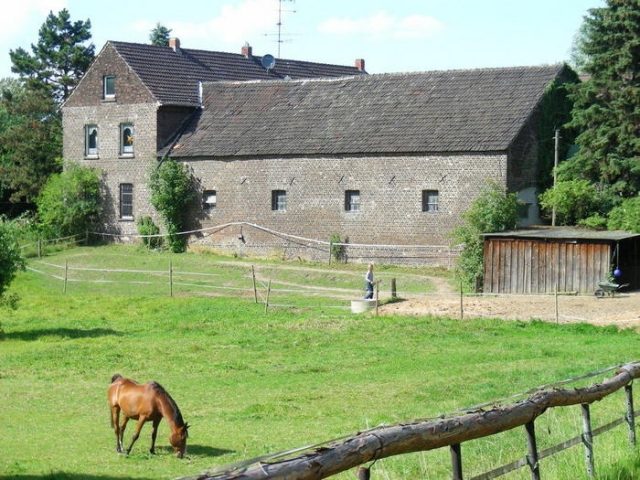
Gut Kesselsberg is a medieval farm on the southern outskirts of Duisburg in the Huckingen district on the Angerbach.
Until the 15th century, the estate was simply called Hof auf dem Berge (Farm on the Mountain). Afterwards, the farm was named after its owners, the Lords of Bottlenberg called Kessel. Gut Kesselsberg therefore stands for the estate on Kessel's Mountain.
The former knight's estate is located above the Sandmühle on a small hill, where traces of the Younger Stone Age, the Iron Age, and the Frankish period have already been found.
Due to its close proximity to the Sandmühle, it is assumed that Gut Kesselsberg was the economic farm for the noble residence Sandmühle. In contrast to the Sandmühle and most other medieval buildings on the Angerbach, Gut Kesselsberg, due to its location, was spared from the recurring floods of the Angerbach in the past.
The first documented mention dates back to 1349. In that year, the Bergian Marshal Wennemar von Bottlenberg received the Hof auf dem Berge from Margarete von Ravensberg-Berg, Countess of Berg, as a lease. In 1434, the redemption of the hereditary rent by payment of 250 guilders to the Count of Berg was documented, which was notarially confirmed in 1568. In 1646, the estate was rebuilt after severe destruction during the Thirty Years' War.
In 1744, Kesselsberg came into the possession of the Lords of Romberg through the marriage of the heiress Mechtild Christina von Bottlenberg gt. Kessel to Conrad Stephan von Romberg. In 1802, Friedrich Gisbert Wilhelm von Romberg, Prussian Lieutenant General and Governor of Stettin, sold Kesselsberg to the Count of Spee. At this time, Heinrich Brockerhoff and the Heesen family are listed as tenants. In 1908, the Count of Spee leased the farm to Michael Kreifels, whose youngest son Peter continued the lease until 1965.
Buildings and Current Use+
The farm buildings are laid out in a horseshoe shape, open to the south. The current residential building and the barn were built at the end of the 18th century.
After a series of construction measures, e.g., new settlements, the B288, the diversion of the Angerbach, had significantly reduced the agricultural areas of the estate, the agricultural use of the estate had to be abandoned in 1965. Today, Gut Kesselsberg is used as an animal boarding house and riding stable.
Take Mobile History with you
You are reading this text for free. Premium adds what matters on the road: descriptions read aloud, sites found through your camera, whole regions taken offline.
- Every description, including the ~17,700 Premium sites
- Audio guide: have descriptions read to you on location
- AR finder: see sites through your camera, with distance and bearing
- Unlimited saved sites
14 days free, then from €2.99 a month. Cancel anytime.
Source: Wikipedia · Licence: CC BY-SA 4.0 · Image: http://www.wehrbauten.de/thread.php?threadid=564
This description draws on the facts documented in the linked Wikipedia article; Wikipedia content is licensed under CC BY-SA 4.0. Wording and editing: Mobile History.
Location: 51.3538, 6.7466