Church community center
ManorBautzen - Schmochtitz
Schmochtitz Manor
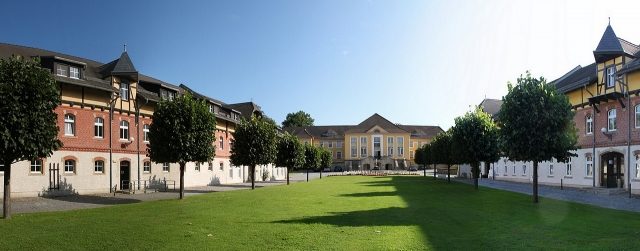
The history of the Schmochtitz estate dates back to the late Middle Ages. Located on the border between the episcopal Meissen Land and the sphere of influence of the Bohemian King, who received Bautzen and the Milzener Land beyond the Salzforst as an imperial fief, the knight's estate was entrusted with administrative functions in the 12th century, thus developing its regional importance.
A coin find in 1986 confirmed that the Hohe Straße, as a via regia, led through Schmochtitz under the protection of Loga Castle, suggesting a toll station there.
The numerous owners of the knight's estate have been known since the 14th century. Mostly they were nobles from the local area. Among the most famous was the von Schreibersdorf family, from whom it passed to the Lords von Pannewitz. In the 17th century, the knight's estate came into the possession of Wiegandt Adolf von Pentzig.
However, the von Schönberg family holds particular significance for the Baroque complex, as it is still evident today in the ensemble of the castle, orangery, and park. After the Seven Years' War, in 1763, the Saxon Chamberlain to Elector Frederick Augustus II, son of Augustus the Strong, Imperial Count and House Marshal Peter August von Schönberg acquired the knight's estate of Schmochtitz. He managed the electoral castles and gardens in Saxony. His life at the Dresden and Warsaw courts, his stay at the court of the Dukes of Courland, and various travels allowed him to get to know numerous castle and garden complexes and find inspiration, which he realized in Schmochtitz.
Renowned architects, such as Pöppelmann jun., supported him in designing a magnificent late Baroque complex, at the center of which stands the simple manor house. Subordinate to this are the landscape and garden design, which derive their orientation from avenues and sightlines.
From the castle, which defines the height, a lime tree avenue is laid out to the south, at the end of which a sandstone palm commemorates the visit of Elector Frederick Augustus and his consort. On the trunk, a boy figure displays a medallion with the equestrian Elector and the year 1769. A moat with two arched bridges crosses the path to the monument.
After the death of Peter August von Schönberg in 1791, his eldest daughter, Auguste Charlotte, widowed Countess Lynar, later Kielmannsegge, took over the property. At 19, she married Count Rochus von Lynar, a territorial lord in Lübbenau. But the Count died already in 1800. Two years later, the widow married Count Ferdinand von Kielmannsegge, a cavalry captain in the Hanoverian Regiment of the Garde du Corps. While the Count was a loyal German soldier who strove in everything to free his homeland from the French, the Countess welcomed the French Revolution as a transformative and unifying force. Pleading for the life of her husband, whom the French had imprisoned as a traitor, Countess Kielmannsegge came to Paris and became Napoleon's confidante.
In connection with the Battle of Bautzen in May 1813, soldiers severely devastated the estate because French troops found enemy weapons and uniforms that her husband had stored there without her knowledge. In 1818, the marriage was dissolved, and in 1821, she sold Schmochtitz. Auguste Charlotte died in 1863 in Dresden and is buried in the Old Catholic Cemetery on Friedrichstraße, not far from the grave of Carl Maria von Weber.
The Counts von Riesch auf Neschwitz, who owned Schmochtitz from 1821-56, transformed the Baroque park into an English landscape garden. In 1892, the Zwickau industrialist Wilhelm Otto Thost acquired the knight's estate of Schmochtitz. He had extensive alterations made to the detriment of the original Baroque complex. Nevertheless, he shaped Schmochtitz Castle and Park most enduringly after the Schönbergs.
With the establishment of the Diocese of Meissen in 1921, Bishop Dr. Christian Schreiber acquired the Schmochtitz estate to set up a seminary. However, the rectangular manor house, built around 1770, burned down in 1945 and was redesigned between 1986 and 1992. The old Baroque architectural style was also taken into account. Thus, the current building with a wide two-armed open staircase and a front fountain was created. Recessed side wings adjoin the central building. Above the passage on the eastern side wing, the coat of arms of the von Schönberg family and an alliance coat of arms are displayed, which more precisely describe the history and social status of the bearer of the coat of arms, Imperial Countess Auguste Charlotte von Kielmannsegge, widowed Lynar, née von Schönberg. Both coats of arms are held together by a count's crown. Immediately next to it, on the street front of the chapel, is the coat of arms of the Diocese of Dresden-Meissen with the personal signum of the first bishop after the re-establishment of the Diocese of Meissen, Dr. Christian Schreiber.
During the reconstruction of the castle, construction workers made a much-noticed discovery: almost 1,000 bracteates, all minted between 1150 and 1225, came to light in a ceramic pot, thus confirming the existence of a high medieval noble residence in Schmochtitz.
In 1992, the solemn inauguration of the Bishop Benno House took place. Since then, it has served as a Catholic educational institution of the Diocese of Dresden-Meissen, offering a variety of seminars and courses for adult education.
Take Mobile History with you
You are reading this text for free. Premium adds what matters on the road: descriptions read aloud, sites found through your camera, whole regions taken offline.
- Every description, including the ~17,700 Premium sites
- Audio guide: have descriptions read to you on location
- AR finder: see sites through your camera, with distance and bearing
- Unlimited saved sites
14 days free, then from €2.99 a month. Cancel anytime.
Source: Wikipedia · Licence: CC BY-SA 4.0 · Image: Norbert Kaiser
This description draws on the facts documented in the linked Wikipedia article; Wikipedia content is licensed under CC BY-SA 4.0. Wording and editing: Mobile History.
Location: 51.2149, 14.3618