To be privately owned
ManorStadthagen
Remeringhausen Manor
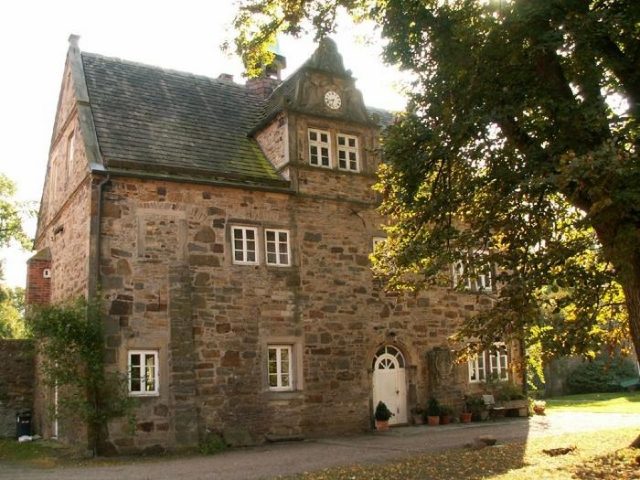
The Remeringhausen manor is a manor house documented since the end of the 16th century in the town of Stadthagen in the Schaumburg district.
The manor is located on the north-eastern foothills of the Bückeberg, about 90 meters above sea level. It lies not far south of Federal Highway 65 between Stadthagen and Bad Nenndorf.
Börries von Münchhausen, lord of Apelern, bailiff of Lauenau, born in 1515, inherited the Hessisch Oldendorf manor and a Meierhof in Remeringhausen from his father-in-law Claus Büschen in 1565 and bequeathed them to his son Ludolph von Münchhausen, who amassed a famous library here and in Oldendorf. He transformed the farm of a serf Meier into a self-managed estate by displacing peasants; however, it only gained the status and privileges of a manor under his son. In 1600, Ludolph married 15-year-old Anna von Bismarck from the house of Krevese and Schönhausen. They had 18 children, including 5 sons. Ludolph built a Renaissance castle in Remeringhausen, of which a side wing still stands today. In 1596, he acquired the sundial adorning this building from Henning Ebbeke, bailiff of Sachsenhagen. Later, the building was replaced by a Baroque manor house, which still stands today. The manor has now been in family ownership for over 500 years. As one of many estates of the von Münchhausen family in the region (including Apelern, Nienfeld, Hessisch Oldendorf, Lauenau), it was often inherited by nephews from childless owners. The name of the owners therefore changed in the 20th century. In 1952, Eberhard von Breitenbuch (resistance fighter in the Third Reich) inherited the estate. The current owner is his granddaughter, Tania von Schöning.
Some historians suspect that Remeringhausen (until approx. 1700 "Remerhusen") was once a Roman outpost. Its location, directly on the edge of the (then swampy) North German Plain, with the impassable Weser Mountains on the other side, is a place where every troop and trade movement could be observed. The square layout, which demonstrably existed around 1600, was typical of fortified Roman camps. Later, the fortified complex would have served the inhabitants of the village of Heuerssen as a defensive castle. During the Thirty Years' War, the manor served the von Münchhausen family as a fortified defensive farm.
Buildings and Park+
The ensemble is characterized by the Weser Renaissance castle built in 1599 and the Baroque manor house built in 1701. The inner courtyard is reached via a bridge and a gatehouse. The bridge was built in 1750; the gatehouse was rebuilt in 1930 after a fire. A remarkable sundial from 1556 is located on the castle. The entire building complex is framed by a wide moat. Another bridge leads to the park, designed in the style of an English landscape garden.
Miscellaneous+
The poet Börries Freiherr von Münchhausen spent several weeks at the manor, which belonged to his father and later his brother, and wrote his ballad "Der Letzte des Geschlechts" (The Last of the Line) about his ancestor Claus Büschen here.
Current Use+
The manor is privately owned and used for agriculture. In addition, exhibitions and events, such as the Romantic Garden Park Festival, take place on the grounds. Rooms can be rented for festive occasions. The so-called barn party, which marks the start of each season of the successful RTL show "Bauer sucht Frau" (Farmer Wants a Wife), takes place every year at the manor.
Take Mobile History with you
You are reading this text for free. Premium adds what matters on the road: descriptions read aloud, sites found through your camera, whole regions taken offline.
- Every description, including the ~17,700 Premium sites
- Audio guide: have descriptions read to you on location
- AR finder: see sites through your camera, with distance and bearing
- Unlimited saved sites
14 days free, then from €2.99 a month. Cancel anytime.
Location: 52.3286, 9.2703