Apartments
ManorAachen
Kalkofen Manor
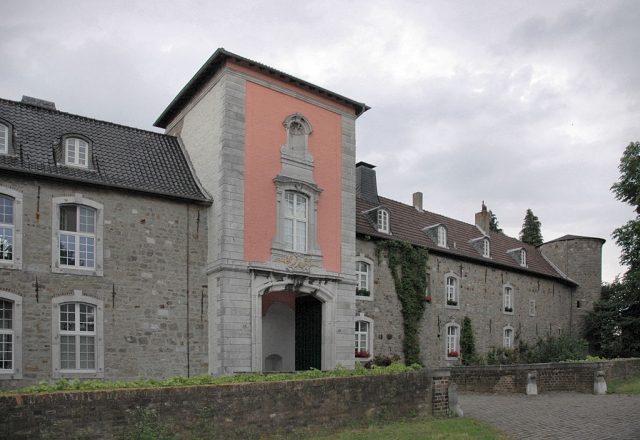
Gut Kalkofen was formerly one of the most important knightly estates in the Lower Rhenish-Westphalian Imperial Circle. The complex is located in today's Nordviertel of Aachen, surrounded by a nature reserve in the Wurm valley.
The complex originated from a manor house, first mentioned in documents at the beginning of the 14th century. Shot and burned in 1582 and subsequently rebuilt, Kalkofen came into the possession of the Aachen cloth manufacturer Johann von Wespien via the Ballhausen family and the copper masters Schardinel. He had the estate converted and expanded into a pleasure palace by Johann Joseph Couven from 1750 to 1753. After his death, it was repeatedly rented to well-to-do spa guests before it came into the possession of the Zurhelle family in 1831, who still own it today.
In the course of its history, the magnificent complex was visited several times by crowned European heads. For example, King Frederick IV of Denmark and Norway was a guest at Kalkofen several times in 1724, and between 1800 and 1804, Emperor Napoleon and his wife Joséphine stayed there. However, it is not certain whether the later Emperor Charles V actually stayed at Gut Kalkofen in 1531 on his way to the coronation of his brother Ferdinand I in Aachen Cathedral, or perhaps in another estate in the present-day area of Haaren.
Gut Kalkofen is a formerly enclosed four-wing complex, whose north side is now about half open. Its core dates back to the 15th/16th century, as evidenced by defensive elements such as loopholes and the remains of the once enclosed and water-filled moat on the south and west sides. Of the formerly four round corner towers, three are still preserved – albeit without their original spires. The most massive of them stands at the western corner and has two-meter-thick walls.
Access to the complex is provided on its southwest side by a three-story gate tower projecting from the wall line, to which a two-arched stone bridge leads. It was installed in 1750 instead of a wooden drawbridge. The front walls of the tower consist of gray-blue limestone for the corner quoins and red bricks, the latter being painted pink. The side tower masonry, like the outer walls of the entire southwest wing, consists of roughly hewn greywacke and coal sandstone ashlar. Above the segmental arch of the gate passage and thus on the sill of the tower window, the Wespien-Schmitz alliance coat of arms can be found, indicating the builders of the gatehouse: the Aachen mayor Johann von Wespien and his wife Anna Maria Schmitz. Above the window is a now empty saint's niche. The original, baroque tower spire with a clock gable and lantern was replaced after the Second World War by a flat, tiled pyramid roof. The tall gate tower overtops the otherwise only two-story southwest wing of the estate. Formerly, the tenant's apartment and stables were located there. The large segmental arch windows of the wing have bluestone surrounds and give the facade a uniform division.
The large round tower at the west corner is adjoined by the two-story manor house with a mansard roof. It is in the late Baroque Rococo style and has brick masonry. Above a high plinth story rises the raised ground floor. A six-step open staircase leads to the portal with a profiled frame and transom, which is not in the central axis of the building but slightly offset to the left. Its arched lintel is supported laterally by two volute-decorated consoles. At the level of the attic, a curved blind gable displays the alliance coat of arms of the Wespien and Schmitz families, supported by two lions. A high wall adjoins the manor house at its north corner, leading to the northern corner tower and dating back to the 15th century.
The area of the stately residence is separated from the farm buildings, which occupy the entire eastern part of the complex, by a wrought-iron gate between bluestone pillars crowned with vases. The farm buildings included a coach house, horse stables, and a large brick barn with a hip roof, behind which a baroque garden parterre once extended to the northeast.
The Beginnings
The estate was first mentioned in writing in 1305, when it was owned by the Aachen mayor Arnold von Kalkofen (Arnoldus de Kalkofen). His family came from the Duchy of Limburg, from the house Kalkofen near Raboitrade. The history of the complex during the following approximately 140 years is not documented. Only on March 27, 1437, is the estate mentioned again in the marriage contract of Adam (Daem) von Haren and his wife Agnes von dem Weyer. It is reported that the complex came from the possession of Adam's mother Mechtildis von Holzappel zu Täsch, the wife of Mayor Gerhard von Haren. After Adam's death, the couple's eldest son, Gerhard, took over the property in 1453. In 1458, he married Benigna von Kaldenborn, called von dem Birnbaum, and in 1459 was appointed Jülich Vogt and Meier in Aachen. His only son Wilhelm died in 1484 without descendants, and so Agnes von Haren, a sister of Wilhelm, inherited the estate. Agnes was married to Fetschyn Colyn, Lord of Linzenich, and had with him a daughter Anna, who married Junker Werner von Merode-Houffalize and brought him the property. After Werner's death on December 20, 1520, Kalkofen came via Richard von Merode-Houffalize in 1569 to his eldest son from his second marriage, the Imperial Baron Johann von Merode-Houffalize. As universal heir of his sickly niece Anna von Merode-Frankenberg, who died at the young age of 15, he also became Vogt of Burtscheid and owner of Frankenberg Castle in 1583.
Destructions
The period of the Aachen religious unrest did not leave Gut Kalkofen untouched. The Catholics' efforts to regain control of the Aachen city council, which was predominantly occupied by Protestants, brought Spanish troops into the Aachen region. A large contingent of Spanish soldiers occupied Gut Kalkofen. From there, they ambushed travelers on the great military road between Aachen and Cologne (today's Jülicher Straße). Since their raids threatened to permanently damage not only Aachen's trade but also its political relations, an Aachen militia besieged Gut Kalkofen on March 19, 1582, shelled it with three cannons, and finally burned it down. The Aachen chronicle of Johann Noppius from 1632 notes: "Anno 1582 Kalckoffen taken, set on fire and burned." The entire Spanish occupation is said to have been killed. According to legend, only a single soldier managed to escape through a secret passage that is said to have connected Kalkofen with Schönforst Castle.
Lord of the manor Johann and his wife were taken hostage to Aachen. Two years later, in 1584, he sold the ruin to the merchant Bartholomäus Schopfinger from St. Gallen. Schopfinger rebuilt it and bought additional lands. However, he had overextended himself financially and went bankrupt. Schopfinger sold the estate on April 22, 1600, for 50,000 Brabant guilders to his three brothers-in-law Karl Billehé (Billaens) and Ludwig and Martin Perez de Varon. Later, the Billehé family was the sole owner of the estate.
In the course of the Jülich-Cleves War of Succession, Emperor Rudolf II had the knightly estate taken possession of on March 25, 1609, by Archduke Leopold of Austria, Bishop of Strasbourg, and his mercenaries. Imperial soldiers were subsequently stationed there. In the same year, the governor of Düren and Palatine general Count Friedrich zu Solms-Rödelheim advanced against Kalkofen with over 1000 men and heavy artillery, besieged it at the end of the year, and was able to take it without much resistance.
Conversion to a Pleasure Palace
Karl Billehé's eldest daughter Charlotte had married Baron Johann Konrad von Ballhausen. Around 1666, the estate came into his possession during an inheritance division, and he took up residence there. On February 20, 1671, he sold it together with his son for 15,242 Pattakons to the copper master Gotthard Schardinel II. After the great Aachen city fire in 1656, he moved his copper works to Stolberg, where he bought a part of the dilapidated Dollartshammer, but he kept his residence at the knightly estate. In 1691, he gifted it to his son Gotthard Schardinel III for his wedding to Beatrix von Slype. After her death, the estate was for sale in 1748.
On March 27, 1749, the Aachen cloth manufacturer Johann von Wespien bought the buildings and the associated 170-acre land for only 19,000 Reichstaler. In the spring of the following year, he had parts of the complex demolished and commissioned Johann Joseph Couven to design and build a pleasure palace. Couven had already planned and built the magnificent and lavishly luxurious Wespienhaus in Aachen's Kleinmarschierstraße for Wespien from 1734 to 1737. In the conversion, he retained Kalkofen's almost square floor plan and incorporated older parts such as towers and enclosing walls into the new building. Couven only had the northern part of the northeastern ring wall demolished to open up the view from the manor house to a new garden parterre. New additions included an orangery and a large barn, "whose design is more suitable for drying cloths than for an agricultural building." The construction work lasted until 1753 and cost more than 100,000 Reichstaler. Because the farm buildings made such a distinguished and elegant impression after Couven's conversion, the complex earned the nickname "Palace Barn."
The marriage of Johann Wespien and his wife Anna Maria Schmitz remained childless, and so his widow appointed her cousin, the Aachen merchant and needle manufacturer Johann Kaspar Strauch, as heir. From his two marriages to two sisters from the von Collenbach family, he left several underage children upon his death, who were placed under the guardianship of Johann Kaspar's father-in-law, Imperial Baron Franz Rudolf von Collenbach. He tried in vain to find a solvent buyer for the estate. Instead, Kalkofen was rented from June 1790 to George Augustus Eliott, 1st Baron Heathfield, who wanted to heal his war injuries in the famous Aachen baths. However, he died on July 6 of the same year, possibly due to excessive consumption of the sulfurous Aachen thermal water, and was initially buried in the garden of the estate. Later, his body was transferred to England and buried there with great ceremonies. Remains of his tomb are still in the Kalkofen garden today.
In the following two years, the pleasure palace served as a domicile for distinguished spa guests several times during their stay in Aachen. During this time, however, nothing was done for the maintenance of the palace and its garden. This only changed when the cloth manufacturer Christian Friedrich Claus acquired the property on August 23, 1792, for 56,000 Reichstaler and subsequently made improvements and embellishments to the garden. After his death in March 1799, his widow continued these efforts.
Property of the Zurhelle Family
After the death of Christian Friedrich Claus's wife, Kalkofen initially stood empty, as none of the sons wanted to take it over. Finally, the Prussian Commercial Councillor and Deputy Mayor of Aachen, Wilhelm Zurhelle (also zur Helle), bought it on December 6, 1831, for 47,100 Thaler and fundamentally renovated it. His eldest son, of the same name, took over the property in 1849. When he died childless, Kalkofen came as an inheritance to his nephew of the same name, whose family resided at Haus Schurzelt in Laurensberg.
At the beginning of the 20th century, 570 acres of land belonged to the estate. During the Second World War, its buildings were severely damaged in 1944 and burned down except for some parts of the outer walls. Wilhelm's son and his wife Maria Louise – also named Wilhelm – took over the property after the war and, together with his wife Elsbeth, began the reconstruction in simplified forms. This first step was completed by 1956, with rental apartments created in some buildings. The couple also began the gradual restoration of the baroque park. To this day, Gut Kalkofen remains the property of Wilhelm Zurhelle's descendants, who had the last renovation and securing works on the complex carried out between 1983 and 1989.
Take Mobile History with you
You are reading this text for free. Premium adds what matters on the road: descriptions read aloud, sites found through your camera, whole regions taken offline.
- Every description, including the ~17,700 Premium sites
- Audio guide: have descriptions read to you on location
- AR finder: see sites through your camera, with distance and bearing
- Unlimited saved sites
14 days free, then from €2.99 a month. Cancel anytime.
Source: Wikipedia · Licence: CC BY-SA 4.0 · Image: http://de.wikipedia.org/wiki/Datei:Gut_Kalkofen_Eingangsfront_02.jpg
This description draws on the facts documented in the linked Wikipedia article; Wikipedia content is licensed under CC BY-SA 4.0. Wording and editing: Mobile History.
Location: 50.7838, 6.1167