To be privately owned
CastleRiegersburg
Riegersburg Castle
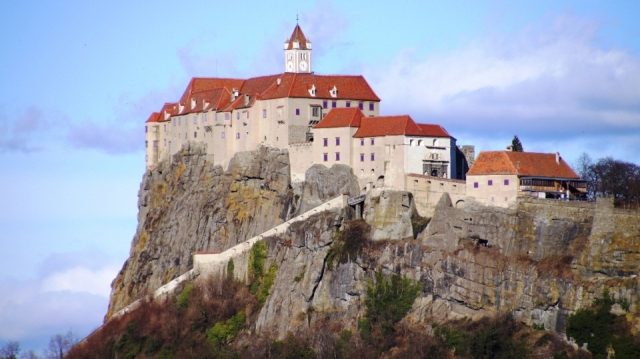
In 1122, Rüdiger von Hohenberg established a stronghold at the site of the present-day Hochburg, which was first mentioned in 1138 as "Ruotkerspurch". The Riegersburgers later took up residence at Wildon Castle and named themselves after it. They owned the castle until 1249. They were followed by the related Khuenring-Dürnstein family.
The plateau sloping to the south already bore two castles in the Middle Ages: the Hochschloss Kronegg and, to its south, the lower-lying Lichteneck Castle, which was built around 1140 by Margrave Otakar III, the sovereign of Styria. But by 1301, both complexes belonged to Ulrich von Wallsee-Graz, who had owned the upper castle for two years already.
In 1412, the castle was forced to capitulate by Duke Ernst the Iron after a short siege. However, Reinprecht von Wallsee regained the castle in 1417. Due to the bad experiences of 1412, he had the "Eselssteig" (Donkey's Path) carved into the rock. With the extinction of the Wallsee family, the dominion reverted to the sovereign. Emperor Friedrich III enfeoffed Reinprecht von Reichenburg with the vast dominion in 1478. While the surrounding area was subsequently devastated repeatedly in the Baumkirchner Feud, and also by the Hungarians and Turks, the castle itself was never besieged again after 1412.
In 1571, the dominion passed by marriage to Erasmus von Stadl, who extensively rebuilt and expanded Kronegg in the Late Renaissance style. However, high debts forced him to sell it in 1618 to the wealthy Georg Christoph von Ursenbeck. Through marriage, the property came into the possession of Seyfried Freiherr von Wechsler from Radkersburg in 1637. He eventually bequeathed it to his sister, Katharina Elisabeth von Wechsler, married Freifrau von Galler, and to his uncle Siegmund. When the latter died in 1648, the "Gallerin" was the sole owner. In view of the constant threat to Eastern Styria from the Turks, she had the fortifications expanded at great cost. During the construction work, the lower castle was demolished. The stones obtained were used as building material for the new bastions and defensive walls.
The development of Riegersburg into the "strongest fortress in Christendom" was completed in 1685 by her son-in-law, Johann Ernst Graf Purgstall. On the south side of the mountain plateau, he erected a magnificent defense system with nine bastions and five freestanding barrier gates, which made the castle practically impregnable at the time. With Wenzel Raphael Graf Purgstall, the family died out in 1817. After the death of the last Riegersburg representative of this family, 17 people shared the inheritance. In 1822, Johann I Prince of Liechtenstein bought the castle and dominion. At the end of the Second World War, the castle was severely damaged by shelling. The devastation was repaired by the Liechtenstein family in the following years.
Take Mobile History with you
You are reading this text for free. Premium adds what matters on the road: descriptions read aloud, sites found through your camera, whole regions taken offline.
- Every description, including the ~17,700 Premium sites
- Audio guide: have descriptions read to you on location
- AR finder: see sites through your camera, with distance and bearing
- Unlimited saved sites
14 days free, then from €2.99 a month. Cancel anytime.
Source: Wikipedia · Licence: CC BY-SA 4.0 · Image: http://www.wehrbauten.at
This description draws on the facts documented in the linked Wikipedia article; Wikipedia content is licensed under CC BY-SA 4.0. Wording and editing: Mobile History.
Location: 47.0047, 15.9325