The Castle can be visited
Museum
ResidenceEllingen
Residence Ellingen
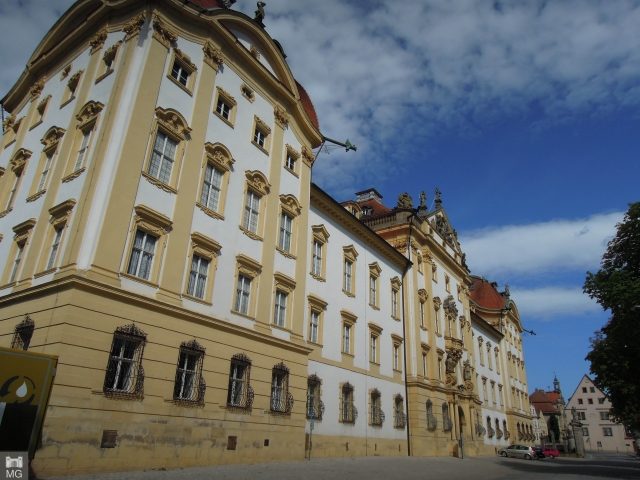
Ellingen Residence is a castle in Ellingen in the Central Franconian district of Weißenburg-Gunzenhausen.
From 1216 to 1789, Ellingen was the residence of the Landkomtur of the Bailiwick of Franconia of the Teutonic Order. The current castle complex, built from 1708 to about 1760, was preceded by several medieval buildings and a Renaissance structure. The current main building was constructed between 1717 and 1721 by the architect Franz Keller according to plans by Wilhelm Heinrich Behringer under the direction of Karl Heinrich von Hornstein. Various ceiling paintings, wall paneling, and floors, as well as stucco by Franz Joseph Roth, are preserved from this period. The colonnades in the inner courtyard were added during the renovation by Pierre Michel d’Ixnard around 1775. In 1815, King Maximilian I Joseph handed the castle over to his field marshal Prince Carl Philipp von Wrede, who had some rooms furnished with silk and paper wallpapers, as well as furniture, glass, and bronze figures from Paris. Around 1939, the castle was sold by the von Wrede family to the Bavarian state. It is now maintained by the Bavarian Palace Administration, which carried out many preservation measures around 1990, such as the gutting of the attics and the renovation of the foundations.
Usage+
Contemporary showrooms are housed in the main wing and part of the east wing of the castle. The west wing is home to the East Prussia Cultural Center with its permanent and special exhibitions. The castle church, Gothic in its core and thoroughly baroqueized in the 18th century by Franz Keller, Franz Joseph Roth, Franz Xaver Feuchtmayer, and Matthias Binder, with around 300 seats, as well as the inner courtyard, are used several times a year for concert performances. The church can also be rented for weddings.
The other part of the east wing is uninhabited; the descendants of the former owner Carl Philipp von Wrede have residential rights there.
The Rentamt (estate office) is located in the manor farm behind the castle, from which the brewery, the lands, and the tree nursery of the von Wrede family are managed. Partially, the stables are used for horses, a painting school is set up in some rooms, and Sophie Baroness and Erwein Freiherr von Aretin, the seniors of the current von Wrede family, lived in the building next to the Brühltor, which was destroyed in World War II.
A view of the castle park from 1726 shows the ideal image of a baroque garden. In the 19th century, it was transformed into an English landscape garden, numerous tree species were planted, and a garden pavilion was erected. It was partially destroyed in World War II; today, only a balustrade remains as park architecture. Besides the old and species-rich tree population, including a 200-year-old ginkgo, the blooming of the glory-of-the-snow (Scilla bifolia) at Easter is remarkable. The park is now three hectares in size and is maintained by the Bavarian Administration of State Palaces, Gardens and Lakes.
Take Mobile History with you
You are reading this text for free. Premium adds what matters on the road: descriptions read aloud, sites found through your camera, whole regions taken offline.
- Every description, including the ~17,700 Premium sites
- Audio guide: have descriptions read to you on location
- AR finder: see sites through your camera, with distance and bearing
- Unlimited saved sites
14 days free, then from €2.99 a month. Cancel anytime.
Source: Wikipedia · Licence: CC BY-SA 4.0 · Image: Mobile Geschichte
This description draws on the facts documented in the linked Wikipedia article; Wikipedia content is licensed under CC BY-SA 4.0. Wording and editing: Mobile History.
Location: 49.0612, 10.9657