Resturant
CastleSulzfeld
Ravensburg Castle
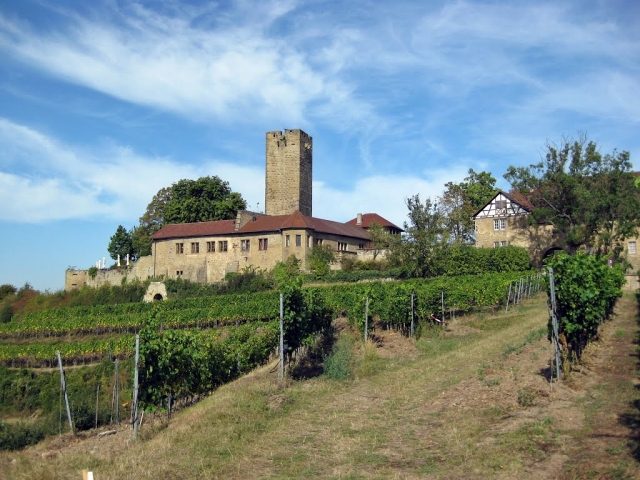
Ravensburg Castle is the former ancestral seat of the Barons Göler von Ravensburg and is one of the most important surviving castles in the Kraichgau region in northwestern Baden-Württemberg. It is located near the village on the territory of the municipality of Sulzfeld in the far northeast of the Karlsruhe district, which is adjacent to the town of Eppingen.
Ravensburg Castle stands about 1.3 km east of the center of Sulzfeld on the 285.8 m above sea level peak of a western spur of the Kohlbach valley, separated by a small saddle, whose base it overlooks by more than 80 m. Except on the northeast side, it is surrounded by vineyards everywhere.
The Period of Origin
A 17th-century chronicle of the Göler family dates the start of construction to around 930 and names a knight Rabanus as the builder and lord of the castle, who is now considered a legend. However, this may refer to an earlier castle or original residence of the Lords of Sulzfeld, which Knauer suspects was in the area of the village. Presumably commissioned by Emperor Frederick II, the important imperial ministerialis Ravan von Wimpfen, mentioned in 1190 and descended from the v. Sulzfeld family (see the ancestry of the Lords of Helmstatt, a collateral line of the Göler), together with his sons Dieter, Ravan, Heinrich, and Conrad, built "Ravan's Castle" consisting of the present keep, as well as residential and farm buildings and an enclosing wall with a gate on the east side, between 1220 and 1222. It served the v. Sulzfeld family as their ancestral seat, after which they also named themselves and a short time later adopted the name "Golere von Ravansburg". The ownership relations between Sulzfeld and Ravensburg at that time are still unclear. However, a document testifies that Ravensburg was at least partially allodial property of the Göler von Ravensburg in 1364. The brothers Albrecht I and Berthold IV transferred their share of Ravensburg, including its appurtenances, to Count Wilhelm II of Katzenelnbogen and received it back from him as a fief. A part of the castle, estimated at one third, was later also enfeoffed to the Counts of Oettingen, who were also the feudal lords for the greater part of the village of Sulzfeld. The family of Crenberg (Erenberg) appears as a vassal of the Counts of Oettingen's share of Ravensburg. In 1425, Ravensburg, including the Oettingen part, was completely enfeoffed to various branches and collateral lines of the Göler von Ravensburg family. After that, the family was almost threatened with extinction due to many deaths on the battlefields. Only through a papal dispensation could the canon of Speyer, Martin Göler, be released from spiritual service. He soon married Anna von Hirschberg and secured the continuation of the family with four sons, which was reflected in lively building activity at Ravensburg in the second half of the 15th century. Thus, in the east, presumably in 1467, another outer gate with a pedestrian gate was built, each with drawbridges. Very probably also a closed second enceinte with shell towers at the most important points. In 1486, according to Oechelhaeuser, a building west of the keep was erected by Georg I, of which today only an accessible cellar remains. In 1502, Albrecht V Göler von Ravensburg, son of Martin, was enfeoffed with Ravensburg for himself and his nephew Bernhard I.
Time of the Reformation
In the course of the Reformation, Sulzfeld also became Protestant very early in 1522. Ravensburg Castle survived the Peasants' War in 1525 unscathed. However, in 1531, the Protestant Schmalkaldic League was formed, and one of the main leaders of the League was the feudal lord of Ravensburg, Landgrave Philipp of Hesse (the original feudal lords, v. Katzenelnbogen, had already died out by this time). Finally, war broke out between the League and the Emperor, and Ravensburg Castle was besieged by imperial troops on December 24, 1546. The castle defenders, consisting of Bernhard I and his family, four mercenaries, some servants, and about 20 peasants, had to surrender after a few days, and Bernhard I was allowed to leave with his family under free conduct. Subsequently, the castle was plundered and devastated, of which many traces of a large fire still bear witness today.
The Reconstruction
Afterwards, Bernhard I carried out extensive reconstruction and conversion of Ravensburg into a modern fortress. Strong gun towers were built in the northeast and southwest, one of which is still preserved today and has three defensive levels. It is very likely that these towers were roofed. Even today, an underground casemate-like passage leads north, or later northeast, from the preserved defensive tower. The excavation material from this was used to build an embankment 15 meters from the outer wall. This structure is considered the only preserved underground defensive passage in the Kraichgau. Once, the passage connected all important defensive points, such as gates, gun towers, defensive walls, etc., and also allowed quick access to the viewing platform on the keep via a stair tower. Also, during that time, the enclosing wall with defensive facilities, the significantly enlarged outer bailey, and certainly also farm and possibly residential buildings were built. The still existing, presumably once 45-meter-deep, but no longer water-bearing well, must also have been built at the latest at this time.
A few years after Bernhard I Göler von Ravensburg had regained the castle and begun the repair and reconstruction work, he died without leaving male descendants. Thus, his property, including the castle, fell to his relatives Bernhard II and Hans III. Knauer assumes that they too were still busy with the elaborate conversion and expansion of the castle into a fortress, although elsewhere more emphasis was already placed on representation than on defensibility. The following generation with David III, Engelhard I, and Hans Friedrich from about 1600, then had some of the previously erected strong defensive structures torn down again to make room for a large representative residential building for Hans Friedrich and his wife Katharina von Mentzingen, as well as two large wine cellars and farm buildings. Around the same time, the middle castle in Sulzfeld was built for Engelhard I and his wife Anna Maria von Mentzingen. According to Knauer, presumably in the area of the old castle, which served the v. Sulzfeld family as their ancestral seat until the construction of Ravensburg. Due to the strong building activity and the associated burdens for the Sulzfeld population, there were several uprisings against the building-loving castle owners. However, this did not stop the building activity. In 1617, a letter of complaint with 221 grievances was even written about this.
The Decline
Although Ravensburg Castle probably survived the Thirty Years' War without significant damage, of the three building-loving castle owners, only Engelhard I survived the catastrophe. Later wars also caused no damage to the castle. In 1806 and 1822, Benjamin Göler von Ravensburg had two dilapidated residential buildings demolished. The last inhabitant of the castle was Johann Friedrich III Göler von Ravensburg. After his death in 1849, according to Knauer, the castle must have been "literally stripped" as a quarry in the second half of the 19th century, as it was already described as a ruin by Naeher in 1885. Since the 1950s, the remaining parts of the castle have been secured and a restaurant has been established.
Layout+
Ravensburg Castle
The complex is divided into the actual core castle, surrounded by a mighty moat and located on the village side, with a keep, defensive towers, and residential buildings, and the younger outer bailey, located on the mountain side, with farm buildings.
The castle is accessible, the keep can be climbed during the day and offers a unique view over the wide landscape of the Kraichgau. A wedding chapel was set up in one of the impressive historic cellars in the summer of 2006.
For the castle, there is a request stop on the Kraichgaubahn about one kilometer to the north. Trains of the Karlsruhe Stadtbahn stop there for registered travel groups.
Ravensburg Castle Winery
The Ravensburg Castle Winery in Sulzfeld has been documented since 1251 and is thus one of the oldest German estates. Until 2009, it was managed under Baron von Göler's administration. At the beginning of 2009, Heitlinger GmbH leased the Sulzfeld winery from the widely branched Göler community of heirs. Due to financial problems and disputes within the community of heirs, they offered the Sulzfeld winery, including the Göler's rent office in Sulzfeld, for sale to Heinz Heiler, the owner of Weingut Heitlinger GmbH, at the end of 2010. The purchase price was approximately seven million euros.
The Ravensburg Castle Winery has 33 hectares of cultivated land, produces 260,000 bottles per year, and limits the yield to 58 hl/ha. The grape varieties Riesling (30%), Lemberger (20%), Schwarzriesling (15%), Spätburgunder (15%), Weißburgunder (6%), Grauburgunder (5%), Trollinger (5%) are cultivated and harvested by hand. The soils are mineral-rich Keuper soils.
The top wines with the additional designation "Großes Gewächs VDP Baden" come from the top sites of Ravensburg Castle Winery, namely "Husarenkappe" (on the castle hill), "Löchle" (in a depression of the castle hill), and "Dicker Franz". The term "Großes Gewächs" is based on the French classification Grand Cru.
The "Dicker Franz" site owes its name to Baron Franz Göler von Ravensburg (1701 to 1765). He was very fond of culinary delights and went down in the family annals as the "Fat Lord". Not only the former castle building at the keep of Ravensburg, but also his favorite vineyard were named after him. The name today stands for powerful Lemberger wines.
The name of the "Husarenkappe" site goes back to Baron Benjamin Göler von Ravensburg, Major in the Baden Hussar Regiment (1782-1834). Legend has it that he received Riesling cuttings from his supreme commander, Margrave Karl-Friedrich von Baden, which he brought to Sulzfeld in his cap to plant on the castle hill.
The "Löchle" site is located in the south-exposed part of the castle hill. The vineyards are partly terraced, partly they have a slope of up to 40%. The special feature of the site, to which it also owes its name, is a natural kettle-shaped incision in the terrain. This depression ensures that the two hillside flanks protect the site from cool winds and that a particularly warm microclimate, ideal especially for Burgundy varieties (Pinot Blanc, Pinot Gris, and Pinot Noir), can develop there.
In addition, there are wines from the "Burg Ravensburg" site from Keuper soils around Ravensburg Castle. Furthermore, vineyards from the Sulzfeld district and the surrounding hilly country on Keuper and loess soils are also cultivated. These are marketed under the designation "Freiherr von Göler" without further site designation.
Take Mobile History with you
You are reading this text for free. Premium adds what matters on the road: descriptions read aloud, sites found through your camera, whole regions taken offline.
- Every description, including the ~17,700 Premium sites
- Audio guide: have descriptions read to you on location
- AR finder: see sites through your camera, with distance and bearing
- Unlimited saved sites
14 days free, then from €2.99 a month. Cancel anytime.
Source: Wikipedia · Licence: CC BY-SA 4.0 · Image: Armin S.
This description draws on the facts documented in the linked Wikipedia article; Wikipedia content is licensed under CC BY-SA 4.0. Wording and editing: Mobile History.
Location: 49.1000, 8.8742