To be privately owned
CastleFeucht
Pfinzing Castle
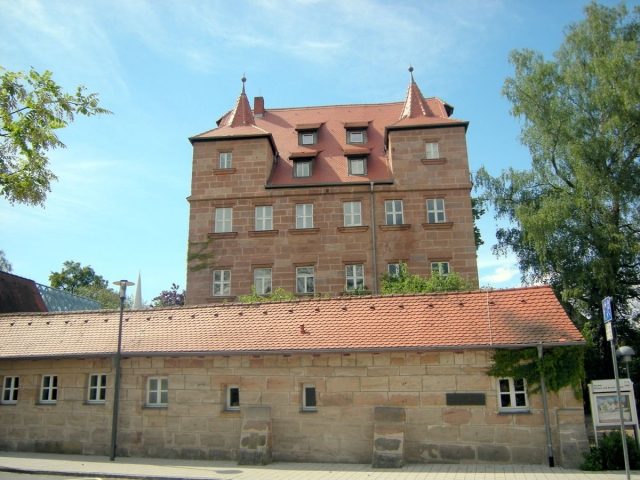
The Pfinzingschloss or Schloss Mornek is, alongside the Tucherschloss and the Zeidlerschloss, one of three preserved castles in Feucht. The castle has been owned and used by the market town of Feucht since 1988. The entrance hall is also used for concerts and art exhibitions.
Although local historians have suggested a ministerial seat at this location as early as the 13th century, the so-called Pfinzingschloss has only been documented since the 15th century. In 1469, the residence of Ludwig Pfinzing was mentioned when he sold his Feucht properties to the Imperial City of Nuremberg. The Nuremberg patrician had acquired the properties through his marriage to a Waldstromerin in 1455. The Waldstromer family, which at times held the Imperial Forester dignity, had acquired several Feucht properties in the 14th century.
The Nuremberg Council soon sold the manor after its acquisition to the council consultant Dr. Sebald Müller, who owned it until his death in 1495. Under his descendants, the Pfinzingschloss, along with the village of Feucht, fell victim to the Landshut War of Succession in 1504. It was not until shortly before 1520 that Gabriel Nützel, who also inherited the "Schloss im Kartäuserweiher," acquired the burnt ruin, but he ceded it to a Bernhard Glotz. The new owner must have started reconstruction soon after his purchase: in 1521, there is already mention of "Glotz's newly built house and manor." But already in 1530, it was sold to the Nuremberg citizen Hanns Pfann and his stepson Christof Mordeisen, and only shortly thereafter to Kaspar Koberger.
Koberger experienced the second destruction of the seat on May 16, 1552, during the Second Margrave War. In 1557, Koberger asked the Council for permission to sell the "Burgstall" with the burnt ruin. The patrician Georg Tetzel, born in 1529, appeared as a buyer. He married in 1558 and apparently carried out the reconstruction of the Pfinzingschloss in the following decade. The year 1568 on a coat of arms depiction on the ground floor likely documents the completion of the construction work.
In 1585, Georg Tetzel sold the new castle to Anton Pfann and Alexander Rosenthaler, apparently property speculators, who sold it in 1586 to the merchant Eustachius Unterholzer. He later bequeathed it to his son of the same name, who was succeeded in 1616 by his grandson Tobias Unterholzer. During the Thirty Years' War, he repeatedly had to endure the manor being occupied, plundered, and its furnishings demolished. After the death of Tobias Unterholzer, the guardians of his still underage son sold the seat in 1650 to Friedrich Otto Freiherr von Herberstein, who, as a Protestant, had been forced to leave his homeland Carinthia. However, the Baron was in such difficult economic circumstances that he largely remained indebted for the purchase price. The property therefore reverted to the Unterholzer family after some legal disputes.
In 1677, the Imperial City of Nuremberg again bought the manor, after Eustachius Karl Unterholzer had been unable to find a buyer from Nuremberg. In 1682, council consultant Dr. Christoph Gottlieb Scheurl von Defersdorf took over the property. He had two towers of the defensive wall, the one on Steingasse and the rear one on Schlosswiese, demolished. At that time, the manor also included a gardener's house and a gatehouse, as well as various agricultural outbuildings. In 1712, small sheds for storing tobacco and fodder were built on the grounds of the two former wall towers.
After the death of the council consultant, Christoph Gottlieb Scheurl Jr. followed in 1713, Karl Wilhelm in 1764, and again a Christoph Gottlieb Scheurl von Defersdorf in 1793. By this time, the name "Schloss Mornek" had already emerged for the seat. According to Wilhelm Schwemmer's research, two contradictory explanations for the origin of the younger castle name were in circulation: on the one hand, Georg Tetzel is said to have already called his new building Schloss Mornek, while according to another story, a Bohemian merchant named Morne is said to have once lived in the castle.
The seat remained with the family until the death of Christoph Gottlieb Scheurl in 1823. It then passed to his daughter, who had married the postal expediter David Friedrich Wild, and shortly thereafter to the grandson Gottlieb Friedrich Wild, who sold the manor in 1847 to Magdalena Schwemmer. Several speculative changes of ownership followed until Georg Konrad and Barbara Elise Schmidt acquired the property in 1876. Their daughter Helena and son-in-law Friedrich Scherrbacher took it over in 1887 and set up a small factory in the castle. Around 1900, however, Scherrbacher had to declare bankruptcy, and the Nuremberg stucco business Otto Schier acquired the property through forced auction. The company soon exchanged the manor for a Nuremberg property, and numerous changes of ownership followed again. In 1943, the space pioneer Hermann Oberth acquired the castle. In 1988, it was sold to the market town of Feucht, which immediately had it renovated.
The manor house built by Georg Tetzel features sandstone ashlar enclosures. In the early modern period, the ground floor consisted of a large paved hall, a milk vault, and a fruit vault. On the first floor were two parlors and two chambers, as well as a kitchen; another hall with a large Soller (forecourt) and two chambers was on the second floor. Above the house entrance on the inner side, two coats of arms with the year 1568 commemorate the builder Georg Tetzel, his first wife Barbara Fütterer, and his second wife, Magdalena Pfinzing. In 1682, the walled courtyard still contained a single-story house for the gatekeeper, a draw well, a two-story annex with rental apartments, a garden house, the castle barn, and the stables.
From 1943 to 1988, the castle belonged to the Oberth family. Even during Hermann Oberth's lifetime, a Hermann Oberth Space Travel Museum was housed on the ground floor of the castle, which is now located in an annex building.
Take Mobile History with you
You are reading this text for free. Premium adds what matters on the road: descriptions read aloud, sites found through your camera, whole regions taken offline.
- Every description, including the ~17,700 Premium sites
- Audio guide: have descriptions read to you on location
- AR finder: see sites through your camera, with distance and bearing
- Unlimited saved sites
14 days free, then from €2.99 a month. Cancel anytime.
Source: Wikipedia · Licence: CC BY-SA 4.0 · Image: http://schloesserrundschau.de/bayern/schloesser01/nuernbergland002.html
This description draws on the facts documented in the linked Wikipedia article; Wikipedia content is licensed under CC BY-SA 4.0. Wording and editing: Mobile History.
Location: 49.3752, 11.2117