To be privately owned
CastleWendelstein
Pfinzing Castle
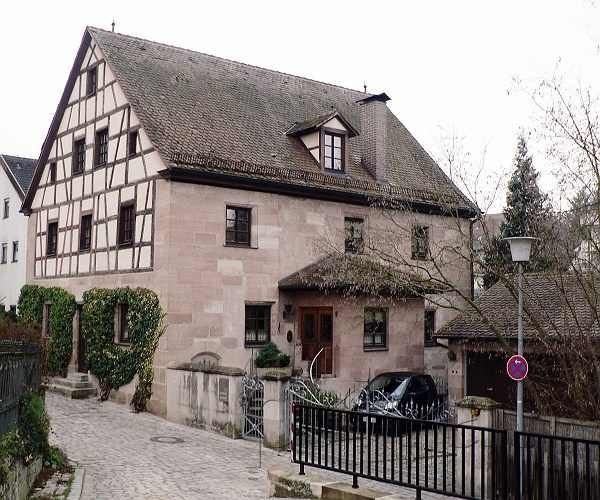
The manor house in the former Mühlstraße could, if an allegedly structural inscription is correct, date back to the year 1499. A second dating with the year 1564 on the east side probably indicates a renovation or repair. The manor house was sold in 1513 by the Nuremberg citizen Magdalena Grüner to the merchant Bruno Engel, who two years earlier had been elected to the Greater Council in Nuremberg. In 1518, the new owner granted the imperial city the right of entry in case of war. In 1530, Engel, who had acquired Schloss (Ober-)Wolkersdorf near Schwabach the year before (he owned it until 1541), sold the seat and other Wendelstein properties to Marx Pflaum the Elder; from an unnamed further owner, the inheritance right passed in 1550 to the rich Nuremberg merchant Christoph Schlaudersbach and his wife Barbara. Whether the house was damaged during the invasion of margravial troops in the Second Margrave War on May 15, 1552, is uncertain, as the damage lists "only" record a looting.
Already before the middle of the 16th century, the seat was no longer inhabited by the lord of the manor, but was granted as a hereditary lease, i.e., the owner, like most farmers, was obliged to pay an annual rent. In 1590, Leonora, the widow of Carl Pfinzing, was the lord of the manor; at that time, Bonaventura Hegner sold the inheritance of the seat and manor house, including the timber felling and rented houses located down on Mühlgasse, to the merchants Pankraz Henn and Georg Ringler. Leonora's son Seyfried Pfinzing bequeathed most of his considerable fortune, including his estates in Wendelstein, to the charitable foundation named after him, which is why the house name "Pfinzingschlösschen" became established. The administration of the foundation was taken over by his nephew Sebastian Scheurl.
The owner at that time was Sigmund Rosenberger, who in 1619 sold his inheritance right to the Nuremberg merchant Hans Rumpler. The manor house was dilapidated at the time, so a renovation was probably imminent for the buyer. In 1712, the Nuremberg citizen Johann Michael Engelhardt appears as owner and liegeman of the foundation, in 1740 the tailor Johann Friedrich Ernst Engelhardt, and in 1762/64 Johann Lorenz Franz. In 1800, the Köbler (smallholder) Stephan Abraham took over the "Schlößlein or manor house" from his in-laws, the Wolfgang Sturm couple, along with accessories for 1,500 guilders. At that time, the seat with its garden reaching to the Schwarzach was still surrounded by a massive enclosure. Around 1802, a small barn was added to the courtyard wall. In the 20th century, a shop of the consumer cooperative was housed in the manor house for a long time; it is now used as a residential building.
According to a pen drawing by J. L. Dorst von Schatzberg, the building still presented the appearance of a typical Nuremberg manor house in 1836: it appeared like a residential tower with a projecting attic floor with a knee wall, with continuous dormer windows on the north and south sides, each bearing pointed helmets at the corners of the house. Whether these really "pierced" the hipped roof in the depicted manner is beyond verification. This picturesque appearance was lost in an undated fire. Roof, gable, and other half-timbered constructions were renewed. The regular fenestration of the restored exterior walls and the structural half-timbering on the east side of the upper floor point to the 19th century. Heinrich Schlüpfinger stated that the house lost much of its former appearance during a further construction measure around 1950.
Take Mobile History with you
You are reading this text for free. Premium adds what matters on the road: descriptions read aloud, sites found through your camera, whole regions taken offline.
- Every description, including the ~17,700 Premium sites
- Audio guide: have descriptions read to you on location
- AR finder: see sites through your camera, with distance and bearing
- Unlimited saved sites
14 days free, then from €2.99 a month. Cancel anytime.
Source: Wikipedia · Licence: CC BY-SA 4.0 · Image: http://www.herrensitze.com/wendelstein-iii.html
This description draws on the facts documented in the linked Wikipedia article; Wikipedia content is licensed under CC BY-SA 4.0. Wording and editing: Mobile History.
Location: 49.3565, 11.1426