Museum
CastleFürstenfeld
Pfeilburg Castle
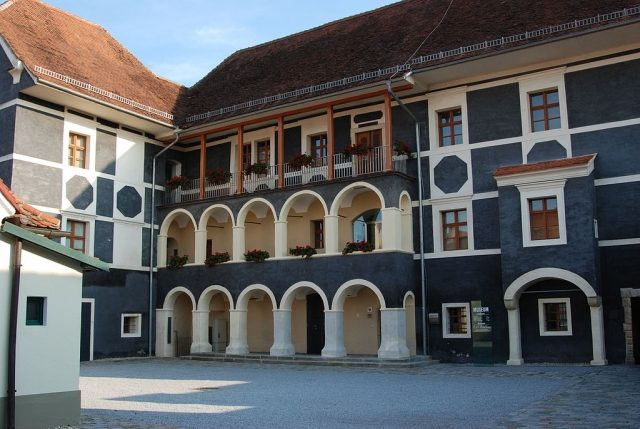
Pfeilburg is one of the oldest preserved secular buildings in the city. The core of the building is one of the oldest preserved medieval residential towers in Styria. This tower, also known as "Schwarzturm" (Black Tower), was probably the most significant tower in Fürstenfeld's city wall. Dating back to the 13th century, it protruded slightly beyond the wall line into the city moat and reinforced the old city wall.
During the construction of the modern fortress in the 16th century, according to the plans of the Italian Domenico dell' Allio, it was incorporated. The castle belonging to the tower was the stately residence of the owners enfeoffed with the care of the tower. The large two-story building forms the L-shaped Pfeilburg in its form preserved to this day. Due to the nearby bastion, the castle was protected as much by the wall and moat.
The expansion in this form took place in the 16th and 17th centuries. A Renaissance bay window, a beautiful entrance portal, and two-story pillar arcades are noteworthy on the exterior facade. Inside, there are several beautiful stucco ceilings, wonderful vaults, a smoke kitchen, and a consistently remarkable room layout. The name comes from Hans Pfeilberg, one of the first owners who acquired the property in 1490 and began its reconstruction after the Hungarian invasion of 1480. Various owners followed. Maximilian Ruepp and Jonas von Wilfersdorf are the best known among them. In the 16th century, Pfeilburg was a nobleman's seat exempt from taxes, which included the right to serve wine. In 1664 (Battle of Mogersdorf / Szentgotthárd), the fortifications located southwest of Pfeilburg – the so-called "Kavalier" – were reinforced according to the plans of the Imperial War Council. This was intended to additionally protect the fortress wall and to reach the hills west of the city with artillery.
In 1691, Johann Christoph Liscutin bought the building, established Austria's first tobacco factory here, and thus made an important decision for the city's economic life that lasted into the 20th century. In 1725, the city acquired Pfeilburg and housed a "Normalschule" (standard school) there from 1782 onwards. In the 19th and 20th centuries, it was finally used as a barracks (factory barracks), military hospital, poorhouse, and prisoner-of-war camp. Afterwards, there was no suitable use for the building, and it increasingly fell into disrepair.
Since the 1970s, the Fürstenfeld Museum Association has been working on its renovation, preservation, and revitalization. With donations and public funds, the roof truss, roof covering, and the restoration of the bay window and archway could be financed during this period, thus preserving the existing structure.
Revitalization
After decades of efforts by the Museum Association, the city council began the complete revitalization of Pfeilburg in 1996. The renovation, which was carried out with the help of state and federal subsidies, cost approximately 1.8 million Euros. The majority of the financial resources flowed into the preservation of the listed substance of the building. Stucco ceilings inside the building were freed from old layers of paint under the supervision of a restorer. For static reasons, the brick pavement from the attic area was removed, cleaned, and re-laid on the lower floors. Damaged plaster surfaces were chipped off the exterior facade.
Considering old construction methods, new lime plaster was applied and given a fresco coloring. All plasterwork was made diffusion-open due to possible rising damp. The walls, some up to two meters thick, were grouted with lime wash to consolidate them. Two collapsed ceilings were closed with concrete ceilings, and a new wooden beam ceiling was installed in the attic to relieve the existing wooden ceilings. Finally, the inner courtyard of the complex and the area up to the Kavalier were redesigned, and the immediately adjacent city wall was renovated.
Take Mobile History with you
You are reading this text for free. Premium adds what matters on the road: descriptions read aloud, sites found through your camera, whole regions taken offline.
- Every description, including the ~17,700 Premium sites
- Audio guide: have descriptions read to you on location
- AR finder: see sites through your camera, with distance and bearing
- Unlimited saved sites
14 days free, then from €2.99 a month. Cancel anytime.
Source: Wikipedia · Licence: CC BY-SA 4.0 · Image: http://commons.wikimedia.org/wiki/File:Pfeilburg_fuerstenfeld.JPG?uselang=de
This description draws on the facts documented in the linked Wikipedia article; Wikipedia content is licensed under CC BY-SA 4.0. Wording and editing: Mobile History.
Location: 47.0497, 16.0758