The church can be visited
ChurchGreßthal
St. Bartholomäus Church
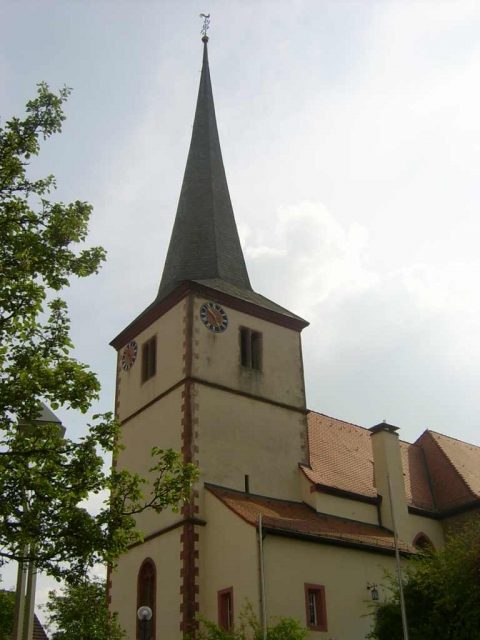
The parish church of St. Bartholomew in Greßthal is one of the oldest church complexes in the Diocese of Würzburg. It originated as a proprietary church of the Counts of Schweinfurt and received the status of an arch-parish in the 15th century. In the 1920s, plans began for an imposing reconstruction, which could not be fully realized. Today, it holds an important position as it houses early frescoes by Alois Bergmann-Franken.
First Structure+
Christianization began in Greßthal around the year 600 through the Franks. The missionaries erected a first cross here at the former pagan cult site. In 680, the first church was built. A Frankish itinerant bishop consecrated it to Saint Matthias at that time. The Counts of Schweinfurt founded the first parish in the 8th century. This was endowed with a large parish estate, which had very high regional significance.
Since 804, Greßthal was assigned to the Fulda Monastery. In the 12th century, the Fulda abbots expanded the parish church into a fortified church (the fortifications were removed in 1601 and 1749 respectively). After numerous disputes between the Abbot of Fulda and the Bishop of Würzburg, Greßthal passed into the possession of the Prince-Bishopric of Würzburg in 1376.
Change of Patronage+
On All Saints' Day 1443, Bishop Gottfried IV. Schenk von Limpurg elevated Greßthal to an episcopal arch-parish. Now, a canon appointed by the bishop governed Greßthal and its filial churches as arch-pastor. The entire arch-parish was his property for life. The first arch-pastor of Greßthal, Eberhard von Grumbach, renovated the interior of the parish church. He then installed Saint Bartholomew as the patron saint. In the middle of the 15th century, many churches were dedicated to the patronage of the Holy Apostle Bartholomew.
Renovations by Julius Echter+
The next major construction measure followed under Prince-Bishop Julius Echter, as part of his Counter-Reformation in the Reichtal. Initially, a new sacristy was built north of the tower. After its completion in 1601, the new late Gothic baptismal font was placed in it. The also late Gothic sacrament niche was walled into the wall. The church received large pointed arch windows. The defiant fortifications around the parish church were largely removed during this renovation phase. A painter from Gerolzhofen decorated the interior with ornaments from 1610 to 1612. In the flat wooden ceiling of the nave, pictorial scenes from the life of Christ were created. It was the same painter who had previously reframed the altars in the Marienkapelle in Rütschenhausen. The choir in the basement of the tower remained largely structurally unchanged. Only the choir arch was raised, and a new window was added to the east side. After the completion of the interior renovation, the tower was raised from 1612 to 1614 and provided with the massive, typical Echter spire. The consecration took place on St. Martin's Day 1614.
Baroquization+
The baroquization of the parish church began in 1749 under parish vicar Johann Sigismund Kilian. The steep slope behind the parish church was removed. After the demolition of the west gable, the nave was extended. In doing so, Arch-Pastor Philipp Karl Freiherr von Fechenbach was bypassed, and no permission was obtained from the cathedral chapter. Finally, the parish vicar completed the construction at his own expense. Inside, the parish church was adorned with simple but elegant-looking stucco. The Baroque altars were added in 1761. These, as well as the pulpit, were made by the Haßfurt artists Johann Diemer and Matthäus Mayer. After the completion of the baroquization, Prince-Bishop Karl Philipp von Greiffenclau-Vollraths honored the achievement of parish vicar Johann Sigismund Kilian with the donation of a white vestment.
Under Pastor Karl Josef Pabst, a redesign of the interior of the parish church took place in 1868. The Baroque altars were replaced by Neo-Romanesque ones. The space was also renovated in this style and richly painted.
St. Bartholomew's Church Today+
After long preliminary planning, the foundation stone for the necessary reconstruction of the parish church was laid on May 16, 1933. On October 9, 1933, Bishop Matthias Ehrenfried consecrated the church interior with its new altars. The frescoes are by the Aschaffenburg painter Alois Bergmann-Franken. The Stations of the Cross also came from his workshop in 1956. His work is represented here by an early work and a late work. The crucifixion is depicted on the high altar, and the Mother of God on the Marian altar. The altars are by the goldsmith Josef Amberg. To the right and left of the tabernacle, saints are depicted in adoration of Christ. The pulpit is the masterpiece of Josef Wiesner. The master cabinetmaker, together with the carpenter Alfons Gößmann, crafted all the wooden furnishings in 1933.
In 1987, the folk altar and ambo were added. On the ambo, tongues of fire symbolize the Pentecost event. On the folk altar, vines and ears of corn recall the wine and bread that are transformed into the blood and body of Christ during the Eucharist. In 1987, a former processional Madonna from around 1860 found a new place on the right nave wall.
Take Mobile History with you
You are reading this text for free. Premium adds what matters on the road: descriptions read aloud, sites found through your camera, whole regions taken offline.
- Every description, including the ~17,700 Premium sites
- Audio guide: have descriptions read to you on location
- AR finder: see sites through your camera, with distance and bearing
- Unlimited saved sites
14 days free, then from €2.99 a month. Cancel anytime.
Source: Wikipedia · Licence: CC BY-SA 4.0
This description draws on the facts documented in the linked Wikipedia article; Wikipedia content is licensed under CC BY-SA 4.0. Wording and editing: Mobile History.
Location: 50.0757, 10.0370