Cultural Events
Restaurant
CastleNeumarkt in der Oberpfalz
Pfalzgrafen Castle
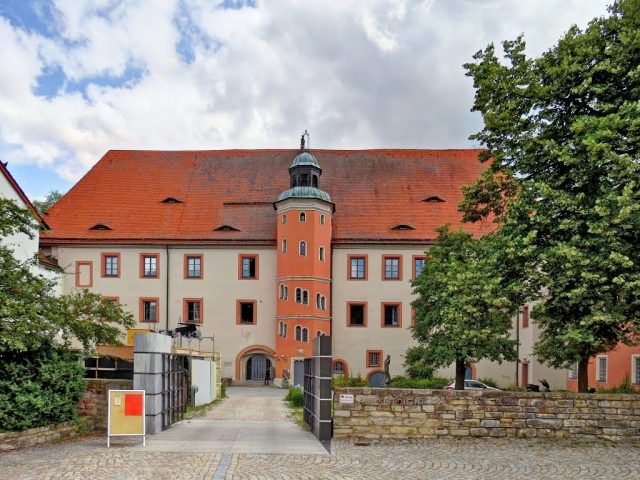
The Palatine Castle Neumarkt, also known as the Neumarkt Residence, forms the center of the castle district in the old town of Neumarkt in the Upper Palatinate (together with the Hofkirche and the Reitstadel) and today houses the District Court of Neumarkt in the Upper Palatinate. In its current form, it was built by Count Palatine Friedrich II in the middle of the 16th century.
It is assumed that at least three predecessor buildings stood on the site of the current residence, but all of them were destroyed.
First and Second Castle
Not much is known about the first two buildings on this site. Probably around 1200 to 1250, a first castle was built, which served as an official and residential building for the then bailiffs of Neumarkt. After its destruction by fire during the pogrom against Neumarkt Jews on July 12, 1298, a successor building was soon erected. Interestingly, it is disputed whether Neumarkt citizens set the castle on fire (because the Jews had fled there) or the Jews themselves (out of revenge against the lord of the castle, who refused them help). Both theories are considered equally probable. Both castles were certainly not of the extent that the residence is found today. They were probably located on the site of the current east wing, closer to the Hofkirche. During the construction of the underground car park at Residenzplatz in 1978, several columns were discovered that showed traces of fire and originated from one of the first two castles. They can be viewed today in the park at the Residence or at Residenzplatz.
The Castle as a Palatine Residence
In 1410, Ruprecht III died at Landskron Castle, and his Palatine possessions were divided among his heirs. Johann von Pfalz-Neumarkt received the Upper Palatinate, moved his seat of government to Neumarkt, and immediately began to expand it into a residential city. He had a new castle built, which in form and location already closely resembled the current building. For better defense, the city moat behind the castle was extended, and an additional rampart was built in today's city park.
Various sources report the Gothic-style residence as one of the most beautiful castles in Germany. The Marienkapelle (St. Mary's Chapel) opposite the castle was expanded under Johann around 1418 into the castle church or Hofkirche. Originally planned with two towers, only the current southwest tower was executed. The Reitstadel was built as an armory and material store.
The Castle Becomes an Observatory
After Johann's death, his son Christoph became Count Palatine in Neumarkt, but had already been King of Denmark, Sweden, and Norway since 1437, so a governor resided in Neumarkt in his place. When Christoph left no heir in 1448, Neumarkt fell to Johann's brother, Otto I of Neumarkt-Mosbach, who soon also moved his seat of government to Neumarkt. He was succeeded by his son Otto II of Neumarkt, who bore the nickname Otto Mathematicus due to his enthusiasm for astronomy and mathematics. In 1490, he retired from his official duties and dedicated himself solely to his research. He had a new, approximately 30-meter-high tower built on the east wing, near the Hofkirche, in the top of which he set up his observatory: the so-called Mathematician's Tower. There he spent most of his time until his death in 1499 with astronomical observations.
Great Fire and New Construction
In 1520, a major fire broke out in the castle district, to which the castle and the Reitstadel fell victim. Both, however, were rebuilt under Friedrich II and his Eichstätt master builder Erhard Reich by 1539. The Reitstadel again fell victim to the flames only in 1945, but the castle has been preserved to this day. Now built in the Renaissance style as a moated castle, the castle features extensive park grounds, gardens, and fountains, and is completely surrounded by a moat. The Neptune Fountain still stands today in the inner courtyard of the residence. For festivities and events, a magnificent ballroom was available on the first floor of the west wing, which could be reached from the inner courtyard via an open staircase. The entire castle was enclosed by a moat, which could be crossed via two drawbridges towards Residenzplatz and towards the city park.
After the Counts Palatine
When Friedrich II moved his seat of government to Amberg in 1543, Neumarkt lost importance. The castle was only inhabited by relatives of the prince. After Friedrich's death in 1556, his widow Dorothea lived here. From about 1560, the residence again became the seat of the Neumarkt bailiffs. Counts Palatine and princes only stayed in Neumarkt temporarily. For example, in the summer of 1619, the presence of the Winter King Friedrich V is reported: in the Mathematician's Tower, one of the cornerstones was laid for him to take over the Bohemian crown shortly thereafter. In 1695, parts of the castle, especially the Mathematician's Tower, showed considerable structural defects and were subsequently demolished.
18th Century to Today
From 1795, a part of the castle found new use: a tobacco factory settled in the residence and existed until the 19th century. In 1805, justice was first administered in the halls and rooms, and the Neumarkt Regional Court moved in. In 1862, the Royal Bavarian District Court of Neumarkt and the District Office of Neumarkt (until 1961) followed. In the east wing, there was a prison that existed until the 1930s. During this time, 2 side wings of the building and the gate tower at the entrance to the castle courtyard were demolished. Although the old town of Neumarkt was heavily destroyed in the last days of the war in 1945, the residence was spared. A complete renovation followed, and from 1990, the remaining parts of the east wing were rebuilt.
Current State and Use+
District Court and Ballroom of the Residence
The main building and the west wing today house the District Court and the Land Registry Office of the city of Neumarkt. Until 1997, a branch of the Bavarian National Museum was located in the former ballrooms (Krümperstallung), where, among other things, baroque nativity scene art could be viewed. Today, the ballrooms are used as an event venue, especially as part of the "Kleinkunst in der Residenz" event series. The cellars of the residence are now used as archives for the District Court; in a part of the cellars in the west wing, there were catering establishments (restaurant Residenzkeller, Krümpers Musikkeller). However, these premises are currently vacant. In the summer months, the inner courtyard transforms into a theater stage when the Neumarkter Schloßspiele perform.
Furnishings and Art Treasures
Over the centuries, a large part of the residence's inventory was lost, and further parts were stored in the Bavarian State Archives in Munich. Preserved in the Palatine Castle to this day are:
- a fireplace with marble inlays carved by the Eichstätt sculptor Loy Hering depicting Friedrich II and coats of arms held by lions
- wood-carved coffered ceilings in today's courtrooms and in the director's office by unknown artists
- two coats of arms, especially the large coat of arms with the chain of the Golden Fleece
- the Neptune Fountain in the castle courtyard
- the two stone lions with coats of arms at the entrance
- a painting depicting Friedrich II
Tours
To avoid disturbing the court's operations, tours of the residence are generally not possible. However, guided tours are offered on Heritage Day and during the Old Town Festival in June. The inner courtyard can be visited at any time, and the entire exterior facade is freely accessible from the city park and Residenzplatz.
Furthermore+
According to a legend, a secret passage is said to lead from the residence to the Wolfstein castle ruins. Its entrance is suspected either in the area of the castle pond or directly in the castle cellar. When Neumarkt was besieged by Nuremberg troops in the Landshut War of Succession in 1504, the archers in the castle are said to have been supplied with food and ammunition from here.
Take Mobile History with you
You are reading this text for free. Premium adds what matters on the road: descriptions read aloud, sites found through your camera, whole regions taken offline.
- Every description, including the ~17,700 Premium sites
- Audio guide: have descriptions read to you on location
- AR finder: see sites through your camera, with distance and bearing
- Unlimited saved sites
14 days free, then from €2.99 a month. Cancel anytime.
Source: Wikipedia · Licence: CC BY-SA 4.0 · Image: Rudolf Henkel
This description draws on the facts documented in the linked Wikipedia article; Wikipedia content is licensed under CC BY-SA 4.0. Wording and editing: Mobile History.
Location: 49.2814, 11.4611