Public library
ResidenceNürnberg
Pellerhaus
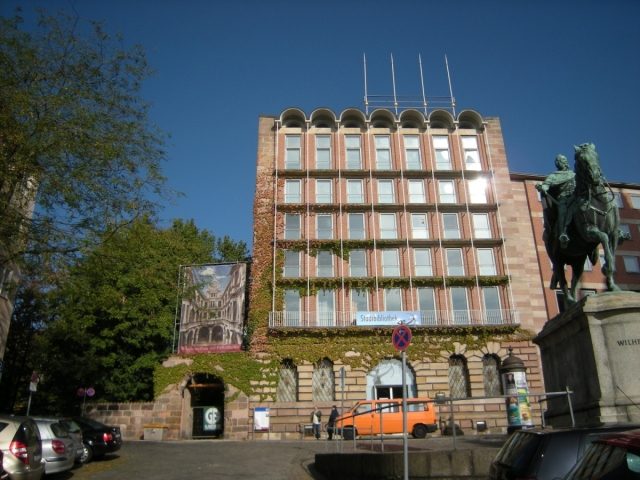
The Pellerhaus in Nuremberg was a Renaissance bourgeois house of great art and architectural historical significance, with rich courtyard galleries, which was largely destroyed by bombing in 1945. However, the ground floor and parts of the courtyard galleries remained intact and were incorporated into the reconstruction in the style of the 1950s, which took place in 1955/56. As one of the art and architectural monuments of the city of Nuremberg, it belongs to the Historic Mile of Nuremberg. The Pellerhaus now serves as the city library.
The Pellerhaus is located in the Sebalder Old Town, southeast of Nuremberg Castle and south of the Maxtorgraben at Egidienplatz No. 23, between Tetzelgasse to the west and Mummenhoffstraße to the east. To the north, the Pellerhaus directly borders the Johannes-Scharrer-Gymnasium. On the south side of the Pellerhaus, on the eastern edge of Egidienplatz, is the Egidienkirche, to which the former Egidien-Gymnasium adjoins to the south, in front of which stands a statue of Philipp Melanchthon, who opened this oldest humanistic gymnasium in Germany in 1526. On the western edge, Egidienplatz 7, is the Tucherpalais, whose classical facade survived the war destruction.
The historic building was a Renaissance structure of world renown, with its gable facing the street, featuring pilaster articulation and a dwarf gable. Bartholomäus Viatis had the house built from 1602 to 1605 according to plans by Jakob Wolff the Elder as a classic "Nuremberg complex" with an inner courtyard in Renaissance style for his son-in-law Martin Peller. It was severely damaged in World War II and rebuilt in 1956/1957 by Fritz Mayer and Walter Mayer as a five-story multi-purpose building, incorporating preserved remnants in contemporary forms.
Late Renaissance building components have been preserved in the area of the ground floor and in the inner courtyard and were incorporated into the new building. The structure is an outstanding example of 1950s architecture and is a protected monument. See also: Art and Architectural Monuments of the City of Nuremberg
Reconstruction of the Inner Courtyard
In autumn 2005, an initiative for the reconstruction of the inner courtyard developed. The Altstadtfreunde Nürnberg joined the project and founded a Pellerhaus working group. The monument protection authority is against a reconstruction, as in their opinion, it would endanger the historical substance.
In May 2006, the city council, in contrast to the monument protection office, generally spoke out in favor of a reconstruction; however, the city does not want to participate financially in a reconstruction. Subsequently, the initiative developed a concept in which everyone can cover the costs for a specific block of the facade through their donation.
In October 2008, the first stone for the reconstruction of the courtyard facade was laid in a festive setting. By mid-2013, the surrounding walls had been rebuilt to their full height up to the second floor, and the reconstruction of the eastern arcade arches had begun.
Take Mobile History with you
You are reading this text for free. Premium adds what matters on the road: descriptions read aloud, sites found through your camera, whole regions taken offline.
- Every description, including the ~17,700 Premium sites
- Audio guide: have descriptions read to you on location
- AR finder: see sites through your camera, with distance and bearing
- Unlimited saved sites
14 days free, then from €2.99 a month. Cancel anytime.
Source: Wikipedia · Licence: CC BY-SA 4.0 · Image: http://schloesserrundschau.de/bayern/schloesser01/nuernberg07.html
This description draws on the facts documented in the linked Wikipedia article; Wikipedia content is licensed under CC BY-SA 4.0. Wording and editing: Mobile History.
Location: 49.4570, 11.0811