Police
ResidenceGraz-Innere Stadt
Wildenstein Palace
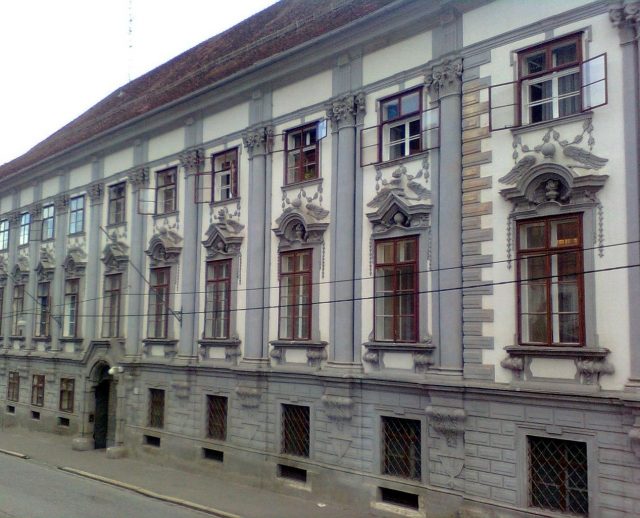
Palais Wildenstein is a former Graz city palace. It is located in Paulustorgasse in the first city district, Innere Stadt. Today, the Security and Traffic Police Department of the Styrian State Police Directorate is housed in its premises.
The extensive garden plot named "in der Scheiben", where the palace stands today, belonged to several owners at the beginning of the 17th century. These included the Graz city parish, the Teutonic Order, Ruprecht von Eggenberg, and a Rueß family. Baron Johann Franz von Wildenstein was the guardian of the heirs of Franz Andreas von Eggenberg in 1648. Count Johann Josef von Wildenstein, Imperial Court Councillor, Inner Austrian Government Commissioner, and Governor of Gorizia, eventually acquired the heavily indebted property. His marriage to Maria Juliana, the widow of Count Michael Weikhart Vetter von der Lilie, brought him wealth and the Palais Stubenberg in the former Neugasse (today's Hans-Sachs-Gasse).
In 1702, two existing buildings were combined, extended upwards, and given a new and uniform facade. The construction project was presumably carried out by the architect Andreas Stengg. In 1732, the palace was sold to the Upper Styrian Abbey of St. Lambrecht, and after its dissolution during the Josephine Reforms, it was adapted as a general hospital. The interiors were altered by structural measures, but the exterior facade remained. Due to acute lack of space, extensive wing buildings were erected. At the end of the 19th century, after the completion of the regional hospital in St. Leonhard, the Republic of Austria bought Palais Wildenstein from the State of Styria and established it as a police headquarters. In 1966, a comprehensive renovation took place. Today, the Security and Traffic Police Department of the Styrian State Police Directorate, as well as the Graz Police Detention Center, are located on the premises.
Architecture and Design+
The mighty three-story building with an L-shaped floor plan is one of the most important Baroque palaces in the city and was built by Andreas Stengg. The show facade is structured by risalits and ellipsoid half-columns. This gives it a plastic facade with segmental gables and stucco decoration. Among other things, griffin claws are depicted as the heraldic emblem of the Counts of Wildenstein.
The round-arched stone portal has a mascaron keystone, a stone with a grotesque face, and dates from the construction period. Above the metal-clad gate wings is a filigree transom grille in foliage forms from 1702. The ground floor windows are protected by wrought-iron grilles, and the window pediments of the first floor are richly decorated. Due to the later use of the palace as a hospital, the original interior decoration has been lost. Only the Baroque stucco in the narrow staircase of the main wing and in the large antechamber of the first floor has been preserved.
Take Mobile History with you
You are reading this text for free. Premium adds what matters on the road: descriptions read aloud, sites found through your camera, whole regions taken offline.
- Every description, including the ~17,700 Premium sites
- Audio guide: have descriptions read to you on location
- AR finder: see sites through your camera, with distance and bearing
- Unlimited saved sites
14 days free, then from €2.99 a month. Cancel anytime.
Source: Wikipedia · Licence: CC BY-SA 4.0 · Image: http://commons.wikimedia.org/wiki/File:Palais_Wildenstein_Graz2.jpg
This description draws on the facts documented in the linked Wikipedia article; Wikipedia content is licensed under CC BY-SA 4.0. Wording and editing: Mobile History.
Location: 47.0751, 15.4405