Restaurant
ResidenceGraz-Innere Stadt
Stürgkh Palace
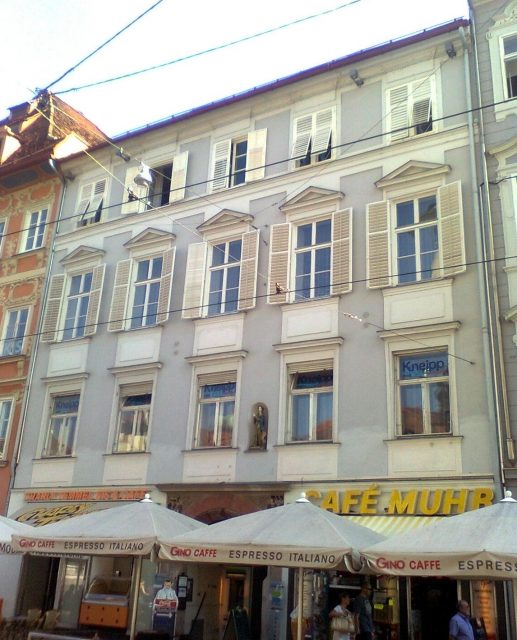
The Palais Stürgkh is a former Graz city palace on the Hauptplatz in the Innere Stadt district.
The house came into the possession of the Graz merchant Georg Stürgkh in 1521 through an inheritance. In 1532, after acquiring Plankenwarth Castle, he was elevated to the nobility. In 1668, a descendant of Georg Stürgkh, the Imperial Administrator Hans Christoph von Stürgkh, received the title of Baron. The palace was included in the family entail after 1718.
From 1756, the architect Joseph Stengg was commissioned with repair work, and in 1798, Count Karl von Stürgkh exchanged the palace for a building belonging to Count Sigmund Auersperg, with an additional payment of 12,000 guilders. The new owner had the palace extended by one floor and given a new facade around 1800 during a renovation. From 1810, the Palais Stürgkh was in bourgeois ownership, and in 1855, it was acquired by the businessman Simon Werner, who had it structurally connected to the neighboring houses. Since the mid-1920s, various credit institutions have owned the city palace. Today, the "Ratskeller" inn is located in the inner courtyard.
Architecture and Design+
The four-story building with a facade in the Plattenstil (slab style) shows different architectural styles from the Middle Ages to the 20th century. Originally, the palace had a Renaissance-style facade, which was later altered in a Neoclassical manner. The third floor was not added during the initial construction but later. To the right above the portal, a round-arched niche is set into the wall, containing a colorfully painted sandstone Madonna (late 18th century).
The basket-arch stone portal with iron-clad gate wings and wrought-iron transom grille dates from the first quarter of the 16th century. It is framed by floral and coat-of-arms reliefs. This framing was only added around 1638, after the Stürgkh family was elevated to the baronial rank. The plastered-over coats of arms were only rediscovered in 1937 and heraldically incorrectly supplemented. They belong to Baron Hans Christoph von Stürgkh and his wife, Baroness Sidonie von Khuenburg.
The inner courtyard is accessible via a long passage with barrel and groin vaults. An open staircase with a Neoclassical wrought-iron railing leads to the upper floors. On the first floor, some rooms are adorned with Rocaille ceiling stucco (around 1760), created in the style of the stucco artist Heinrich Formentini. The building fabric around the second courtyard of the Palais Stürgkh, where the "Ratskeller" is located, was built in the 15th century and is thus the oldest part of the house. Another staircase was only added later in 1800.
Take Mobile History with you
You are reading this text for free. Premium adds what matters on the road: descriptions read aloud, sites found through your camera, whole regions taken offline.
- Every description, including the ~17,700 Premium sites
- Audio guide: have descriptions read to you on location
- AR finder: see sites through your camera, with distance and bearing
- Unlimited saved sites
14 days free, then from €2.99 a month. Cancel anytime.
Source: Wikipedia · Licence: CC BY-SA 4.0 · Image: http://commons.wikimedia.org/wiki/File:Palais_St%C3%BCrgkh_Graz_Hauptplatz.jpg
This description draws on the facts documented in the linked Wikipedia article; Wikipedia content is licensed under CC BY-SA 4.0. Wording and editing: Mobile History.
Location: 47.0710, 15.4389