University
Cinema
ResidenceMainz
Palais Schönborner Hof
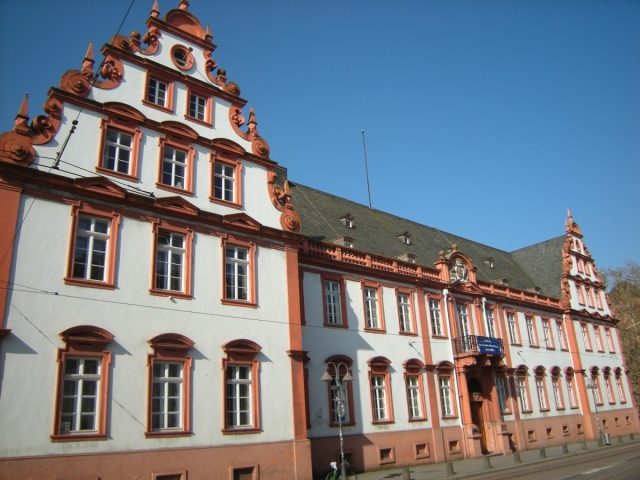
The Schönborner Hof is a noble residence in Mainz. It was the seat of the Schönborn noble family, who were significant in electoral Mainz after the Thirty Years' War.
Construction+
The Schönborner Hof was built between 1668 and 1670 at the northwestern end of the former Thiermarkt (today's Schillerplatz) in Mainz. Despite structural similarities to the House Römischer Kaiser, built in the Late Renaissance style, it is considered the first noble residence in Mainz built in the new Baroque style. It served as the Mainz city residence for the Counts of Schönborn, who originally came from the Taunus region and later primarily worked in Franconia. The builder was the Mainz Privy Councillor Philipp Erwein von Schönborn, the younger brother of the then-reigning Elector and Archbishop of Mainz, Johann Philipp von Schönborn. The Mainz master builder Clemens Hinck is responsible for the design of the main building. Behind him was probably Edmund Rokoch, the builder of Marienberg (later Zum Römischen Kaiser) on Liebfrauenplatz, as an advisor. The similarity of the facades with their scrollwork gables and bay windows reinforces this view. At that time, the Hof had only one upper floor and a side risalit with Renaissance stepped gables. The architects Dientzenhofer, the family architect from Bamberg, as well as Maximilian von Welsch and Balthasar Neumann for later alterations, are also considered as stylistic advisors.
Garden Layouts+
The Hof possessed significant extensive Baroque garden layouts, the so-called Schönborn Garden in the Early Baroque style. These were described in more detail by Nicolaus Person, a significant draftsman and engraver around 1700, in his Novi architecturae apeculi. These three-part layouts, located to the side of the main building, encompassed the entire area of the large square and the former barracks on Münsterstraße and today's Proviantmagazin. To the west, it bordered Altmünsterstraße, and to the south, the convent of the Weißfrauen nuns.
Almost all Mainz noble families at that time had larger gardens that bordered the adjoining hills and were therefore usually terraced. The Schönborn Garden was already designed according to the model of the formal French Baroque garden: parterre de broderie, water features, fountains, and a garden house with loggias.
Expansion+
The first extensions took place as early as 1706, and in 1773, the complex was supplemented by the so-called Wichernhaus. Towards the end of the 18th century, in 1798, the Hof was re-purposed as barracks and a hospital under French rule. In the 19th century, the Schönborner Hof became an officers' casino. It was raised by one floor and lost its characteristic gables.
The garden layouts were abandoned in 1863 during the construction of the neighboring Proviantmagazin and the Prinz Karl Barracks. In the summer of 2002, a Baroque fountain system was found next to the Proviantmagazin as the last remnant of the garden.
Destruction and Reconstruction+
After severe damage in World War II, the second upper floor was removed again, and the 17th-century condition was reconstructed, with the northern risalit being set back slightly from its original alignment to widen the Schillerstraße in front of it.
Current Use+
As early as 1946, a French study center was established in Mainz, partly by Raymond Schmittlein (Directeur Général des Affaires Culturelles in the French occupation zone), which later adopted the name Institut français and found a prestigious location in the Schönborner Hof. Today, a Maison de France is located in the rooms of the Schönborner Hof.
The goal of the Institute or the "Maison" is to promote French culture, language, and France in Mainz. The Maison de France is intended to take on the role of a cooperation center for media in addition to its previous functions and aims to bring together German and French journalists so that they can learn about the media landscape of the partner country and establish contacts.
Today, the Schönborner Hof houses a library with more than 13,000 volumes, including both classical works of literature and modern books on current problems and challenges of contemporary French society. For young people, 1,500 books and "comics" are available.
The most famous French newspapers and magazines such as Le Monde, Libération, Paris-Match, or l'Histoire can be read there. As part of the media library, the Bureau de la Musique française (Office of French Music) also moved into the building.
Under the name CinéMayence, a municipal cinema was established in 1994, operated by the Mainz association AG Stadtkino e.V. in a hall that had already served as the institute's film hall in the 1950s. The cinema participates in the Kino Vino program of the Rhineland-Palatinate Ministry of Viticulture.
Furthermore, Mainz University has been using parts of the building for several years. The Institute for Prehistory and Early History is represented with a large library.
Since 1995, the State University Treasury of Rhineland-Palatinate has been housed in the Wichernhaus of the Schönborner Hof.
In the remaining green area between the Schönborner Hof and the Proviantamt stands the Mainz Schoppenstecher statue.
Take Mobile History with you
You are reading this text for free. Premium adds what matters on the road: descriptions read aloud, sites found through your camera, whole regions taken offline.
- Every description, including the ~17,700 Premium sites
- Audio guide: have descriptions read to you on location
- AR finder: see sites through your camera, with distance and bearing
- Unlimited saved sites
14 days free, then from €2.99 a month. Cancel anytime.
Source: Wikipedia · Licence: CC BY-SA 4.0 · Image: http://schloesserrundschau.de/pfalz/schloesser/mainz03.html
This description draws on the facts documented in the linked Wikipedia article; Wikipedia content is licensed under CC BY-SA 4.0. Wording and editing: Mobile History.
Location: 49.9988, 8.2663