Museum
ResidenceArnsberg
Palais Landsberger Hof
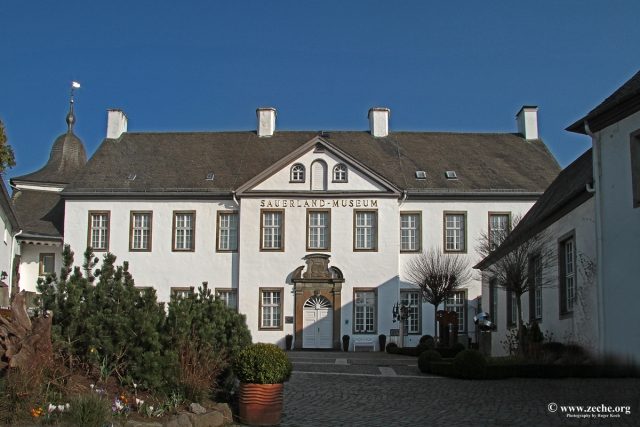
The Landsberger Hof is a city palace built in 1605 in the old town of Arnsberg, which today houses the Sauerland-Museum.
It consists of a main building with a tower built at the rear, a side wing, and outbuildings. Below the courtyard, there was a representative garden and a promenade, which later had to make way for urban expansion.
The building was commissioned by Elector Ernst von Bayern (1583-1612) over a section of the medieval city wall (approx. 1240) in the area of the then lower town, based on French models. After its completion, the Elector transferred the building to Gertrud von Plettenberg, who was responsible for managing the princely castles in Schloss Arnsberg, Schloss Höllinghofen, and Hirschberg. The Countess was the Elector's mistress and possibly also his secret wife. After Gertrud's death, the building, later known as Landsberger Hof, passed to her daughter Katharina, who, like Wilhelm von Bayern (Landdrost in the Duchy of Westphalia from 1613-1624 and later Prince-Abbot of Stablo and Malmedy), was born from Gertrud's relationship with Ernst von Bayern. This daughter of the Elector, also called von Bayern, married a nobleman in Spanish service and therefore had to leave Arnsberg. The Hof was rented to the Electorate for 1,000 francs a year. During the reign of Elector Ferdinand von Bayern (1612-1650), the Electorate bought out Katharina's heiress, a nun in Belgium, for 4,000 guilders. The money was intended for the construction of a church for the nunnery in France. During Ferdinand's time, the building served as the residence and official seat of the Landdrost, the highest electoral official in the Duchy.
Under the rule of Maximilian Heinrich, the building was purchased by the electoral state, but at the same time, the Drost's official rooms were moved to the castle itself. As an award for his services to the Duchy, the Estates of the Duchy decided to transfer the complex to the Landdrost Daniel Dietrich von Landsberg zu Erwitte. Since then, the building has been referred to as "Landsberger Hof". It remained in the possession of the von Landsberg family until the building became the property of the city of Arnsberg in 1921.
However, it had been used for public purposes since the 18th century. After a fire, the Landsberger Hof was rebuilt between 1733 and 1741 by the master builder Michael Spanner. After the destruction of the castle (1762), the Landsberger Hof was the residence of the Electors of Cologne during their stays in Arnsberg. After the flight of the electoral administration from Bonn before the French revolutionary troops, the Hof served as the seat of the Supreme Court of Appeal of the Electorate from 1794. Even during Hessian (since 1803) and Prussian times (since 1816), it was the residence and official seat of authorities and institutions. After the Duchy of Westphalia was taken over by Hesse-Darmstadt, it was a government building and the seat of the Court Chamber and the War Commission. Upon its transfer to Prussia, the Hof served as the official and residential seat of the first District President von Bernuth. From 1825, the Royal Court of Justice was housed there. After the construction of a new courthouse, the Landsberger Hof housed, among other things, the Upper Post Directorate. Plans by the city of Arnsberg in the 19th century to establish a girls' school there failed due to the purchase price demanded by the von Landsberg family.
After its transfer to the city, the building became the seat of the local volunteer fire brigade and a local history museum. Due to lack of funds, the complex was sold to the Arnsberg district during World War II and later passed to its successor, the Hochsauerlandkreis. After the war, it served, among other things, as a school for children of Belgian soldiers stationed in Arnsberg, the information center "Die Brücke", and the district police. After the fire brigade moved out in 1959, the war-damaged building was carefully restored and has been the exhibition venue for the regional history Sauerland-Museum since 1964. A museum café is located in an outbuilding.
Take Mobile History with you
You are reading this text for free. Premium adds what matters on the road: descriptions read aloud, sites found through your camera, whole regions taken offline.
- Every description, including the ~17,700 Premium sites
- Audio guide: have descriptions read to you on location
- AR finder: see sites through your camera, with distance and bearing
- Unlimited saved sites
14 days free, then from €2.99 a month. Cancel anytime.
Source: Wikipedia · Licence: CC BY-SA 4.0 · Image: http://www.zeche.org/
This description draws on the facts documented in the linked Wikipedia article; Wikipedia content is licensed under CC BY-SA 4.0. Wording and editing: Mobile History.
Location: 51.3969, 8.0651