Museum
ResidenceGraz-Innere Stadt
Herberstein Palace
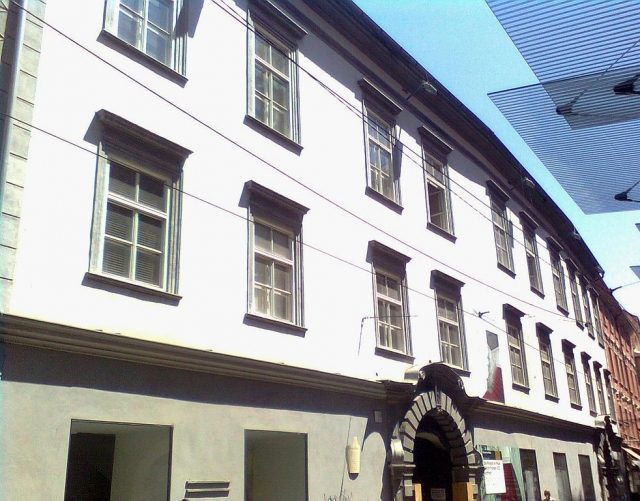
Palais Herberstein is a former Graz city palace located on Sackstraße in the Innere Stadt district. The premises house the Museum im Palais of the Universalmuseum Joanneum.
The Palais, with the address Sackstraße 16, is situated between the Kellerperg'sche Stadthaus and the Palais Khuenburg. It later came about through the amalgamation of two burgher houses, one of which was the so-called "Hubhaus," where coinage was housed. After the dissolution of the mint, King Ferdinand ceded the building to Siegmund von Dietrichstein in 1528. Before 1581, it came into the possession of Georg Sigmund von Herberstein. Later owners included Freiherr von Thurn (from 1581) and Wilhelm von Gera (from 1591).
Gera's heiress, Elisabeth von Schärffenberg, sold it to Hans Ulrich von Eggenberg in 1602. After his son Johann Anton acquired the neighboring house, the two houses were adapted as a city palace for the Eggenberg family. After the male line of the Eggenbergs died out, it came into the possession of the Herberstein family through inheritance in 1742. Count Johann Leopold von Herberstein commissioned the most important Styrian Baroque master builder Josef Hueber to undertake the renovation in the Late Baroque style. The Rococo stucco work and the ovens were created by Heinrich Formentini.
From 1834, Duchess Maria Karolina of Naples-Sicily resided in the Palais and established her art and painting collection in the premises. This was considered one of Graz's greatest attractions. Already in 1837, she moved to Schloss Brunnsee in Southern Styria. In the mid-19th century, the bel étage was used for events. From 1878, the k.k. Regional Court, with its jury courtroom and land registry office, occupied Palais Herberstein. In 1928, the Herberstein family transferred the Palais to a large purchasing cooperative. Since 1939, Palais Herberstein has been owned by the City of Graz. Until 2009, the Neue Galerie of the Universalmuseum Joanneum was housed in the premises. Today, the Museum im Palais is located in the building. Important exhibits include the Styrian Ducal Hat and the only known example of a short-lived order, the Order of the Braid, founded by Duke Albrecht III in the 14th century.
Architecture and Design+
The Palais Herberstein complex consists of three wings, each with three floors, and two inner courtyards that extend to the Schlossberg rock. On the back of the left inner courtyard, niches were carved into the rock of the Graz Schlossberg, which were used as horse stables. The core of the building dates from the 16th century and was supplemented by a Baroque renovation. The two mighty portals with iron-clad gate wings from 1640 were newly created. The originally simple framing was replaced in the 18th century by a Baroque one designed by Josef Hueber. Pilasters with volute consoles rest on the plinth stones. They support a curved pediment. The keystones are decorated with tendril patterns. The ground floor was massively altered by the installation of commercial premises. The northern inner courtyard is connected to the southern one by a connecting passage. The facade of the transverse wing is designed as a show front. It has an attic zone with an alliance coat of arms of the Eggenberg and Herberstein families, created by the sculptor Johannes Piringer. Above it stand three stone vases. The facade of the inner courtyards is more simply designed towards the Schlossberg.
A special feature of Palais Herberstein is the staircase in the central wing, built by Josef Hueber from 1754 to 1757. It is accessible from both courtyards. The grand staircase is one of the most beautiful Baroque structures in Styria. In addition to a wrought-iron Rococo railing, it is equipped with sandstone putti pairs serving as lantern bearers. The figures were designed by the South Tyrolean artist Veit Königer. All ceiling frescoes depicting the reception of Ganymede into Olympus and the four seasons (1756) are attributed to the painter Philipp Carl Laubmann. On the second floor, an oval room, also with a ceiling fresco by Laubmann, adjoins the staircase.
The bel étage, here called "Nobletage," is located on the second floor. The doors of the state rooms feature carved frames. The Mirror Hall is particularly noteworthy. It is decorated in white and gold. Due to their wallpaper, the adjoining halls are referred to as the Yellow and Red Salons. Of the magnificent ovens by Heinrich Formentini, only one remains in the Mirror Hall and one in the Red Salon. The two portraits in the fireplace cabinet show pastoral scenes. The painting in the lecture hall dates from the third quarter of the 18th century and depicts Hans Ulrich von Eggenberg.
Take Mobile History with you
You are reading this text for free. Premium adds what matters on the road: descriptions read aloud, sites found through your camera, whole regions taken offline.
- Every description, including the ~17,700 Premium sites
- Audio guide: have descriptions read to you on location
- AR finder: see sites through your camera, with distance and bearing
- Unlimited saved sites
14 days free, then from €2.99 a month. Cancel anytime.
Source: Wikipedia · Licence: CC BY-SA 4.0 · Image: http://commons.wikimedia.org/wiki/File:Palais_Herberstein_Graz.jpg
This description draws on the facts documented in the linked Wikipedia article; Wikipedia content is licensed under CC BY-SA 4.0. Wording and editing: Mobile History.
Location: 47.0724, 15.4368