Local government
ResidenceWilster
Palais Doos
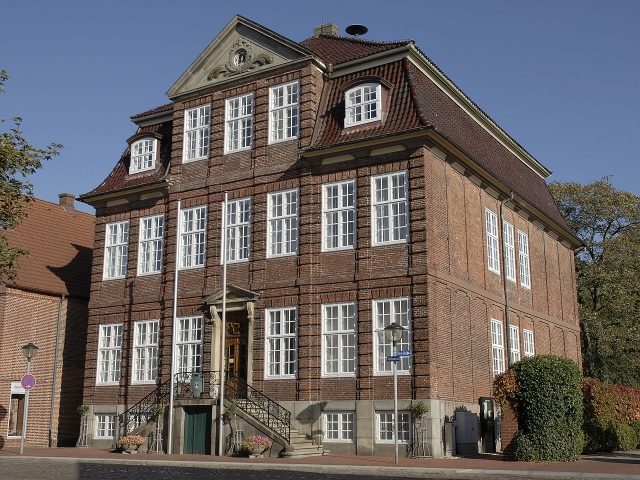
The Palais Doos - or Doos'sche Palais - in Wilster, Schleswig-Holstein, is a former grand bourgeois residence that came into the possession of the city of Wilster in 1829 through a donation. Today it houses the city's New Town Hall.
The Palais Doos
The palace was built from 1785 to 1786 on behalf of the Privy Councillor Johann Hinrich Doos as a residence for himself and his family. The late Baroque brick building was designed as a two-story palace with a mansard roof, modeled after the Ahlefeldtschloss in Pinneberg, known as the Drostei. The architect Ernst Georg Sonnin from Hamburg is presumed to be the master builder, as was the case there. Almost all of the furnishings, including furniture, paintings, chandeliers, and statues for the garden area, were acquired by the builder Doos during the sale of Friedrichsruhe Castle. This residence in nearby Drage had been built by the Schleswig-Holstein governor Friedrich Ernst von Brandenburg-Kulmbach until 1751 and was left as a heavily indebted inheritance after his death; the building was already demolished in 1787.
One enters the palace on the first floor through a deep hall via the seven-axis facade facing the city with its grand staircase. The large Baroque cabinets still originate from the castle in Drage. The rooms around the hall are symmetrically arranged and served as living quarters for the Doos family, while the reception rooms, such as the Rococo room, are located on the second floor. Under the roof of the house, an extensive library with more than 10,000 volumes was housed, which has since found its place in the so-called Old Town Hall, today's City Museum. After interim structural changes to the city side of the palace, the facade was reconstructed in 1938.
Behind the palace is the Town Hall Garden, a green area inspired by Baroque gardens. The statues displayed here also come from Friedrichsruhe Castle.
The New Town Hall
Through a donation, the Doos'sche Palais, including its garden and outbuildings, came into the possession of the city of Wilster as early as 1829. From then on, according to the will of Councillor Doos, it was to serve as the residence of the respective mayor and for the accommodation of the city administration. Today, the palace serves entirely as the town hall, and the Rococo ballroom on the upper floor is used as a wedding room. On various occasions, such as the farmers' market or on Sundays with open shops, the town hall can be visited.
Take Mobile History with you
You are reading this text for free. Premium adds what matters on the road: descriptions read aloud, sites found through your camera, whole regions taken offline.
- Every description, including the ~17,700 Premium sites
- Audio guide: have descriptions read to you on location
- AR finder: see sites through your camera, with distance and bearing
- Unlimited saved sites
14 days free, then from €2.99 a month. Cancel anytime.
Source: Wikipedia · Licence: CC BY-SA 4.0 · Image: http://de.wikipedia.org/wiki/Datei:Neues-Rathaus-Wilster_V2.jpg
This description draws on the facts documented in the linked Wikipedia article; Wikipedia content is licensed under CC BY-SA 4.0. Wording and editing: Mobile History.
Location: 53.9217, 9.3768