Cultural facilitie
ResidenceLübeck
Palais Brömserhof
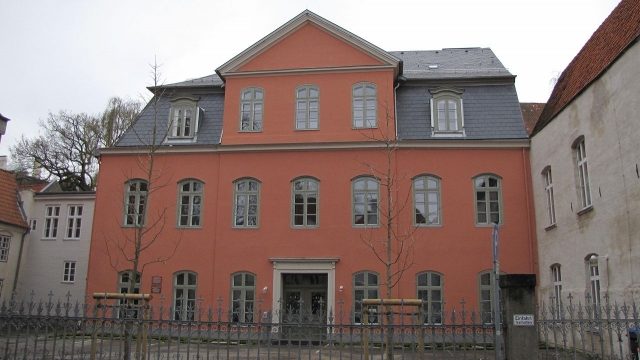
The Brömserhof is a small late Baroque palace in the Aegidien quarter of Lübeck's Old Town.
The exceptionally wide plot of land at Schildstraße 12-14, unusual for Lübeck's gable-end parceling, originally consisted of two parcels. These were already documented as built in the Middle Ages in 1291. Due to its location in the south of the Old Town island, not far from Mühlenstraße and the Mühlentor, it was initially used as agricultural land by two farmsteads, from which the lands in front of the Mühlentor of Lübeck's city fortifications were cultivated. The property was acquired in 1300 by the councilor and later Lübeck mayor Marquard Vorrade and initially remained the ancestral seat of this Lübeck patrician family. Marquard's son Bertram Vorrade also became mayor in 1363.
In the 15th century, the property passed to the knight Engelbert von Tiesenhausen, who was related to the Lübeck family von Warendorp, and then through the Lübeck council families of von Calven, Brömse/von Brömbsen, Gloxin, and Lüneburg.
Since the mid-17th century, it has been called "Brömserhof" after the Brömse family.
Building+
The late Baroque, eaves-facing house of seven axes is not directly on Schildstraße, but set back behind a high iron fence, so that due to the forecourt, untypical for Lübeck, in conjunction with the neighboring buildings extending to the street, the impression of a Corps de Logis with a courtyard of honor is conveyed. The slate-covered mansard roof is surmounted by the three-axis, simple central risalit with a classical gable, which also contains the simple entrance portal. According to dendrochronological findings, the wood of the roof was felled in the winter of 1744/45. The building in its current form was probably built in the summer of 1745; however, the barrel-vaulted cellar and part of the west gable still date from the 13th/14th century. The house was rebuilt in 1769 and around 1800, as well as in the course of repurposing in the late 19th and 20th centuries.
Inside, a Rococo hall and a Baroque staircase system over all three floors are preserved on the ground floor. The house features numerous original decorative elements (stucco ceilings, wood paneling).
On the rear property, there is also a preserved row of stalls from the 15th century.
Building Uses+
The building was acquired in 1819 by the well-known Lübeck orthopedist Matthias Ludwig Leithoff and used for his Orthopedic Institute, founded the year before. This institution was so successful at the time that Leithoff acquired the property St.-Annen-Straße 4 (the later Jenische Freischule) in 1821, whose rear garden property adjoins Schildstraße 12-14. In 1852, the judge Karl Georg von Wächter was the owner of the building, and in 1879 it was acquired by Georg Wilhelm Daniel Rey, the owner of the Lübeckische Anzeigen and the publishing house Gebr. Borchers.
In 1914, the Free and Hanseatic City of Lübeck acquired the complex and used it as a mother's home, health office, and housing office.
Since 1999, the Brömserhof has been the seat of the Cultural Administration of the Hanseatic City of Lübeck and the seat of the Cultural Foundation of the Hanseatic City of Lübeck.
Owners
- 1229-1307: Councilman Marquard Vorrade and his sons Bertram and Marquard
- 1379: Councilman Tidemann Vorrade, Bertram's son, after his death in 1385 his widow and children
- 1425 Knight Engelbert Tissenhusen
- 1438-1465: Councilman Reyner von Calven
- 1472-1504: Councilman Heinrich von Calven, in possession of the von Calven family until 1562
- 1562: as dowry of Catharina, daughter of Andreas von Calven, successively to her husbands Hartwig von Stiten († 1562) and Dietrich von Broemse († 1600)
- 1633-1638: Councilman Dietrich von Brömse (1579-1638), then his son
- 1652: Mayor David Gloxin
- 1663: Andreas Albrecht Brömse
- 1703-1744: Lüneburg family
- 1744-1785: Chamberlain von Albedyl
- 1798: Henning von Rumohr († 1805), father of Carl Friedrich von Rumohr
- 1805: Henning Rumohr's widow, Wilhelmine von Rumohr, née von Fersen (1751–1807)
- 1811: Johann Hinrich Neeser (Postmaster)
- 1819: Dr. Matthias Ludwig Leithoff
- 1852: Karl Georg von Wächter, President of the Higher Court of Appeal of the Four Free Cities
- 1879: Georg Wilhelm Daniel Rey, merchant and publisher (1830-1892)
- 1907: Johannes Heinrich Thomas Drath, merchant
- 1914: Free and Hanseatic City of Lübeck
Take Mobile History with you
You are reading this text for free. Premium adds what matters on the road: descriptions read aloud, sites found through your camera, whole regions taken offline.
- Every description, including the ~17,700 Premium sites
- Audio guide: have descriptions read to you on location
- AR finder: see sites through your camera, with distance and bearing
- Unlimited saved sites
14 days free, then from €2.99 a month. Cancel anytime.
Source: Wikipedia · Licence: CC BY-SA 4.0 · Image: http://de.wikipedia.org/wiki/Datei:Broemserhof_4_2013_1.JPG
This description draws on the facts documented in the linked Wikipedia article; Wikipedia content is licensed under CC BY-SA 4.0. Wording and editing: Mobile History.
Location: 53.8637, 10.6884