Restaurant
CastleMeuselwitz
Meuselwitz Orangerie
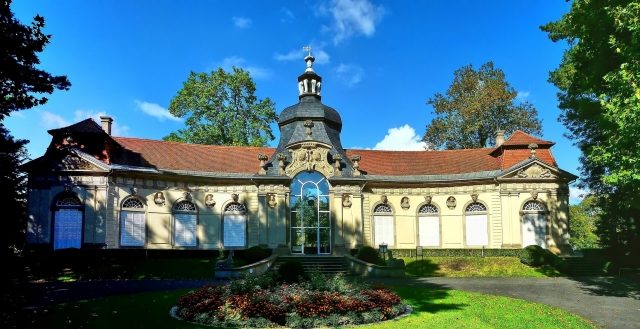
The Orangerie Meuselwitz is a historic building located in the rear part of the former palace park, now Von-Seckendorff-Park, in the town of Meuselwitz in the Altenburger Land district of Thuringia.
The approximately 40-meter-long structure features a shallow-arched floor plan and is terminated at both ends by slightly elevated sections that protrude backward beyond the main longitudinal building. These sections are structured by four pilasters each and a triangular gable. In the three window axes between the central and the end sections, a total of 12 portrait busts of men and women with different facial expressions are mounted above and between the floor-length arched windows.
The richly decorated central section, bounded by four pilasters, features an elevated glazed portal whose supraporte is formed by a coat of arms and framed by flower vase sculptures. The portal has an equally large counterpart on the rear side. The central part of the building culminates in a curved and stepped baroque dome, crowned by a lantern with a vase finial.
In the central part of the building is a round pavilion. Statues of the four seasons stand in the niches of the rotunda. From this central structure, rooms extend into both wings.
The Orangerie is located at the end of an axis of the Von-Seckendorff-Park. Plinth stones, though still without statues, flank the path to the staircase leading to the central pavilion, which is lined by two sphinxes.
The Orangerie is the last remaining part of the palace complex, which initially originated as a moated castle in the 16th century, came into the possession of the von Seckendorff family in 1676, and was rebuilt. Under Imperial Count Friedrich Heinrich von Seckendorff, extensive expansions took place from 1724 to 1724. In this context, the baroque Orangerie was built in the palace park, which had already been created in the French-Dutch style in 1709. The designs came from the Electoral Saxon state architect David Schatz. The construction was probably carried out by the Altenburg building expert Johann Georg Hellbrunn, who also executed the palace expansions.
The palace and park, including the Orangerie, were visited by high society. The most prominent guests were Augustus the Strong and King Frederick William I of Prussia. Similarities in construction suggest that the Orangerie may have served as a model for the first construction phase of Sanssouci Palace, built in 1745 according to plans by Frederick II.
During the bombing raid on Meuselwitz on March 20, 1945, the Orangerie also burned out, and its dome collapsed in 1954. After that, the securing and reconstruction of the Orangerie began, after the partially preserved palace had been completely demolished. In 1963, the interior rooms were also renovated. In 1969, the Orangerie could be reopened as a museum and concert hall. In the following period, decay set in again. In the 1980s, the building seemed to be left to ruin. After emergency securing, a comprehensive renovation of the entire structure was carried out between 1991 and 1998. Since then, the building, with an attractive café/restaurant and a banquet hall, has been open to visitors for cultural and literary events.
The Meuselwitz Orangerie, together with the surrounding park, is listed in the Wikipedia list of cultural monuments in Meuselwitz.
Take Mobile History with you
You are reading this text for free. Premium adds what matters on the road: descriptions read aloud, sites found through your camera, whole regions taken offline.
- Every description, including the ~17,700 Premium sites
- Audio guide: have descriptions read to you on location
- AR finder: see sites through your camera, with distance and bearing
- Unlimited saved sites
14 days free, then from €2.99 a month. Cancel anytime.
Location: 51.0460, 12.2967