Museum
CastleSiegen
Oberes Castle (Siegen)
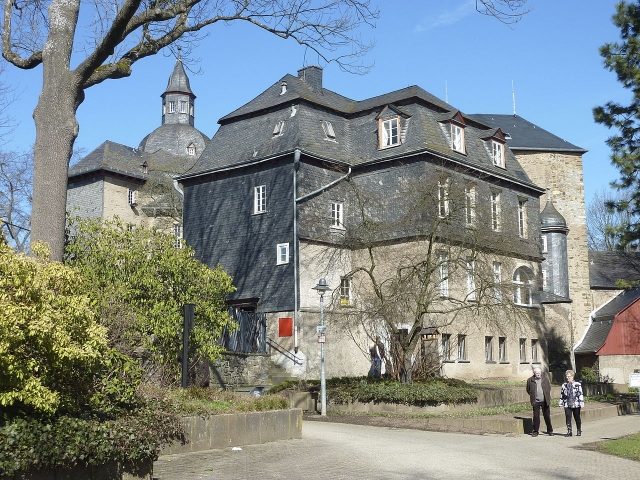
The Upper Castle is located on the 307 m high Siegberg in the city of Siegen. The complex dates back to a medieval hilltop castle, which was initially in joint possession of the Archbishops of Cologne and the Counts of Nassau. Later, it passed entirely into Nassau possession. Partially rebuilt, it temporarily served as a residence. Today, the complex houses the Siegerlandmuseum.
The complex was first mentioned in a document dated September 2, 1259, in the name of Bishop Henry of Liège as "burch inde der stad zen Sigin". From another document from 1261, it can be concluded that the castle had existed since at least 1224 – at the time when Count Henry II of Nassau and Archbishop Engelbert I of Cologne divided the city of Siegen between them. The construction of the castle is presumed to have taken place around the year 1200. However, the first documentary mentions do not yet allow conclusions about the size and structure of the castle. A document from 1341 only mentions the "vestin Sigin, Ginsberg unde der Han". Only another contract from 1343, through more precise documentation of the division existing since 1224, provides information about the nature of the buildings. Thus, two gates, the main tower, and the inner courtyard with a well were in joint possession. The buildings facing the Sieg were archiepiscopal ("Bishop's House"), while the buildings facing the Weiß were comital ("Count's House"). Over time, the archiepiscopal influence steadily decreased. Until the late 15th century, the complex was referred to in documents as a castle ("burch"), fortress ("vestin"), or with the Latin term for castle, "castrum"; only after that did the designation as a palace gradually prevail. Since 1670, the complex has been called the Old Castle or Upper Castle.
At the beginning of the 15th century, the Counts of Nassau were the sole lords of the city and castle. The abolition of the bipartite division of the castle is recorded for the year 1421. In the late Middle Ages, the complex was expanded and more strongly fortified with defensive towers and walls. A fire, triggered by lightning, destroyed large parts of the central buildings on July 19, 1503. As part of the reconstruction from 1506 onwards, the Gothic Hall and the Oranier Hall were built, among other things. During the 16th to early 17th centuries, the castle only occasionally served as a residence for the counts. After the division of the Nassau possessions, John the Middle became regent in Siegerland. Since then, the castle served as the residence of the House of Nassau-Siegen.
Due to confessional disputes, a further division occurred in 1623. The Protestant line resided in the former Franciscan monastery, which later developed into the Lower Castle. The Upper Castle remained in the hands of the Catholic line. The confessional conflicts only ended in the 18th century. In 1742, all possessions of the House of Nassau located north of the Lahn passed to the Nassau-Dietz line, which also provided the hereditary stadtholders of the Netherlands from 1747. With this, Siegen lost its residential function. It became the seat of an Amtmann.
Under the subsequent changing rulers up to the Prussian era, the Upper Castle was the seat of various authorities such as the district administration and domain administration. Since 1888, the castle has belonged to the city of Siegen. Since 1905, it has housed the Siegerlandmuseum.
Complex+
Main Complex
The so-called three-story Bishop's House in the north of the complex probably dates partly from the 13th century. This features a Gothic hall on the upper floor. The building was probably rebuilt in the 15th century. On the second upper floor is the Oranier Hall, established in 1506. This is in Baroque style and equipped with 18th-century works. A pavilion tower was added to the west of the Bishop's House in the 17th century.
The Count's House from the beginnings of the castle is no longer preserved in its old form. In its place is a two-story half-timbered building. It was not built before the 18th century. This building was extended in 1906 by an annex.
The comital and episcopal parts of the castle were connected by the Haintor. The building is rectangular and four-story. A lower building was attached to it in the direction of the castle garden. This is called the Old Chapel and probably actually served as the castle chapel, as remnants of paintings suggest.
A formerly existing large round main tower was demolished in the 16th century, as evidenced by account books documenting the demolition of a large tower in the castle area for the year 1529. The foundations of this keep were rediscovered during archaeological excavations in 1989–1990. The west building of the complex had also been removed in earlier centuries. Later, an outbuilding was built in the southwest of the main courtyard. This fell victim to the destruction in World War II, after having served as a youth hostel since 1926.
Outer Works and Outbuildings
The main castle complex is surrounded by a system of outer works, mostly built in the early 17th century under Count John the Middle, after the castle became a residence in 1607. On the east side of the complex, the castle wall with the remains of two round towers – Hexenturm and Sackturm – from the late medieval period has been preserved. Immediately next to the Hexenturm is a side entrance in the wall called "Armesünderpforte" (Poor Sinner's Gate), through which condemned prisoners were led to the execution site. In the northeast corner of the fortifications lies a largely preserved battery tower called Großer Krebs (Great Crab), which carried several cannons aimed at the Sieg valley to the north, and which controlled the eastern access to the city via the Marburger Tor of the Siegen city fortifications. Access to the former burgmann settlement was provided by the gate tower Marburger Pforte next to the Marburger Tor. In the area of the Burgfreiheit on the west side of the castle, a Jesuit college was built in 1643. Two bastions facing the city in the west of the complex – Jesuit Bastion and Hasengarten Bastion, originally each equipped with three cannons – were built by Prince Johann Franz Desideratus in 1683. Between them lies the gatehouse from the early 17th century with a slate-covered upper floor and the main entrance to the castle grounds. In the area of the Burgfreiheit was also the building, destroyed in World War II, where Peter Paul Rubens was born in 1577. In addition, there is a former armory from the 17th century, located somewhat outside the fortifications west of the gatehouse.
Use since the 20th Century+
Siegerlandmuseum
In 1888, the city of Siegen acquired the Upper Castle for the "relatively favorable" price of 30,400 Marks from the Kingdom of Prussia and established the Siegerlandmuseum there in 1905, a museum for regional history. The inauguration took place on March 25, 1905. The museum's task was to "represent the essence of the Siegerland homeland in terms of history, culture, and folklore." The museum began with only three exhibition rooms in the castle; by 1929, it already extended to 35 rooms. Currently, the museum has approximately 1,500 m² of exhibition space. The exhibition rooms house, among other things, one of the most important portrait collections of the Houses of Nassau and Orange. In the Rubens Hall, nine original paintings by the Baroque painter Peter Paul Rubens are permanently exhibited, including a version of his famous work The Rape of the Daughters of Leucippus. Among the most significant rooms of the museum is also the 14th-century Gothic Hall with an original preserved floor paving of greywacke stones in a herringbone pattern. Other rooms are dedicated to famous personalities from the Siegerland, including the physician and writer Johann Heinrich Jung-Stilling and the musician family Gebrüder Busch. Under the castle courtyard, a show mine was established in 1938 at a depth of 14 meters, which shows original facilities and equipment of a Siegerland ore mine over approximately 150 meters of tunnel length. The show mine was opened on July 8, 1938, during the Westfalen Day in Siegen. In addition to the permanent exhibition, the museum regularly hosts temporary exhibitions. The city of Siegen has been the sole sponsor of the Siegerlandmuseum since 1981. The museum has been directed by Ursula Blanchebarbe since 1991. Predecessors in this position included Wilhelm Weyer from 1946 to 1949 or Bernd Roedig. The castle also houses the scientific city library (Siegerlandbibliothek).
Castle Park and Periphery
The largest part of the castle grounds is occupied by the castle park, which mainly serves as an ornamental garden with large flowerbeds, including about 60,000 tulips. Several contemporary sculptures are permanently exhibited in the castle park, including the Rubens Fountain with a sculpture by Hermann Kuhmichel, which commemorates the birth of Peter Paul Rubens, born in Siegen in 1577. Under a tent roof construction in the southern half of the park, cultural events – concerts and theater performances – regularly take place during the summer months. In addition, the grounds include a café-restaurant and a children's playground. The armory immediately in front of the castle grounds is currently used as a student dormitory and also houses a restaurant on the ground floor.
During the National Socialist era, two high bunkers for civilian air raid protection were built on the southern part of the castle park, partially integrated into the historical fortifications. A third air raid bunker with two separate buildings was built on the grounds of the Burgfreiheit on the north side of Burgstraße. For camouflage purposes, the external appearance of the buildings was partly based on the architecture of the Upper Castle. Together, the bunker systems had a seating and lying capacity for approximately 3,000 people. After the end of World War II, the upper floors of two of the bunkers were converted into private living space, which is still in use today.
Take Mobile History with you
You are reading this text for free. Premium adds what matters on the road: descriptions read aloud, sites found through your camera, whole regions taken offline.
- Every description, including the ~17,700 Premium sites
- Audio guide: have descriptions read to you on location
- AR finder: see sites through your camera, with distance and bearing
- Unlimited saved sites
14 days free, then from €2.99 a month. Cancel anytime.
Source: Wikipedia · Licence: CC BY-SA 4.0
This description draws on the facts documented in the linked Wikipedia article; Wikipedia content is licensed under CC BY-SA 4.0. Wording and editing: Mobile History.
Location: 50.8757, 8.0300