Apartment
CastleGreiz
Upper Castle Greiz
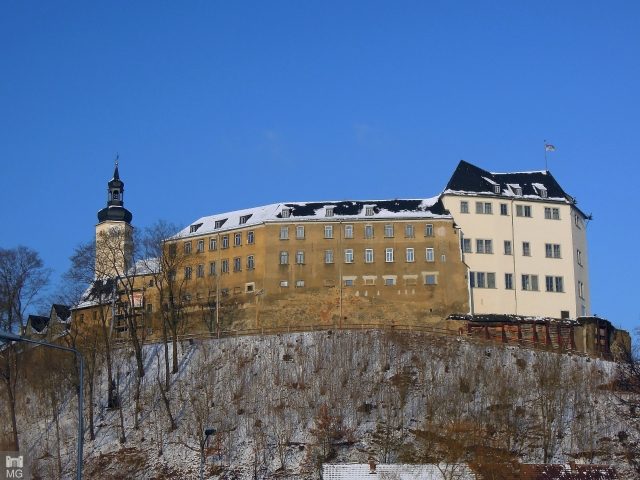
The Upper Castle is the landmark of the Thuringian city of Greiz. It is a widely known, architecturally valuable, and striking cultural monument. From the south, the Upper Castle appears as a simple tall house. Especially the impressive Renaissance gables of the east wing hint at the castle-like character of the complex, while from the north and west, the Upper Castle still looks like a medieval fortress today. The more or less interconnected buildings of the extensive complex extend in an elliptical shape from NNW to SSW and rise in the same direction, while a transverse wing in an EW direction divides the interior. The first documented mentions of a Greiz castle complex on the 50-meter-high mountain cone of clay slate rock date back to 1209 and 1225. As the former castle of the Vögte of Weida and Plauen, the Upper Castle still shows remnants of the old castle fortifications in a few places today. In between was a Zwinger (outer bailey), which is partly preserved on the south side. From a southern exit, a connecting path led over a bridge to a tower building located at the southernmost tip of the mountain. After this redoubt, the garden there is now called Untere Schanze (Lower Redoubt).
From the beginning of the 13th century, the castle was the residence of the Vögte of Weida and Plauen and later of the Reuss lords. After a lightning strike on June 3, 1540, it burned down almost completely and was subsequently gradually rebuilt. From approximately 1620 to 1625, the keep on the isolated rock cone received its current form. The transformation of the castle into a comital residence took place from 1697 to 1714. During this time, among other things, most of the defensive structures were removed. Through numerous new constructions and additions in the late Baroque style, the lower castle courtyard took on its present form between 1733 and 1753. A city view from 1714 shows the access road from the city for the first time. This road was created in its current form between 1705 and 1737. The older main entrance to the castle was at today's Stelzentor. The ascent to the castle was originally only possible from Parkgasse.
After the relocation of the Reuss princes in 1809 to the Lower Castle Greiz, which was rebuilt after the city fire of 1802, the Upper Castle became the seat of the government authorities of the Principality of Reuss Elder Line. This principality was, incidentally, the smallest monarchy in terms of area of the German Empire founded in 1871. In the course of the November Revolution in 1918, the prince and the state government abdicated, and the Upper Castle was transferred to the possession of the People's State of Reuss by settlement agreement. Already in the 19th century, the Upper Castle housed many apartments. As early as 1884, the residents received the status of their own castle community with its own mayor and self-government. Only in 1919 was this castle community reincorporated into the city of Greiz. Today, part of the buildings still serves residential purposes. The Upper Castle belongs to the city of Greiz and has been undergoing renovation and restoration on its behalf since 1991.
Take Mobile History with you
You are reading this text for free. Premium adds what matters on the road: descriptions read aloud, sites found through your camera, whole regions taken offline.
- Every description, including the ~17,700 Premium sites
- Audio guide: have descriptions read to you on location
- AR finder: see sites through your camera, with distance and bearing
- Unlimited saved sites
14 days free, then from €2.99 a month. Cancel anytime.
Source: Wikipedia · Licence: CC BY-SA 4.0 · Image: Mobile Geschichte
This description draws on the facts documented in the linked Wikipedia article; Wikipedia content is licensed under CC BY-SA 4.0. Wording and editing: Mobile History.
Location: 50.6576, 12.1969