Kindergarten
CastleBurg-Gräfenrode
Oberburg Castle (Burg-Gräfenrode)
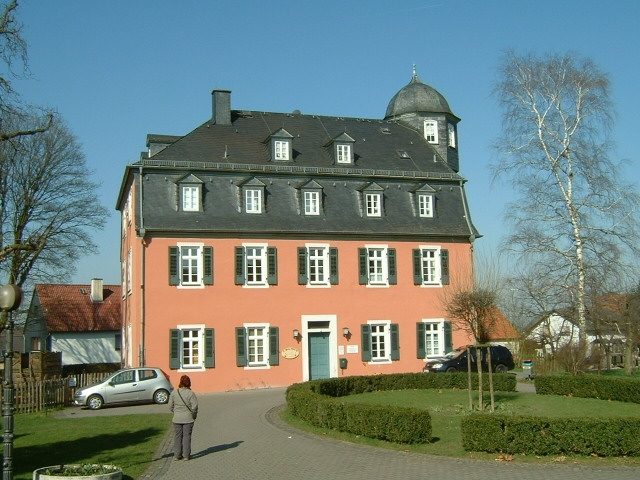
The Oberburg is the only remaining castle in the village. It was first mentioned in 1429 as the "Oberste Wonunge daz Steynen Huß mit Syme Begriff" and served as the seat of members of the von Carben family until their extinction in 1729. It was originally built in the Gothic style. Between 1550 and 1565, it was extended in the Renaissance style; at least these dates are found on two windows of the stair tower, which was added to the northern transverse side of the fortified building during the renovation. In the 18th century, the currently dominant Baroque-style redesign took place. From this period date the octagonal top and the onion dome of the stair tower, as well as the slate mansard roof. Characteristic of the building is its pink paint, which was originally mixed with oxblood.
The Oberburg formed the focal point of the village's fortifications and secured the village to the north and east. The moats around the castle were drained after the Thirty Years' War. Since 1867, the castle has been owned by the church community; in that year, the old castle gate was also demolished, and the moat and outer bailey were filled in. Today, the castle houses a kindergarten on the ground floor, with offices for the church community and apartments on the upper floors. The approximately one-hectare park-like castle garden is open to the public and is planted with cherry and pear trees, among others; an old walnut tree with a trunk circumference of a good five meters, long one of the village's landmarks, had to be felled around 1990 due to trunk rot. The castle garden is now primarily used by the village youth as a football pitch and is also equipped with a table tennis table, a fire pit, and a small playground.
Opposite the castle stands an outbuilding from 1688, which, as the art monument inventory of Hesse-Darmstadt noted in 1895, "lacks any artistic distinction."
The only remaining corner tower of the castle complex is the so-called Lieselturm. This round tower protected the castle gate and the entrance to the outer bailey and also served as the castle dungeon. On the first floor, a pointed-arch sandstone portal opens into the round interior, which is connected to the underground dungeon via a square opening in the floor. The second floor of the tower, an octagonal half-timbered structure crowned by a tent roof, also served as a prison. Next to the door opening on the north side, on the south side of the tower, there was a small opening closed by a flap, through which food could be passed to the prisoner without opening the door. The flap, a cast-iron plate with a relief depicting the Last Judgment, is now displayed in front of the tower. During an excavation in 1979, the dungeon in the tower was uncovered. However, the persistent belief in the village that there was once a secret escape tunnel from the castle or the Lieselturm to Ilbenstadt has not yet been confirmed.
A legend is associated with the Lieselturm, but it is unlikely to be based on historical facts and may have been invented only in the 20th century, as there are no earlier written references to it. According to the legend, a cruel lord once threw his sister Liesel, who often gave food to the poor villagers, into the dungeon and then had it flooded; Liesel, however, survived thanks to the help of her servant. On the occasion of the village's 600th anniversary celebration in 2005, a wooden statue of the legendary Liesel was erected on the roundabout at the southern entrance to the village.
Take Mobile History with you
You are reading this text for free. Premium adds what matters on the road: descriptions read aloud, sites found through your camera, whole regions taken offline.
- Every description, including the ~17,700 Premium sites
- Audio guide: have descriptions read to you on location
- AR finder: see sites through your camera, with distance and bearing
- Unlimited saved sites
14 days free, then from €2.99 a month. Cancel anytime.
Source: Wikipedia · Licence: CC BY-SA 4.0
This description draws on the facts documented in the linked Wikipedia article; Wikipedia content is licensed under CC BY-SA 4.0. Wording and editing: Mobile History.
Location: 50.2604, 8.7966