The remains of the Castle can be visited
RuinDysert O'Dea
O'Dea Castle
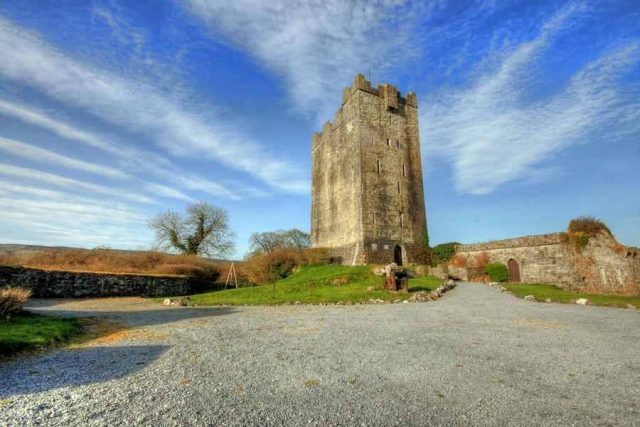
O'Dea Castle is an Irish fortified tower house, loosely described as a castle at Dysert O'Dea (Irish: Dísert, meaning "hermitage"), the former O'Dea clan stronghold, 5 km from Corofin, County Clare just off the R476 road.
It was built between 1470 and 1490 by Diarmaid O'Dea, Lord of Cineal Fearmaic, and stands some 50 feet high on a limestone outcrop base measuring 20 feet by 40 feet.
Clare Archaeology Centre+
The castle is home to the Clare Archaeology Centre, with exhibits of area archaeological artefacts from 1000 BC to 1700 AD, local history over the last three centuries, and a wall walk of parts of the castle.
The Dysert O’Dea Archeology Trail includes sites around the castle, including the remains of the Dysert O'Dea Monastery. The Battle of Dysert O'Dea, which drove the Anglo-Normans from the region for over 200 years, took place at this site on 10 May 1318.
In 1968, John B. O'Day of Wisconsin Rapids, WI, USA, while touring Ireland, discovered Dysert O'Dea Castle was for sale. He also knew that he was a direct descendant of the builder. Between 1971 and 1983, he purchased and commenced with repairs to protect what remained of the castle. Dysert O'Dea has become one of the most visited sites in Clare and continues to be a site of valuable archaeological investigation. It has also won the "Clare Tourism Award" for being one of the most authentically rebuilt castles in Ireland.
Site description from Irish Tourist Board:
Dysert O'Dea Castle and Archaeological Centre in Corofin is known for its wealth of historical and archaeological remains. Built in 1480 the castle is now an archaeological centre with more than twenty five archaeological and historical sites. Notable aspects are the 15th century Dysert O'Dea Castle itself, two stone forts used during battles between local noblemen in the 16th century and the Saint Tola's High Cross, which dates from the 12th century. There is also an example of a fulacht fiadh, or ancient cooking site. An archaeological trail has been developed to highlight 25 of the field monuments within a 6km radius of the Castle, the most famous of which include a Romanesque Doorway (dating from the 12th century) and High Cross.
Take Mobile History with you
You are reading this text for free. Premium adds what matters on the road: descriptions read aloud, sites found through your camera, whole regions taken offline.
- Every description, including the ~17,700 Premium sites
- Audio guide: have descriptions read to you on location
- AR finder: see sites through your camera, with distance and bearing
- Unlimited saved sites
14 days free, then from €2.99 a month. Cancel anytime.
Source: Wikipedia · Licence: CC BY-SA 4.0
This description draws on the facts documented in the linked Wikipedia article; Wikipedia content is licensed under CC BY-SA 4.0. Wording and editing: Mobile History.
Location: 52.9114, -9.0664