Ministry of Justice of Mecklenburg-Vorpommern
ResidenceSchwerin
Neustädtisches Palais
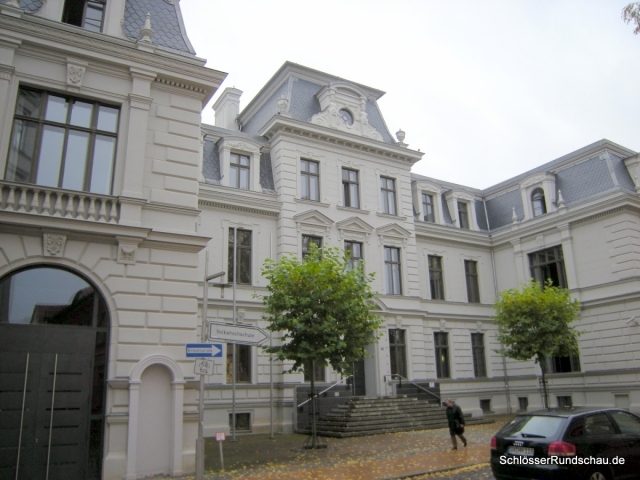
The Neustädtisches Palais (also: Marienpalais) is a representative magnificent building in Schwerin's Schelfstadt from the 18th century. The house at Puschkinstraße 19 is a listed building.
Architecture and Building History+
The plastered building was erected in 1779 according to plans by Johann Joachim Busch. A redesign in the French Renaissance style was carried out in 1878 by Hermann Willebrand. The three-winged, two-story complex with a three-story central risalit and the courtyard of honor were preserved. The former mansard roof was replaced by a plateau roof with dormer windows. The facades received strong plastered rustication, strongly profiled cornices, herms, and decorations in the form of festoons. In 1849, Georg Adolph Demmler added a hall extension to the rear, inspired by the throne room of Schwerin Castle. In 1883/84, Willebrand also added a residential wing for Duchess Marie to the rear.
The plastered facade contains elements of Baroque and Renaissance. Inside, the cast-iron staircase in the side stairwell, the stucco ceilings, and the panel doors are worth mentioning.
The plot of land on which the palace stands today was acquired in 1708 by Friedrich Wilhelm for his brother Christian Ludwig II, on which the Prinzenhof (also Ludwigshof) subsequently arose. By order of Duke Friedrich, the widow's residence for Charlotte Sophie, the wife of his brother Ludwig, was built on the site in 1779, where she lived until her death in 1810. After ten years of vacancy, the building was initially used by Grand Ducal Finance Minister Leopold von Plessen and later served as a ducal residence and, after an extension from 1883, as the widow's residence of Grand Duchess Marie. After the abdication of the last Grand Duke Friedrich Franz IV, the palace passed into the possession of the Free State of Mecklenburg-Schwerin in 1920.
Until 1945, various authorities were housed in the building. In 1947, it was made available to the Society for the Study of the Culture of the Soviet Union for political-ideological and cultural-political work and renamed Maxim Gorky House (also: House of German-Soviet Friendship). Until the fall of the Berlin Wall, social and festive events regularly took place in the palace. The painting Triumph of Leninism hung in the entrance area.
After the fall of the Berlin Wall until 1998, the Neustädtisches Palais was the seat of the city council and the city president, after which it stood empty again. From 2003 to 2008, the complex was extensively renovated for a total of 11.3 million euros. In June 2006, the Ministry of Justice of the State of Mecklenburg-Vorpommern was able to move into the premises. A previously considered new building for the authority elsewhere was rejected. Subsequently, the Golden Hall was refurbished, which is again available to the residents of Schwerin for celebrations and is accessible via a separate entrance. The hall was reopened in April 2009.
Take Mobile History with you
You are reading this text for free. Premium adds what matters on the road: descriptions read aloud, sites found through your camera, whole regions taken offline.
- Every description, including the ~17,700 Premium sites
- Audio guide: have descriptions read to you on location
- AR finder: see sites through your camera, with distance and bearing
- Unlimited saved sites
14 days free, then from €2.99 a month. Cancel anytime.
Source: Wikipedia · Licence: CC BY-SA 4.0 · Image: http://schloesserrundschau.de/meckpomm/schloesser/schwerin02.html
This description draws on the facts documented in the linked Wikipedia article; Wikipedia content is licensed under CC BY-SA 4.0. Wording and editing: Mobile History.
Location: 53.6311, 11.4164