Local government
CastleNeuhausen auf den Fildern
New Castle Neuhausen
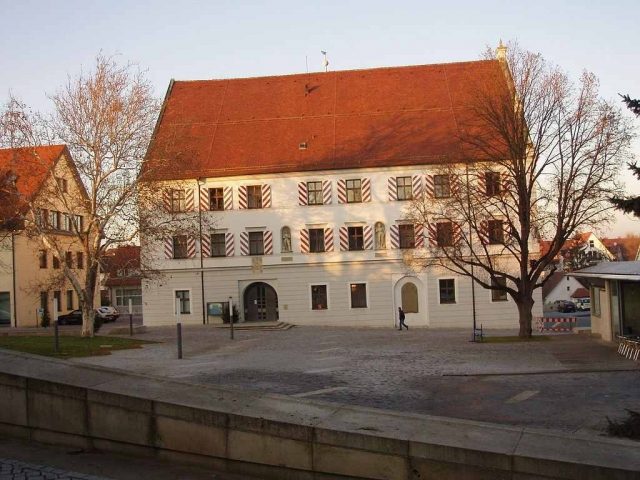
The New Castle in Rentweinsdorf+
A Jewel of the Renaissance in Lower Franconia+
The New Castle in Rentweinsdorf, an impressive architectural ensemble, is idyllically situated in the valley of the Weisach, a tributary of the Main, in the district of Haßberge in Lower Franconia. This historic building, surrounded by a picturesque landscape, is a significant example of Renaissance architecture in the region.
History and Architecture
The New Castle was built between 1561 and 1567 by the Lords of Rotenhan. It replaced an older castle, the so-called "Old Castle," which was located on a hill nearby and had become too small and uncomfortable for the needs of the time. The new building was designed as a representative residential castle, reflecting the increased status and wealth of the Rotenhan family.
The architecture of the castle is characterized by clear Renaissance forms. It is a four-winged complex with a rectangular courtyard. The facades are adorned with numerous decorative elements, including bay windows, gables, and portals, which testify to the high craftsmanship of the builders. Particularly striking is the main portal on the west side, which is richly decorated with coats of arms and sculptures.
Over the centuries, the castle has undergone several alterations and additions, but its original Renaissance character has been largely preserved. In the 18th century, for example, some Baroque elements were added, particularly in the interior, which gave the castle a new splendor.
The Lords of Rotenhan
The history of the New Castle is closely linked to the Lords of Rotenhan, one of the oldest and most influential noble families in Franconia. The family, first mentioned in documents in the 12th century, played a significant role in the political and social life of the region for centuries. They held numerous offices and dignities and were known for their extensive landholdings.
The Rotenhan family still owns the castle today and continues to inhabit it. They have always endeavored to preserve the historical substance of the building and to adapt it to modern living requirements. The castle is thus not only a living monument to Franconian history but also a vibrant family residence.
Significance and Use Today
The New Castle in Rentweinsdorf is of outstanding historical and architectural significance. It is considered one of the most important Renaissance castles in Lower Franconia and is a protected cultural monument. The castle is not regularly open to the public, as it is privately inhabited. However, there are occasional opportunities for guided tours or special events that allow visitors to catch a glimpse of this impressive building.
The castle also serves as a venue for various cultural events, such as concerts, exhibitions, and readings, which contribute to making it a lively center of cultural life in the region. The picturesque surroundings of the castle, with its extensive park and the nearby Weisach, also invite you to take walks and relax.
The New Castle in Rentweinsdorf is a fascinating example of how history and present can be combined. It is a place that tells stories of past centuries and at the same time is a vibrant home for a family that is committed to preserving this unique cultural heritage.
Take Mobile History with you
You are reading this text for free. Premium adds what matters on the road: descriptions read aloud, sites found through your camera, whole regions taken offline.
- Every description, including the ~17,700 Premium sites
- Audio guide: have descriptions read to you on location
- AR finder: see sites through your camera, with distance and bearing
- Unlimited saved sites
14 days free, then from €2.99 a month. Cancel anytime.
Source: Wikipedia · Licence: CC BY-SA 4.0 · Image: http://de.wikipedia.org/wiki/Datei:Neuhausen2.jpg
This description draws on the facts documented in the linked Wikipedia article; Wikipedia content is licensed under CC BY-SA 4.0. Wording and editing: Mobile History.
Location: 48.6835, 9.2779