Museum
Restaurant
CastleIngolstadt
New Castle Ingolstadt
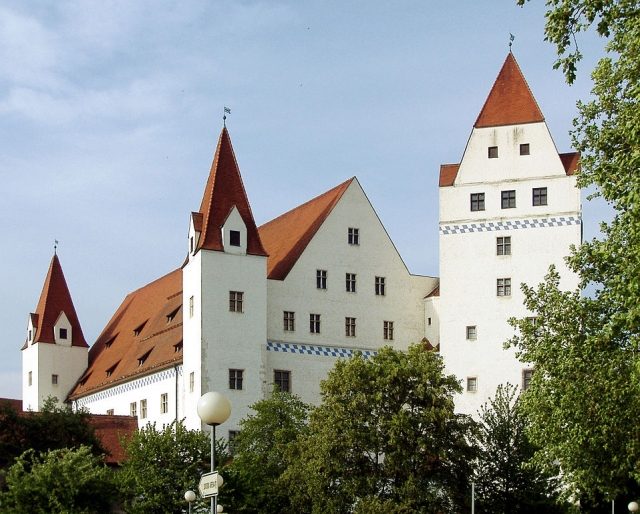
The New Castle in Ingolstadt is one of the most important Gothic secular buildings in Bavaria. The patron was Duke Ludwig VII of Bavaria-Ingolstadt. The neighboring Old Castle, a medieval fortress from the 13th century, is now called Herzogskasten.
As the brother of the French Queen Isabeau, Ludwig spent more than ten years in France. After returning to his residential city of Ingolstadt, he had ample financial resources and commissioned the construction of the New Castle in 1418, based on French models.
The complex is located on the eastern edge of the city wall and is designed as a city castle, which, with its deep and wide moat facing the city, offered protection both outwards and inwards. From a tower, now only a stump, the city could be controlled along the axis of today's Ludwigstraße. During the construction of the castle, one of the four city gates of the city fortifications, the Feldkirchner Tor, was integrated into the complex and is still preserved today – unlike the New Feldkirchner Tor, built as a replacement, which was demolished in 1879.
The outer walls form a rectangle and are up to four meters thick. On its west side are two square towers placed diagonally, a third tower on the east side is pentagonal, and the fourth and most powerful tower stands freely. The palas itself is three-storied and has a high gabled roof.
Under the rule of the Landshut dukes, further buildings were added at the end of the 15th century:
- the Statthalterei (governor's residence), built around the core of the Feldkirchner Tor,
- the granary from 1472/73 with an integrated round tower.
With the expansion of Ingolstadt into Bavaria's strongest state fortress, reinforcements in the form of bastions, such as the Eselsbastei, were also made at the New Castle, none of which remain today. The beginnings of the castle portal date back to around 1580, with the bell tower only being built in the mid-18th century.
Interiors+
Almost all rooms are vaulted. On the ground floor, the net rib vault of the Great Hall is supported by two octagonal pillars, while in the Beautiful Hall, the ribs unfold star-shaped from a central column. The frames of doors and windows are decorated with sculptural ornamentation. In the castle chapel, old paintings have been preserved, otherwise, the rooms are plastered white.
Further Development and Current Use+
In the 19th century, some wings of the castle were demolished or altered; during the Second World War, it was severely damaged and had to be fitted with an emergency roof. The extent of the damage is still clearly visible in the partially missing vaults of the armory. After the war and the demolition of the Donautor, parts of the gate were added to the portal of the New Castle.
It was not until the 1960s that the castle was extensively restored and now houses the Bavarian Army Museum, including workshops and gastronomy. In addition, the spatial surroundings of the castle serve as a venue for numerous events.
The highlight is the Ingolstadt Ducal Festival, which takes place every two years in honor of the builders. The main attraction is the Ingolstadt City Guard with its large field camp.
Take Mobile History with you
You are reading this text for free. Premium adds what matters on the road: descriptions read aloud, sites found through your camera, whole regions taken offline.
- Every description, including the ~17,700 Premium sites
- Audio guide: have descriptions read to you on location
- AR finder: see sites through your camera, with distance and bearing
- Unlimited saved sites
14 days free, then from €2.99 a month. Cancel anytime.
Source: Wikipedia · Licence: CC BY-SA 4.0
This description draws on the facts documented in the linked Wikipedia article; Wikipedia content is licensed under CC BY-SA 4.0. Wording and editing: Mobile History.
Location: 48.7647, 11.4305