To be privately owned
CastleGuntersblum
New Castle Guntersblum
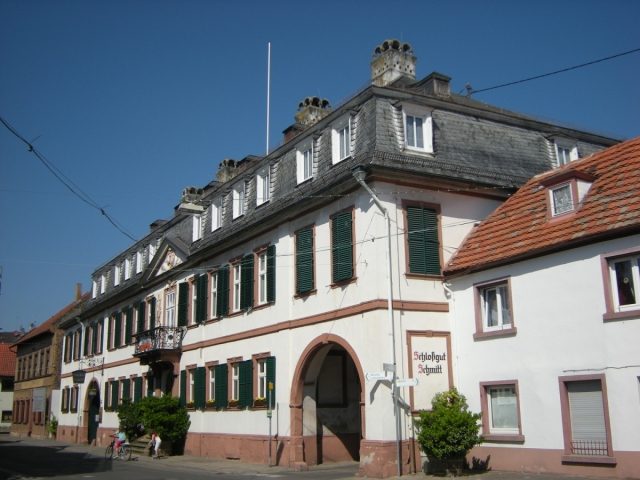
The history of what is known today as the New Castle in Guntersblum dates back to 1404. In that year, the Oppenheim monastery Mariacron was mentioned, which at that time owned almost seven acres of arable land and meadows in Guntersblum. In 1451, the abbess of Mariacron monastery, Miltedrut Schressin (also Schraß) von Ülversheim (today Uelversheim), leased 16 acres in the Guntersblum district to local residents. In the meantime, the family member Emmerich Schraß von Ülversheim, a Landkomtur of the Teutonic Order from 1464 to 1475, came into possession of the land. However, when he died in 1483, his private property, and thus also the land on which the New Castle stands today, passed as an inheritance to his nephew Adam von Sötern. The further ownership is unclear.
It was not until the 16th century that a sale of the property to a lawyer named Christoph von Otthera was documented. The man, originally from Mühlhausen in Thuringia, then settled in the neighboring town of Oppenheim, where he died in December 1563. From then on, the estate bore his name for about 150 years. From 1558, the Guntersblum court clerk already listed the estate as owner. During this time, the year 1561 was also carved into the archway to the current entrance to the Schmitt Castle Estate. This indicates strong building activity on the then very large site in the center of Guntersblum.
After the death of Christoph von Otthera, his property passed to his son Jacob von Otthera, who was also a lawyer. He died at the end of March 1613 in Butzbach in Hesse as a retired princely Hessian bailiff of the Lordship of Eppstein. After the property was inherited by his descendants, it was leased after the Thirty Years' War to Adam Sachs, Stadian Weisser, and Niclas Adam Greuel. When they died, Greuel's son Caspar managed the entire estate alone. The then location of the property, where the New Castle estate is found today, is described as being bordered by the Guntersblum town hall in Rathausgasse (today Hauptstraße), towards Worms partly by Rathausnebengasse (today Geißenmarkt) and various courtyards, towards Oppenheim by dozens of house and courtyard plots, and towards the Rhine by the village ditch. The only building is said to have been a barn. This was probably due to the consequences of the Thirty Years' War.
At the beginning of the 18th century, in 1707, Platzmajor Renner von Brandt was finally documented as the owner of the property. In the following years, he is said to have established a farm with a garden on the property. In the coming years, he is said to have fallen into severe financial difficulties, so that his property in Guntersblum was managed by an administrator until after his death in 1721 until 1737 during an ongoing lawsuit against him. From 1726, a Philipp Schmidt is said to have managed the estate, who was still referred to as "Otterauischer Hofmann" in 1737.
In July 1737, the Count-Leiningen councilor in Guntersblum, Johann Christian Klotz, bought the so-called Otterau estate with all its associated buildings (houses, barns, stables, wine presses, the house plot and garden) for 5,000 guilders from the widowed Anna Metta Renner von Brandt, who was now married to Johann Christoph von Kahlden. After Klotz's death in 1749, Anna Metta von Kahlden lived here at least until 1767. In 1787, Anna Metta von Kahlden having already died, Count Wilhelm Carl von Leiningen-Guntersblum finally bought the property for 2,500 guilders and had the new Guntersblum Castle built on the property by 1789, after the first Guntersblum Castle, the Leiningen Castle, had already been completed in 1708. After her divorce, Countess Eleonore von Leiningen finally became the owner of the New Castle. When she died in 1832, she bequeathed it to her daughter Elisabeth Margarethe Auguste, wife of Baron Karl Ludwig von Stockhorn. After her death in 1874, she bequeathed the castle to her daughter Amalie von Budberg, who in turn sold it in 1876 to Simon Kaufmann from Jugenheim in Rheinhessen. He in turn sold it only a short time later to Johann Schätzel and his wife Magdalena Schätzel.
Location+
The castle is located in the center of Guntersblum. A few hundred meters to the west is the Protestant church, and only a few hundred meters to the south is the first Guntersblum Castle, today's Leiningen Castle. On the directly opposite side of the street from the castle in today's Hauptstraße was also the old Guntersblum town hall, before it was demolished in 1834 as part of the move to Leiningen Castle.
Layout+
When the castle was built, there were many gardens and meadows with an agricultural character around the property. The castle was located from the beginning on one of Guntersblum's main streets. As more and more houses were built north and south of the castle over the years, the castle square became smaller and smaller, before it consisted only of a piece east of the castle. Today, the castle square features a generously designed courtyard, which is mainly used for many wine festivals. A special feature of the castle's layout is the Geisenmarkt street, which today leads directly through the former entrance of the castle under the castle to the east. Furthermore, the Guntersblum Kellerweg and the Guntersblum market square are easily accessible via Julianenstraße.
Current Use+
Since the sale of the castle in 1876 to Simon Kaufmann from Jugenheim, the castle has been in private ownership. Today, the castle, with the address Hauptstraße No. 45–47, serves as the residence of the Schmitt family. The Schmitt family also owns a winery called Schlossgut Schmitt KG. The size of the castle is well utilized by the extensive administrative work of today's winery.
Take Mobile History with you
You are reading this text for free. Premium adds what matters on the road: descriptions read aloud, sites found through your camera, whole regions taken offline.
- Every description, including the ~17,700 Premium sites
- Audio guide: have descriptions read to you on location
- AR finder: see sites through your camera, with distance and bearing
- Unlimited saved sites
14 days free, then from €2.99 a month. Cancel anytime.
Source: Wikipedia · Licence: CC BY-SA 4.0 · Image: http://schloesserrundschau.de/pfalz/schloesser/bingen14.html
This description draws on the facts documented in the linked Wikipedia article; Wikipedia content is licensed under CC BY-SA 4.0. Wording and editing: Mobile History.
Location: 49.7978, 8.3459