Museum
CastleNürnberg
Nassauer Haus
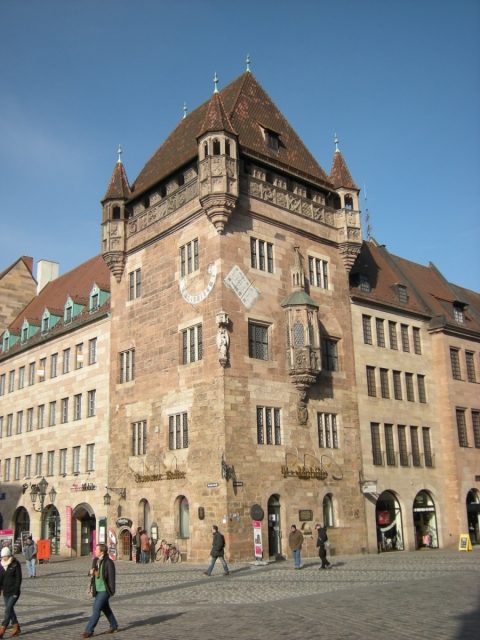
The Nassauer Haus or Schlüsselfeldersche Stiftungshaus in Nuremberg is a medieval residential tower made of so-called red castle sandstone. Although originally built in Romanesque style, the house is still characterized by Gothic stylistic elements after several alterations. It is the last remaining residential tower or "Geschlechterturm" in Nuremberg.
The tower is located in the Lorenzer Altstadt, opposite St. Lorenz Church, at Karolinenstraße 2.
The name "Nassauer Haus" is the name commonly used for the corner house since the 19th century and is based on an erroneous reference to King Adolf of Nassau in the 15th century.
The cellar (with an irregular cross-rib vault) and the two lower floors are dated to the 12th or 13th century. Around the 16th century, the vault of the cellar as well as that of the ground floor was raised. The two upper floors, which clearly differ from the small-scale structured masonry of the lower floors by their regular ashlar masonry, belong to the 15th century. At least the penultimate floor is attributable to a renovation around 1422 by the then owner Jobst Haug. The uppermost floor with its coat of arms frieze and the three corner oriels was renovated around 1433 by Ulrich Ortlieb, to whom the small choir is also owed.
Coat of Arms Frieze+
According to the latest knowledge, the following coats of arms are affixed to the house (starting from the southwest oriel): Archduchy of Austria, the great city coat of arms of Nuremberg, County of Cilli, Electorate of Trier, Electorate of Cologne, Electorate of Mainz, Roman King, Pope Eugene IV, Holy See, City of Rome, Roman Emperor, Electorate of Bohemia, Electorate of the Palatinate, Electorate of Saxony, Electorate of Brandenburg, St. Lorenz, the small city coat of arms of Nuremberg, the coat of arms of the Ortlieb family. With its coat of arms decoration, the Nassauer Haus possesses the earliest example of the two city coats of arms, as well as for the juxtaposition of the king's and (double-headed) emperor's eagle.
It only became a "fortified tower" for 19th-century observers, who initially had to recognize a uniform structure, from a single hand, with the decorative battlement contributing to this assessment. The most important external change is the installation of the round-arch openings on the ground floor in 1836; one of them was enlarged into a door around 1900.
Owners+
Nothing is known about the original owners of the building. Peter Stromer (1310–1388) is said to have lived there, around 1422 Jobst Haug, in 1426 the brothers Erasmus and Heinrich Schürstab owned the building. From 1427 until their extinction in 1478, it was owned by the Nuremberg patrician family Ortlieb and subsequently in the hands of the Haller von Hallerstein. Around 1556, Willibald Imhoff is said to have inhabited the house.
In 1581, the Schlüsselfelder von Kirchensittenbach acquired the residential tower and made it their ancestral seat in Nuremberg. After their extinction in 1709, the building passed into the possession of the Schlüsselfeldersche Familienstiftung, established by will.
War Damage+
The tower was severely hit by American bombing raids in 1945 and suffered considerable war damage. Reconstruction took place between 1950 and 1952. The building was restored by Rudo Göschel on behalf of the Schlüsselfeldersche Familienstiftung, which remains the owner to this day.
Take Mobile History with you
You are reading this text for free. Premium adds what matters on the road: descriptions read aloud, sites found through your camera, whole regions taken offline.
- Every description, including the ~17,700 Premium sites
- Audio guide: have descriptions read to you on location
- AR finder: see sites through your camera, with distance and bearing
- Unlimited saved sites
14 days free, then from €2.99 a month. Cancel anytime.
Source: Wikipedia · Licence: CC BY-SA 4.0 · Image: http://schloesserrundschau.de/bayern/schloesser01/nuernberg01.html
This description draws on the facts documented in the linked Wikipedia article; Wikipedia content is licensed under CC BY-SA 4.0. Wording and editing: Mobile History.
Location: 49.4511, 11.0777