School
CathedralRheinmünster
Schwarzach Abbey
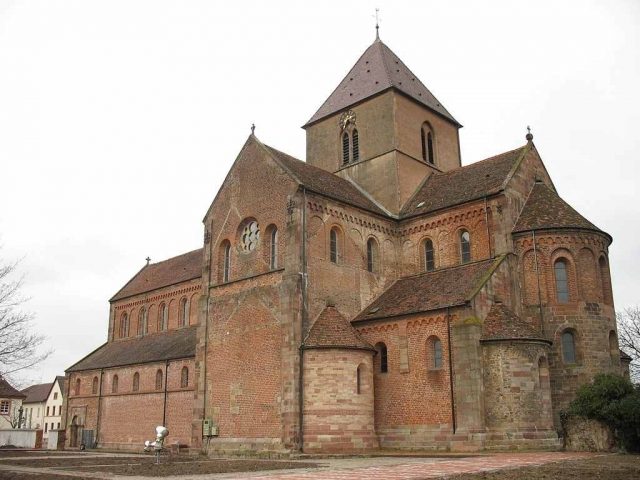
The Münster Schwarzach in the Schwarzach district of the municipality of Rheinmünster is the former monastery church of St. Peter and Paul of the former Benedictine abbey of Schwarzach, which was first mentioned in a document in 826. The Münster in Schwarzach is not to be confused with the Benedictine abbey of Münsterschwarzach in Bavaria.
In the Pirminsvita, written at the end of the 9th century, Suarzaha (Schwarzach) is mentioned as a foundation of Pirmin. The monastery is first mentioned in a document in 826.
It cannot be definitively determined when the village of Schwarzach developed around the monastery. When the Benedictines founded the monastery on the Schwarze Ache, Schwarzach did not yet exist.
In 1032, King Conrad II granted the monastery as a fief to the bishops of Speyer, who financially exploited the monastery. Only Henry IV released the monastery from its feudal dependence on Speyer. In the 13th century, the abbey had to contend with its vogts, especially the Knights of Windeck. The further territorial assignment of the monastery is difficult. The monastery complained for centuries against the sovereign rights derived by the Margraves of Baden from their protective rule over the monastery, which had existed since 1422. A lawsuit before the Imperial Chamber Court in Wetzlar was not decided until the end of the monastery. The monastery suffered destruction during the Peasants' War in 1525 and the Thirty Years' War. In 1653, the relics of Saint Rufina were transferred to Schwarzach, which led to a revival of monastic life. The monastery was also damaged in the War of the Palatine Succession in 1688–1697, but was splendidly renewed in Baroque style around 1724/32 according to plans by Peter Thumb. In 1802/03, secularization ended the existence of Schwarzach monastery; Baden took over its property and building complex. Of the former monastery complex, only the church and some administrative and economic buildings with the monastery portal from 1761 to 1790 remain.
Church Building+
The church building preserved today, built between 1220 and 1225, is already the fourth church on this site. It is the only large Romanesque building in brick on the Upper Rhine.
On the east side, one can see that the earliest parts of the building are constructed from red sandstone, but at half height, the material changes to brick. The west facade, however, is entirely made of sandstone again. On its wall, one can still see the beginnings of a narthex. The west portal has a tympanum with Christ between the apostles Peter and Paul. The columned basilica, with its flat ceiling in the nave, represents an extremely conservative building type for the 13th century construction period. This is particularly evident in the renunciation of complete vaulting and the adherence to the column as a support form. Elsewhere, the cathedrals of the High Gothic were already being built at that time. Only the choir bay is cross-rib vaulted. The side choirs end in apses, creating a three-apse choir. Originally, two more apses were attached to the transepts, creating an impressive east view with five apses (reconstructed).
The building follows the example of the nearby Gengenbach Abbey Church and represents one of the last examples of Romanesque flat-ceiling basilicas in German architecture. Gothic pointed arches are found in the sound windows of the later crossing tower. Parts of the choir stalls date from the Renaissance, while the high altar from 1752, moved to the left transept, and the organ on the west gallery date from the Baroque period.
The current appearance, which is intended to convey a stylistically pure image of Romanesque architecture, is due to a restoration in the 1960s, during which Baroque and historicist furnishing elements were removed or relocated.
Take Mobile History with you
You are reading this text for free. Premium adds what matters on the road: descriptions read aloud, sites found through your camera, whole regions taken offline.
- Every description, including the ~17,700 Premium sites
- Audio guide: have descriptions read to you on location
- AR finder: see sites through your camera, with distance and bearing
- Unlimited saved sites
14 days free, then from €2.99 a month. Cancel anytime.
Source: Wikipedia · Licence: CC BY-SA 4.0
This description draws on the facts documented in the linked Wikipedia article; Wikipedia content is licensed under CC BY-SA 4.0. Wording and editing: Mobile History.
Location: 48.7458, 8.0478