The church can be visited
ChurchSalzwedel
Mönchs Church
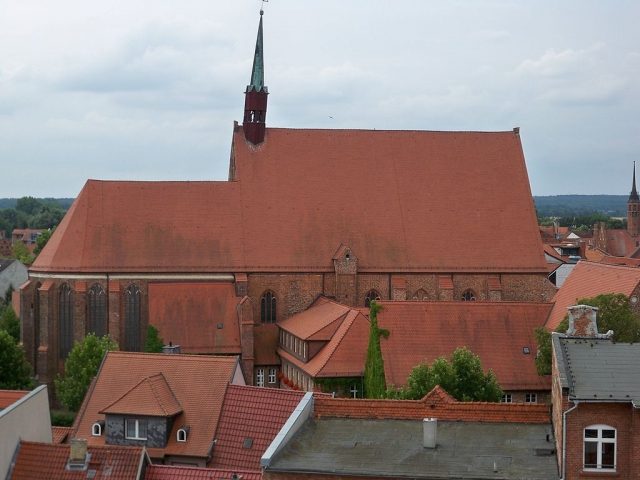
The Mönchskirche is a church in the city of Salzwedel in the northwest of Saxony-Anhalt. It is attributed to Brick Gothic and serves as a concert and art hall.
The Mönchskirche was built around 1250 on the last free plot of land in Salzwedel's old town, on the border with the new town, as a monastery church of the Franciscan order. In 1345, a vaulted choir and a side aisle were added on the south side. The main and side aisles were vaulted. From 1435 to 1500, the choir, main, and side aisles were extended, and a hall rood screen was installed. After the Reformation, the monastery fell to the city of Salzwedel. The last monk living there died in 1552. The cloister, which was immediately north of the church, was subsequently used as a Latin school. The church itself was generously furnished. In 1582, an altar created in the workshop of Lucas Cranach the Younger was placed in the Mönchskirche. It depicts the parable of the laborers in the vineyard from the Gospel of Matthew. Another altar from the village of Bukau, which was devastated during the Thirty Years' War, was also placed in the Mönchskirche.
In the 19th century, the Salzwedel Gymnasium was located in the former cloister, and since 1895, the town hall. Until 1920, the Mönchskirche was a garrison church. The Bukau altar was placed in the Salzwedel Katharinenkirche in 1947. Services were held in the church until 1964. After that, the church stood empty and fell into disrepair. A late Gothic door frame, bronze chandeliers, and numerous organ pipes were stolen. The Cranach altar was restored and handed over to the Johann-Friedrich-Danneil-Museum in Salzwedel in 1968. From 1984 to 1986, the Mönchskirche was converted into a concert hall. The occasion was the 21st Workers' Festival of the GDR, which took place in 1986 in the Magdeburg district and thus also in Salzwedel. The organ was re-inaugurated in 2009.
Architecture, Furnishings, and Use+
The Mönchskirche is a two-aisled hall church made of brick. It features a roof turret that is tilted to the side. The interior walls are painted white, and the ribs are red. The furnishings include the choir stalls from the 15th century, the organ loft from 1579/81, the pulpit from 1581, and several tombstones, including the tombstone for Anna von der Schulenburg from 1575. The Mönchskirche is used as a concert and art hall.
Surroundings+
At the northeast corner of the church stands the sculpture "Für Walter – statt Blumen" (For Walter – instead of flowers), a stylized large sculpture of a praying mantis made of iron by Hans Molzberger, which was created for Expo 2000. Immediately west of the church flows the Jeetze, and to the north, the town hall borders the church. The Mönchskirche is located in the north of Salzwedel's old town. Other medieval churches in the old town are the Marienkirche and the Lorenzkirche.
Take Mobile History with you
You are reading this text for free. Premium adds what matters on the road: descriptions read aloud, sites found through your camera, whole regions taken offline.
- Every description, including the ~17,700 Premium sites
- Audio guide: have descriptions read to you on location
- AR finder: see sites through your camera, with distance and bearing
- Unlimited saved sites
14 days free, then from €2.99 a month. Cancel anytime.
Source: Wikipedia · Licence: CC BY-SA 4.0 · Image: http://commons.wikimedia.org/wiki/File:M%C3%B6nchskirche_vom_neuen_Rathaus.jpg
This description draws on the facts documented in the linked Wikipedia article; Wikipedia content is licensed under CC BY-SA 4.0. Wording and editing: Mobile History.
Location: 52.8515, 11.1532