To be privately owned
CastleMindelheim
Mindelburg Castle
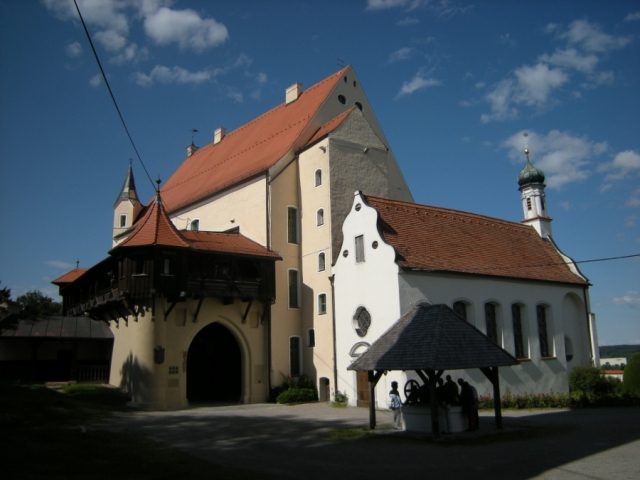
The castle was built around 1160 on the remains of a Roman fortification and an older 10th-century castle, probably by Duke Henry the Lion. After 1180, ownership passed to the Lords of Mindelberg. On June 22, 1363, it was sold by the last Lords of Mindelheim to the Augsburg canons Walter and Heinrich von Hochschlitz. In April 1365, the property was sold to the Augsburg Bishop Markwart von Randeck, administered by Duke Friedrich von Teck, who refused to hand it over when the bishop became Patriarch of Aquileia and defended the lordship against the bishop and the cathedral chapter of Augsburg. Around 1370, it was expanded into a manorial seat. In 1433, ownership passed to Bero I von Rechberg through inheritance. In 1467, Bero II von Rechberg sold the property to his brother-in-law Ulrich von Frundsberg and his brother Hans, whose descendants held the property until 1586. From 1586 to 1616, inheritance disputes followed between the cousin of the last Frundsberg, Wolf Veit von Maxlrain, and the husband of a niece, Christoph Fugger. On July 18, 1614, Duke Maximilian I of Bavaria acquired the Maxlrain claims and forcibly occupied the town and castle in 1616, so that the Fuggers gave up for a small compensation. In 1632, the castle and town were occupied by the Swedes and plundered and burned down by them in 1646. Around 1670, the castle was rebuilt. It now served as a manorial granary. From 1706 to 1714, the castle was granted to John Churchill, Duke of Marlborough, by Emperor Joseph I as Prince of Mindelheim. At the beginning of the 18th century, the Zündt family acquired the agricultural buildings of the outer bailey, which remained in their possession until 1832. In 1878, the dilapidated main building was sold to the Munich architect Ludwig Schramm, who converted it into a residential castle. After 1903, several changes of ownership followed. On November 5, 1927, the city of Mindelheim bought the castle and used it as a municipal museum. From 1935, the castle served as a farmers' school for the Reichsnährstand. From 1943, the Hitler Youth's regional leadership school was housed in the castle. From 1945, the castle housed a hospital for the disabled. Since 1950, the castle has been leased to Verlag W. Sachon.
Take Mobile History with you
You are reading this text for free. Premium adds what matters on the road: descriptions read aloud, sites found through your camera, whole regions taken offline.
- Every description, including the ~17,700 Premium sites
- Audio guide: have descriptions read to you on location
- AR finder: see sites through your camera, with distance and bearing
- Unlimited saved sites
14 days free, then from €2.99 a month. Cancel anytime.
Source: Wikipedia · Licence: CC BY-SA 4.0
This description draws on the facts documented in the linked Wikipedia article; Wikipedia content is licensed under CC BY-SA 4.0. Wording and editing: Mobile History.
Location: 48.0371, 10.4848