To be privately owned
CastleQuirnheim
Mertzsches Castle
The Historic Building: A Journey Through Time+
From Medieval Origins to Baroque Splendor+
The history of the castle, majestically situated on a hill overlooking the valley, dates back to the medieval period. Although the exact date of its foundation remains shrouded in the mists of time, archaeological findings suggest the existence of a fortified structure as early as the 12th century. This early fortification likely served as a strategic outpost to control trade routes and protect the surrounding settlements.
Over the centuries, the castle underwent numerous transformations. What began as a simple wooden palisade and earthwork evolved into a robust stone fortress. The first major documented construction phase occurred in the the 14th century under the patronage of the powerful Counts of Hohenberg. They expanded the castle significantly, adding a keep, curtain walls, and several residential buildings. These additions reflected the growing wealth and influence of the Hohenberg family, who used the castle as their primary residence and administrative center.
The 16th century brought further changes, as the castle was adapted to the changing military technologies of the time. Cannon bastions were added, and the walls were thickened to withstand artillery fire. However, it was in the 18th century that the castle truly transformed into the Baroque masterpiece we largely see today. Under the direction of the renowned architect Johann Michael Fischer, the medieval fortress was largely demolished and rebuilt as a magnificent residential palace. This ambitious project was commissioned by Prince-Bishop Lothar Franz von Schönborn, who sought to create a summer residence befitting his status and taste.
Architectural Features and Interior Design+
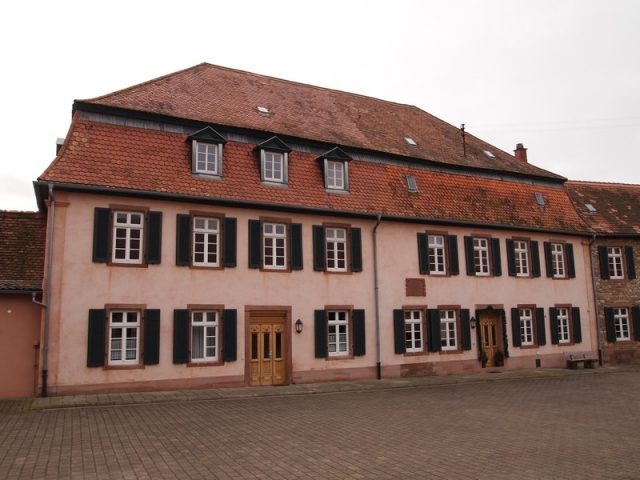
The Baroque reconstruction by Johann Michael Fischer left an indelible mark on the castle's architecture. The palace is characterized by its symmetrical facade, adorned with intricate stucco work and sculptures. The central axis is emphasized by a grand entrance portal, leading into a spacious courtyard. The use of local sandstone, combined with contrasting elements of white plaster, creates a visually appealing and harmonious exterior.
Inside, the castle boasts a series of opulent rooms, each meticulously designed to impress. The grand staircase, with its elaborate frescoes and gilded balustrades, is a masterpiece of Baroque artistry. The state rooms, including the Kaisersaal (Emperor's Hall) and the Spiegelsaal (Mirror Hall), are adorned with ceiling paintings, tapestries, and antique furniture. These rooms served as venues for lavish banquets, balls, and diplomatic receptions, reflecting the vibrant court life of the 18th century.
Beyond the main palace, the castle complex includes several ancillary buildings, such as the chapel, the stables, and the orangery. The chapel, dedicated to St. Michael, features a richly decorated altar and impressive ceiling frescoes. The orangery, with its large windows and south-facing orientation, provided a sheltered environment for exotic plants during the colder months.
The Castle in Modern Times+
After the secularization in the early 19th century, the castle passed into state ownership. It served various purposes over the years, including a military hospital and a school. During World War II, the castle suffered some damage, but fortunately, the main structures remained largely intact.
In the post-war period, extensive restoration efforts were undertaken to preserve the castle's historical integrity. Today, the castle is a popular tourist attraction, drawing visitors from around the world. It houses a museum that showcases the castle's history, its architectural evolution, and the lives of its former inhabitants. The museum's collection includes historical artifacts, furniture, and artworks, providing a fascinating glimpse into centuries of aristocratic life.
The castle also serves as a venue for cultural events, concerts, and exhibitions. Its magnificent halls and picturesque grounds provide a unique setting for a variety of occasions. The surrounding park, designed in the English landscape style, invites visitors for leisurely strolls and offers breathtaking views of the surrounding countryside.
The castle was built in the 18th century by the Lords of Merz. In 1806, a new building was constructed.
Take Mobile History with you
You are reading this text for free. Premium adds what matters on the road: descriptions read aloud, sites found through your camera, whole regions taken offline.
- Every description, including the ~17,700 Premium sites
- Audio guide: have descriptions read to you on location
- AR finder: see sites through your camera, with distance and bearing
- Unlimited saved sites
14 days free, then from €2.99 a month. Cancel anytime.
Source: Wikipedia · Licence: CC BY-SA 4.0 · Image: http://www.wehrbauten.de/thread.php?threadid=1338
This description draws on the facts documented in the linked Wikipedia article; Wikipedia content is licensed under CC BY-SA 4.0. Wording and editing: Mobile History.
Location: 49.5840, 8.1225