Cultural Events
Conference center
CastleBad Alexanderbad
Marktgrafen Castle
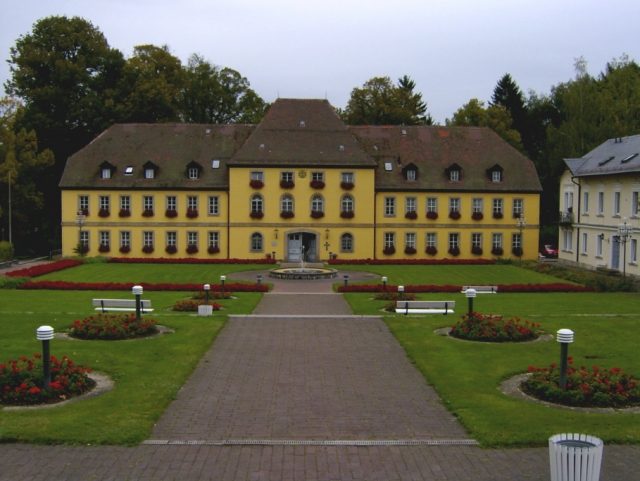
The so-called Alexandersbad Castle forms the historic center of the spa town of Bad Alexandersbad in the Fichtelgebirge.
Actually, the building known as Alexandersbad Castle is not a real castle at all, as it was not built as the residence of a noble potentate, but as a bathhouse, so to speak, as a hotel for accommodating spa guests. The healing spring in the valley south of the village of Sichersreuth was discovered rather by chance in 1734. After the healing of farmer Brodmerkel from Sichersreuth, who was severely ill with gout, by drinking the sour spring water became known, the then Wunsiedel Kastenamtmann Schwarz had a ditch dug around the spring "to keep back the rush of the wild water, to excavate the opening 5 feet (= 1.46 m) deep and 6 feet (= 1.75 m) wide, to secure it with boards and a pillar and to enclose it with laths on the outside. In the following year, a large hollowed-out fir trunk was placed into the depth of the well hewn through the rocks, and a wooden railing with three entrances was erected." Under Amtshauptmann Leo Bernhard von Lindenfels, the construction of a wooden house as a dwelling for the well supervisor followed in 1741.
After Margrave Friedrich acquired the land on which the spring originated from the community of Sichersreuth in 1751, he privileged the owner of the Dünkelhammer ironworks, Matthäus Purucker, in 1753 to build a bathhouse, where 10 spa guests could find, albeit modest, accommodation. The well master Strinz, employed since 1760, finally began shipping the Sichersreuth spring water; in 1774 alone - the year before his retirement - Strinz had sold 1200 bottles of the precious water at 8 Kreuzer each. In a memorandum from 1774, the Wunsiedel physician Dr. Erdmann Friedrich Martius pointed out that full baths in the mineral spring water would support its internal application. The transformation from a mere mineral spring to a mineral bath began.
Margrave Alexander of Brandenburg-Ansbach, who had taken over the principality of Bayreuth, which was close to state bankruptcy, in 1769, sought by all means to reduce the national debt. He recognized the important role that a functioning spa operation in Alexandersbad could play in the national economy. Therefore, in 1780, he began to develop the Sichersreuth sour spring into Alexandersbad. Initially, his concern was the spring itself. The old casing was removed, and the well shaft was given a stone casing. On both sides of the spring, two bathing pavilions were erected according to plans by the Bayreuth court building inspector Johann Gottlieb Riedel. On August 12, 1781, the newly erected spring buildings were handed over to their intended purpose in the presence of the prince.
In 1782, the foundation stone was laid for the building now known as Alexandersbad Castle, which was intended as accommodation for bathers. It was also built according to plans and under the direction of Johann Gottlieb Riedel and contained 27 rooms and cabinets, as well as - in the central risalit - a large hall. Finally, Margrave Alexander also had various stables and coach houses, avenues, gardens, and walking paths laid out to offer spa guests all possible amenities. He himself, together with his mistress Lady Craven, also enjoyed staying in Alexandersbad. In total, he had spent almost 40,000 guilders on the development of the spa town.
In 1833, the facilities in Alexandersbad were described as follows: "The beautiful massive castle-like main building, 200 feet (= 58.4 m) long and 40 feet (= 11.7 m) wide, lined with bricks inside for dryness, contains a high, tastefully decorated hall with an orchestra and two adjoining rooms, one of which contains a billiard table and a grand piano, and also 43 smaller rooms. The large open space above the castle, on which two granite pyramids pour precious water into stone basins, is enclosed by a second house with 11 more rooms, then by stable buildings and carriage houses, further up by tree plantations. The ridge running transversely at some distance and a wide avenue leading up to it, which for the eye ends with a slender, widely visible tree on the height, provide a very pleasant view. Tall shady rows of lime trees, a park with various deciduous shrubs and pretty larch trees on one side, a small forest with a hermit's house, the ice cellar, in its cool darkness, on the other side, provide a most pleasant stay and entertaining walks.
A quadruple dense tree-lined path leads past a small building also furnished for bathers, the old well house, in whose upper floor dancing often takes place on Sundays, down to the healing spring. This lies in a pleasant meadow valley, in the middle of a large flat area by the Zwenderbach. Formerly, it was enclosed by a bricked depression surrounded by a tasteful stone railing, into which two stone stairs led; in the middle of the paved floor were two circular granite containers, one of which served to enclose the spring, the other to receive the outflow. Several benches offered pleasant resting places for those drinking. Of this entire comfortable and beautiful arrangement, nothing more is now seen than the significantly raised cylinder enclosing the spring, which is 4 feet (= 1.2 m) in diameter and over 8 feet (= 2.3 m) deep and is now, like other baths, covered by a dome resting on eight granite columns. Two tasteful buildings on both sides of the square contain the bathhouses."
Layout+
Alexandersbad Castle is a simple but stately complex in the early Classicist style. A slightly projecting two-and-a-half-story central risalit of four axes is adjoined to the south and north by two-story wings, each with 7 window axes. The floors are separated by a continuous band. The main facade faces the valley towards the healing spring. Here is the following inscription:
A. 1783. Sanitati publicae. Aedes hasce. Suo aere exstrui jussit ALEXANDER M. B. D. P. B. N. P. P. A. O. R. MDCCLXXXIII. Exstructas aedes miraris, candide lector Quas sistit nitidas haec solitudo tibi; Desine mirari. Princeps has condidit Almus. Qui monimenta sui nobiliora dedit.
(In the year 1783, for the benefit of public health, Alexander Margrave of Brandenburg, Duke in Prussia, Burgrave of Nuremberg, etc., ordered this building to be erected at his own expense in the year 1783. You gaze in wonder at the proud building, admiring reader, which this solitude presents to you in its splendor; cease to wonder. A sublime prince was its founder, who created many nobler monuments to his memory.)
Take Mobile History with you
You are reading this text for free. Premium adds what matters on the road: descriptions read aloud, sites found through your camera, whole regions taken offline.
- Every description, including the ~17,700 Premium sites
- Audio guide: have descriptions read to you on location
- AR finder: see sites through your camera, with distance and bearing
- Unlimited saved sites
14 days free, then from €2.99 a month. Cancel anytime.
Source: Wikipedia · Licence: CC BY-SA 4.0
This description draws on the facts documented in the linked Wikipedia article; Wikipedia content is licensed under CC BY-SA 4.0. Wording and editing: Mobile History.
Location: 50.0160, 12.0173