University
CastleErlangen
Markgräfliches Castle
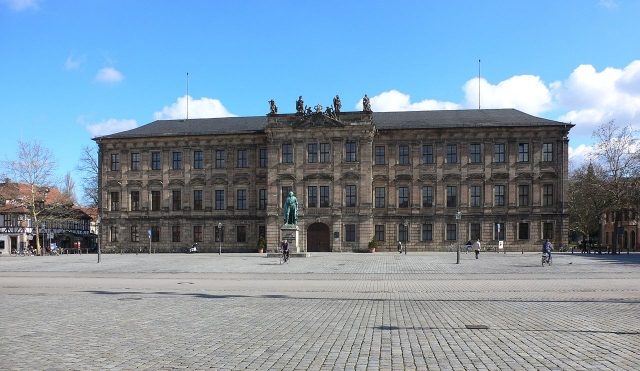
The Margravial Palace of Erlangen, built from 1700 onwards in Erlangen, together with the palace garden, orangery, and Konkordienkirche, forms the first completely newly conceived, self-contained Baroque ensemble in Franconia.
The construction of the former margravial palace was commissioned by Hereditary Prince Georg Wilhelm in 1700 and begun by the architect Antonio della Porta. After his death in 1702, Gottfried von Gedeler continued the work and completed the building in 1704. Already in 1703, Margrave Christian Ernst acquired the still unfinished palace to give it to his third wife Elisabeth Sophie ("Elisabethenburg").
Behind the palace, a 280-meter wide and 550-meter long palace garden was created with an orangery (completed in 1706), Konkordienkirche (1706; today the Geological Institute), Huguenot Fountain, equestrian statue, and the now no longer existing hedge theater.
After a short period as a princely residence, the palace served as a widow's residence until the beginning of the 19th century. Since the secondary flues leading to the ten main chimneys were difficult to clean, several fires occurred as early as the 18th century. Nevertheless, on New Year's Day 1814, the position of chimney sweep was eliminated. On January 14, 1814, a fire broke out in an attic filled with junk, which could no longer be extinguished because the water froze in the hoses at -25 °C and the nozzles, even with warmed water, could not reach the necessary height. The palace burned down completely; only the furniture could be saved.
Only from 1821 to 1825 was the palace rebuilt according to plans by university architect Friedrich Wilhelm Örtel and prepared for the purposes of the Friedrich-Alexander University. The building received a much flatter roof than the original structure. The university library was housed in the palace, as evidenced by massive columns on the first floor today, as well as lecture halls and seminar rooms. During the World Wars, it was used as a reserve hospital. Since 1945, it has served exclusively for university administration.
Take Mobile History with you
You are reading this text for free. Premium adds what matters on the road: descriptions read aloud, sites found through your camera, whole regions taken offline.
- Every description, including the ~17,700 Premium sites
- Audio guide: have descriptions read to you on location
- AR finder: see sites through your camera, with distance and bearing
- Unlimited saved sites
14 days free, then from €2.99 a month. Cancel anytime.
Source: Wikipedia · Licence: CC BY-SA 4.0
This description draws on the facts documented in the linked Wikipedia article; Wikipedia content is licensed under CC BY-SA 4.0. Wording and editing: Mobile History.
Location: 49.5979, 11.0046